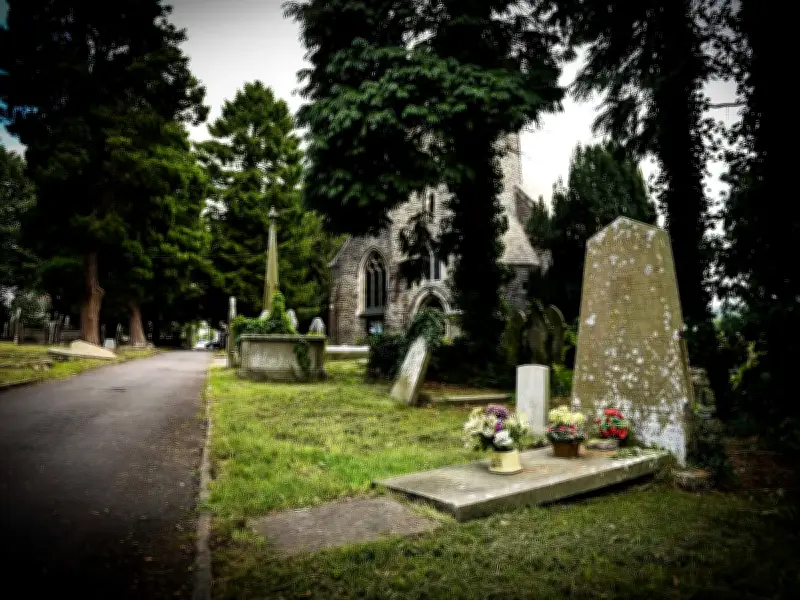
A stone monument at St Catwg's Church near Neath still stands as a permanent reminder of an unsolved murder from 1822. The stone, known locally as "the murder stone," commemorates Margaret Williams, a 26-year-old woman whose battered body was discovered in marshland between the village and the River Neath in July 1822. Her killer has never been identified.
The Murder Stone and Its Message
Among the graves surrounding St Catwg's Church lies the stone, recognised by anyone raised in the village simply as "the murder stone." The stone, understated yet striking, doesn't merely mark a burial site – it conveys the fury of a community and was designed to bother the person responsible for a brutal killing.
St Catwg's is an attractive building with origins dating to the Normans, featuring a distinctive wagon-ceiling and an impressive stained glass window. Within its extensive cemetery lie graves from an area far broader than the village boundaries, as the parish historically extended from Skewen to Glynneath.
The cemetery contains some highly elaborate gravestones commemorating members of prosperous families, alongside some extremely modest ones. And it contains a murder stone, one of merely a handful of such monuments in Wales.
The Life and Death of Margaret Williams
The stone commemorates the burial of Margaret Williams, originally from Carmarthenshire, who was employed by a farming family in Cadoxton. Contemporary newspaper accounts report that she was employed as a servant for a local tenant farmer when she fell pregnant. Miss Williams claimed the father was the farmer's son.
It is known that she left her position approximately 10 weeks before her murder – whether voluntarily or having been dismissed remains unclear – and relocated to Neath. She was discovered on the morning of Sunday, July 14, lying on her side in a narrow pill amid the marshy ground south of the village, her head submerged beneath the water. Beside her lay a basket containing her hat and a sheep's head she had apparently purchased at Neath market the previous day.
A physical examination revealed bruising and discolouration to her neck and throat, leading to the conclusion that she had been strangled.
The Inquest and Its Aftermath
An inquest into her death was convened the following Tuesday and Wednesday. As The Cambrian newspaper reported at the time: "The inquest was attended by several magistrates and other gentlemen, whose interest had been strongly excited by a well-founded suspicion that the deceased did not die from any natural or accidental cause."
Suspicion fell upon the son of the farmer she had worked for. As the local paper described it: "He was generally suspected of having committed the diabolical act." The suspect remained in custody while the coroner and jury deliberated and on Wednesday – following a "deliberate and able investigation" – the conclusion was reached. According to the newspaper: "Though the strongest suspicions existed against the prisoner, no evidence was adduced to establish his guilt, the verdict of the jury was, therefore, of wilful murder against person or persons unknown."
Without physical evidence linking him to the crime scene, lacking eyewitnesses, and with no confession forthcoming, the suspect was freed. The publication continues: "The magistrates have declared their resolution to seek out fresh evidence with unremitting scrutiny: and it is devoutly to he wished, that the inhuman monster who perpetrated this foul and horrid deed, may yet be brought to justice." However no further arrests were made and nobody faced prosecution.
The Epitaph and Lasting Mystery
The memorial stone itself wasn't installed until the year after the death, with the inscription composed by Elijah Waring, a Neath Quaker and renowned speaker. The carving on the stone concludes: "God hath set his mark upon him either for time or eternity, and the cry of blood will assuredly pursue him to certain and terrible but righteous judgement."
Through the decades numerous stories surrounding the killing have emerged. One account features a deathbed confession from a man who initially claimed to have witnessed the victim and the farmer's son quarrelling on the marsh that fateful evening. In another variation the murdered woman became pregnant by the son of a local squire.
The stone itself is positioned at an unusual angle to the main pathway through the churchyard, and some suggest it was deliberately placed to face the accused's house as a daily reminder of his misdeeds. A common element in many versions tells of the suspected killer fleeing the village after the inquest – one vivid account describes the sound of his horse's hooves echoing through the village as he makes a midnight escape to Swansea port to board a sailing ship bound for America. What became of him and his new existence in the New World remains untold. The mystery has never been solved.