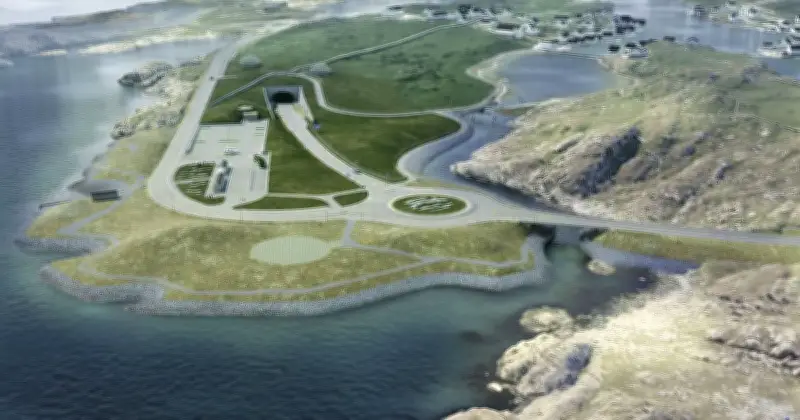
Work is underway on a new European road tunnel that will smash several records and cut journey times by 40 minutes. The E39 Rogfast will be the world's longest and deepest undersea road tunnel, intended to cut travel time between major cities.
Record-breaking design
At 27 kilometres (17 miles), it will become a major part of a ferry-free highway along Norway's western coast, linking Nord-Jæren and Haugalandet. The tunnel is called Rogfast, short for "Rogaland fastforbindelse", after the name of the region it's in and the Norwegian word for "fixed link."
At its deepest, it will be 392 metres (1,286 feet) below sea level, which is a full 83m more than the UK's tallest building, the Shard, is tall. Such extreme engineering is required because of the fjords, which reach down 400m below sea level. The English Channel, for comparison, averages around 60 metres and reaches a maximum of 174 metres.
Challenging route
The E39 highway runs 1,100 kilometres from Trondheim in the north to Kristiansand in the south. At the moment, drivers have to take nine separate ferry crossings to complete the entire thing, which is more than any other single road in Europe. The journey takes around 21 hours.
Tackling this mammoth journey has long been an issue. When the first postal route along this same coastline was established in 1647, postmaster Henrik Morian had to row across the open fjords and then climb 1,500 metres on the far shore. Snow and ice regularly made entire stretches of the route impassable, B1M reports.
Safety and design features
Norconsult, the lead design and engineering consultant for Rogfast, explains: "The tunnel project is groundbreaking in terms of tunnel length and includes the construction of a junction in the middle of the tunnel for the exit to Kvitsøy. The junction, featuring a roundabout within the tunnel, is located at an elevation of -250 m."
Because of the tunnel's extreme depth and length, as well as its 7% gradient, which increases the risk of engine burnout, fire is a major potential hazard. Emergency cross-passages will be spaced closer together than normal standards, placed at 250-metre intervals instead of the typical 330 metres. This will allow drivers to walk safely out of the smoke-filled tube and into the clear, structurally isolated parallel tunnel within minutes if a fire does break out.
Another potential issue is boredom. "Inside the tunnel, an art project will be developed to prevent monotony, alleviate tunnel anxiety, shorten the perceived travel time, create a sense of orientation, and foster recognition. Additionally, the decoration will help 'open up' the tunnel space, and the use of dynamic lighting may lead to solutions that are adaptable and ever-changing," the Norconsult plans continue.
Timeline and records
After a false start in 2018, work began properly in late 2021, with the project due to be completed in 2033, at a cost of approximately 25 billion Norwegian kroner (£1.97 billion).
According to the plan, it will set several world records: the world's longest underwater road tunnel for regular traffic (approximately 27 km), the world's longest four-lane road tunnel (approximately 27 km), the world's deepest four-lane road tunnel (-392 m), and the world's deepest road junction (-200 m).