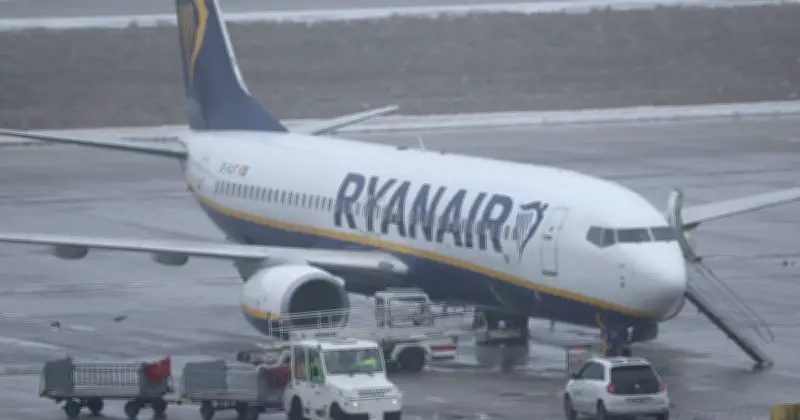
A Ryanair passenger was detained by police at a European airport and immediately sent back to the UK after being wrongly accused of overstaying her visit by the EU. The woman, named as Paula Pugh from Norfolk, was travelling to Reggio Calabria in Italy to celebrate her husband's 60th birthday when the incident occurred.
British travel writer Simon Calder revealed the case in the latest episode of his Travel Expert podcast, describing it as the most serious example he had encountered of difficulties arising from the EU's Exit-Entry System (EES). He said several Italian authorities had been contacted for a response, but none had come forward.
What happened at the airport
Mr Calder explained that from the moment Paula touched down, everything went wrong. He told listeners: "They said, 'You've overstayed.' She said: 'I've just got off that Ryanair plane from Stansted. Of course, I haven't overstayed.'"
He continued: "Anyway, the machine had got it wrong. They said, 'Right, come this way.' They put her in a police car with guards. They took her to the nearest airport with flights still available. They marched her out to the plane in front of all the other passengers. There was nothing that she had done wrong, but they put her on the plane. They gave the captain her passport. They flew her back. And then afterwards, Ryanair charged her for the deportation flight. Poor woman."
How the EES system works
The ordeal stems from the EES, which mandates that non-EU residents queue at airports to use designated machines for entry into 29 Schengen countries. These are nations that have abolished passport and border controls at their internal frontiers, encompassing the majority of the European Union, including Germany, France, Italy and Spain.
Mr Calder's guidance urged passengers to print all relevant boarding passes and bank statements as proof of their whereabouts, which he suggested should help prevent this type of situation during holidays. He noted Paula's was the only instance he had encountered where officials still acted despite evidence showing a person was not in the EU when the system said they were.
Impact on British travellers
Fellow host Greg Dickinson said: "There seem to be many British passport holders who are finding that their exit is not being correctly recorded." He explained travellers are permitted to spend 90 days out of every 180 in the EU Schengen zone, but warned "people's tickers are slowly going down because as far as the machines are aware, they are still in the European Union" due to machines incorrectly recording them as remaining in the EU after departure.
He added: "It's creating massive headaches and a lot of worry for Travel Expert listeners." Mr Calder revealed there is an EU tool available that displays how much time the tickers indicate you have spent in the EU, saying "in most cases they will get it right", but noted the difficulty emerges when officers fail to properly register the ins and outs.
The EES system has resulted in lengthy queues and hold-ups for numerous British tourists this year. Britain was especially impacted due to its departure from the European Union. The system was introduced from October 2025 but wasn't fully operational until April this year. Several airports in Spain and Portugal experienced frequent substantial delays as travellers were detained by the machines.
Ryanair's chief operational officer Neal McMahon stated in September: "The EU's handling of EES has been a shambles from start to finish. Airlines, airports and border authorities repeatedly warned Brussels that the rollout was not ready, that it would increase processing times and that it would create excessive queues for passengers. Those warnings were ignored, with EU citizens the ones delayed and disrupted. Passengers should not be made pay the price for the EU's failed EES rollout."
EU Commission spokesperson Markus Lammert said during the summer that the EU could provide extra help during an extra period of adjustment at a few border crossings, stating: "We have offered additional help to the member states concerned and asked them to further intensify the operational preparedness, including the necessary technical, organisational, and communication measures, with a view to ensuring that remaining challenges are fully addressed by the end of the year."
Ryanair's website states that if an immigration authority does not let a passenger enter a country, the passenger must pay any fines or a reasonable proportion of the fine as decided by Ryanair, as well as the cost of transporting them back to where they flew from. It also states that costs relating to any flight a passenger cannot use as a result of being refused entry will not be refunded, and any costs paid on the passenger's behalf will be charged to the card used for the booking.