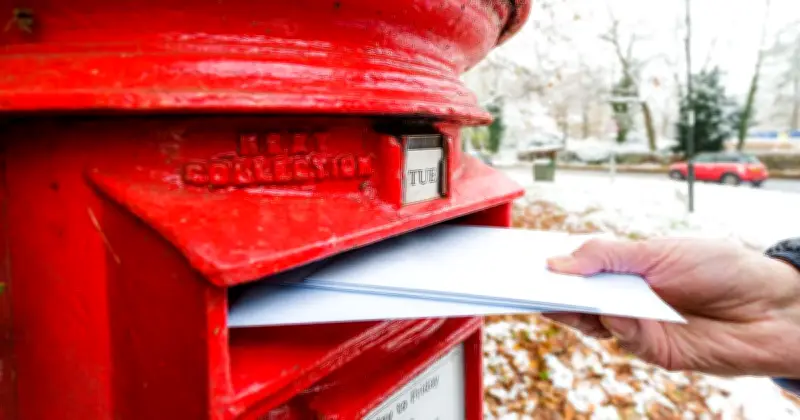
Royal Mail has asked customers sending Christmas cards this year to follow a simple addressing rule to avoid delays. The postal service says the address should not be written in the centre of the card, but in the bottom left-hand corner of the envelope, with clear handwriting and no commas or full stops. It also advises using a pen rather than a pencil.
Guidance for fast delivery
In its guidance, Royal Mail said: "The name and address go on the bottom left corner of the front of the envelope or parcel. Use clear and easy-to-read handwriting (or font if you are printing the address). Use a pen or ink that is clear against the colour of the envelope or parcel."
It added: "Left-align the text (no centred or 'stepped' lines). No commas or full stops. Leave a generous margin around the address. Place the correct postage on the top right."
The service also said: "These guidelines show the best way to address your mail for fast delivery in the UK and abroad. Write the address clearly on the front, following our guidelines, and always include a postcode if possible."
Postcode Finder and privacy warning
Customers can use Royal Mail's Postcode Finder to check up to 50 addresses before sending their cards. To protect privacy, the service also warned senders against putting phone numbers or email addresses on the outside of the parcel.
Delivery performance pressure
The advice comes as Royal Mail faces continued pressure to improve its delivery performance. Under targets set by regulator Ofcom, 90% of first-class post should be delivered the next day, while 95% of second-class mail should arrive within three days. These targets were lowered from April as part of wider universal service reforms.
Royal Mail has insisted it is making progress as it overhauls its operations and is "broadly on track" with the changes. These include moving to every-other-day deliveries for second-class post and ending Saturday deliveries, although the company has warned that the turnaround will take time.
Last month, it announced that up to 2,500 head office and support function jobs would be cut by the end of 2027 as it looks to reduce costs.
The group said: "Given the scale and pace of the universal service change, we do not expect progress on quality of service to be linear. The introduction of the new delivery model requires time for delivery offices to adapt to the new processes before customers receive the most reliable service possible throughout the transition."