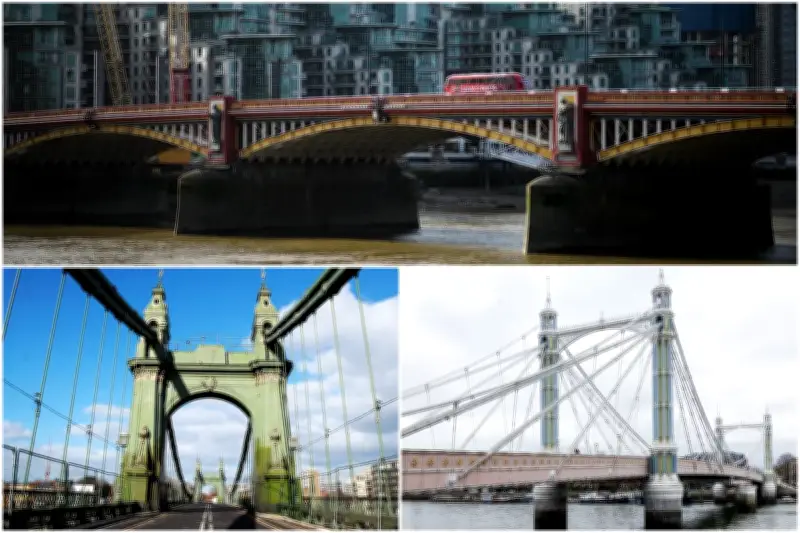
More than half of all bridges crossing the River Thames in London are in a "poor" or "very poor" condition, according to findings shared at a London Assembly meeting. Of the 30 structures surveyed, 16 are deteriorating, while only six are rated in a "good" state.
Satbir Gill, chairman of the London Technical Advisors Group, presented the data on Tuesday, November 3. He noted that ratings for the remaining eight bridges had not yet been received from their owners.
Challenges Facing Aging Bridges
Underinvestment, extreme weather including new stressors from prolonged heatwaves, and heavier car models have created fresh difficulties for maintaining bridges, many of which were built in the 1800s.
The Grade II-listed Hammersmith Bridge has been closed to vehicles since 2019 after failing safety inspections, with damage largely attributed to a heatwave. It is currently open only to cyclists and pedestrians.
Funding was hoped to bring the bridge back into use, but the managing council said the Department for Transport had not yet announced whether it would receive the requested money. "Without investment being made, the bridge will have to close for safety reasons," Mark Averill, assistant highways director for Hammersmith & Fulham, said at the meeting.
Maintenance and Funding Concerns
Averill added: "Without work to replace bearings, hangars (which hold bridge in place) and all the way they interact with each other, the bridge is slowly getting worse. So it's not getting any better it can only go one way and get slowly worse."
Maintenance work on the bridge this year cost £1.1 million, he said. The council has requested £128 million from the DfT, and if funded, the works would need completion by 2030—an ambitious target. Averill said the council lacks the funds itself, and the works would not guarantee the bridge's longevity.
Other Bridges Under Restrictions
Since 2021, several of London's road bridges have been closed or had traffic restrictions imposed due to their deteriorating condition. In February, Albert Bridge, linking Battersea with Chelsea, was shut to motor traffic, and later closed to pedestrians for two days during a summer heatwave.
Andrew Burton, director of highway services at Kensington and Chelsea council, said: "There have been instances where steel has expanded because of the heat so we've put in extra measuring. We did close Albert Bridge once in the summer, because it had expanded it was outside tolerance."
Vauxhall Bridge, connecting Pimlico with Vauxhall, had an 18-tonne weight restriction introduced earlier this year, pushing more traffic onto nearby Chelsea Bridge. "Heavy vehicles cause the most damage" to the structure, Burton told the transport meeting. Richmond Bridge and Tower Bridge are also subject to an 18-tonne weight restriction.
The full list of crossings in a poor state was not released, but Westminster Bridge near Parliament and Lambeth Bridge were among those affected. In September, it was revealed that Waterloo Bridge could be forced to close within four years unless urgent repairs are completed. Bridges are owned by various organisations, including local authorities and TfL, which said in 2025 that it needed to spend £1.1 to £1.2 billion every year to maintain its bridges in a good state.