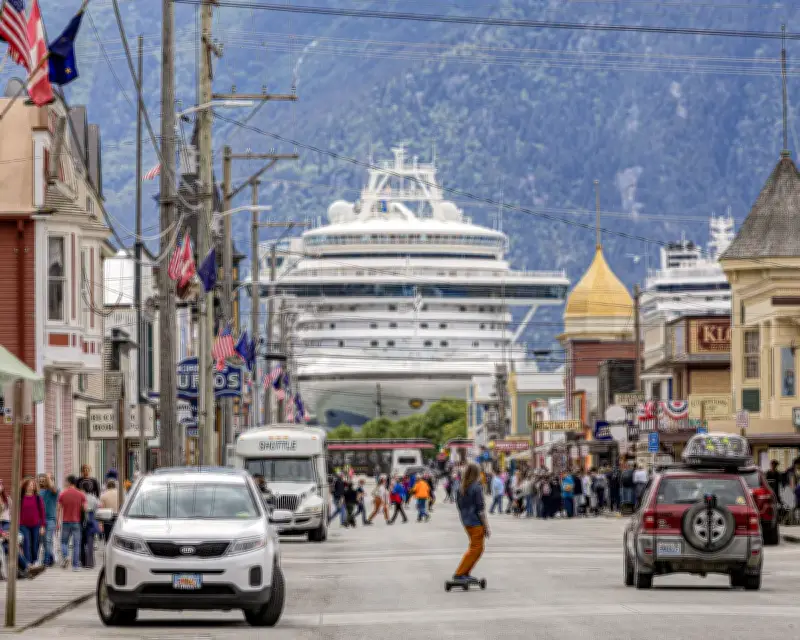
Skagway, a small coastal town in Alaska, experiences a dramatic seasonal shift as cruise ship visitors swell its population each summer before departing for winter. The town's year-round community of about 1,100 people faces growing challenges from the demands of the cruise ship industry.
Seasonal Swings and Economic Concerns
During the tourist season, which runs from April through the summer, shops bustle and workers fill overcrowded bunkhouses. By October, most seasonal employees have left, and the crowds of cruise passengers dwindle to a trickle. Snow becomes visible on nearby mountains, and the town settles into its quieter winter rhythm.
Skagway's mayor, Orion Hanson, expressed concerns about the year-round economy and population. "What does Skagway do without a coffee shop to congregate in or without a restaurant open all the time? We don't have a diner any more," he said. The Sweet Tooth cafe, once a longstanding year-round diner, has been replaced by a storefront for Diamonds International, a tax-free jewellery store that partners with cruise lines.
Historical Context and Current Pressures
Skagway was once the largest town in Alaska during the Klondike gold rush, with a population of about 10,000 people. By 1910, as the gold rush subsided, the population had dwindled to about 600. Today, the town can see thousands of visitors flood its streets in a single day during the cruise season, only to leave by sunset.
In 2025, more than 1.35 million tourists arrived in Skagway by cruise ship, alongside more than half a million crew members. These numbers are growing each year, putting pressure on housing, services and infrastructure designed for a town of about 1,000 people.
Housing Shortage and Community Impact
Skagway faces a severe housing shortage, exacerbated by its geographic constraints. The town is squeezed into a narrow valley at the northern end of Alaska's Inside Passage, with no room to expand and only one road leading to Canada. A 2023 report commissioned by the Skagway Development Corporation found there were 644 housing units in town, but not enough to accommodate the cruise ship industry, permanent residents, seasonal employees and essential service workers.
Al Wall, director of the town's Dahl Memorial Clinic, noted the prevalence of congregate living and couch surfing. "There are quite a few people that sleep in hammocks in the woods. And frankly, some would prefer to sleep in a hammock in a tree than stay in a crowded place with a bunch of people," he said.
Janilyn Heger, a longtime Skagway resident who owns the town's distillery, Skagway Spirits, said the city's decision to abandon town-owned camp sites created a domino effect. "Employers started buying buildings and displacing year-round housing and so now we're at an absolute standstill. There's none to be had," she said.
Some of the town's limited hotels have been converted into accommodation for seasonal employees. Longtime resident Mike Healy purchased Sergeant Preston's hotel, the only year-round hotel in the community, and converted it into seasonal housing after failing to secure land for employee housing.
Regional Debates and Future Outlook
The scale of cruise tourism is a frequent topic of debate throughout the Inside Passage. In Juneau, Alaska's capital, a ballot measure for "ship-free Saturdays" failed in 2024, leading the city to introduce a voluntary limit on the number of ships that could dock daily. Ketchikan has reported more ships as a result of cruises adhering to Juneau's limitations, while Sitka is reviewing its agreements with the industry after an anticipated increase in visitor numbers in 2027.
A survey conducted by Oregon State University found that just over 40% of respondents in Skagway thought the benefits of tourism outweighed the costs, compared with 25% who held the opposite view. Another 33% viewed the relationship as roughly balanced.
Mayor Hanson acknowledged the town's limited options. "There's only so much we can do, even if we wanted to. We need to be incredibly careful about not rocking the boat," he said.