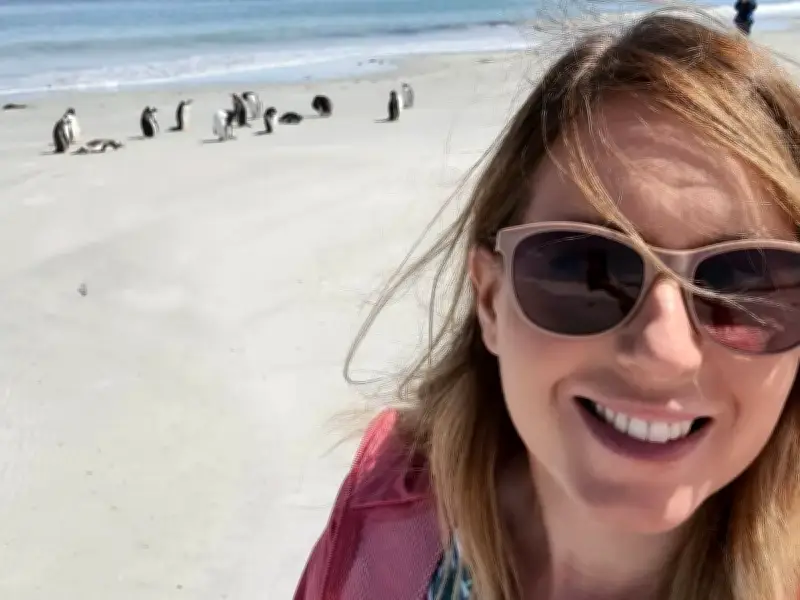
Roxanne King-Clarke, a lifelong Falkland Islander, is on a mission to correct misconceptions about her home, which she says is far more than the "barren rock" outsiders often imagine.
The Falkland Islands, a British Overseas Territory in the South Atlantic Ocean, are among the most isolated inhabited archipelagos, located some 300 miles east of mainland South America. For many Brits, the image of the islands is shaped by grim footage from the 1982 conflict between Argentina and the UK. But locals like Roxanne, 40, a mother of two, are eager to share the islands' quirky charm.
Independent Spirit and Local Life
Roxanne, who runs tour business Lupin Tours, loves the islands' independent spirit. "Everything is independent, which I think is really nice. In the supermarkets, it's all the same brands, but I like that there's no big chains," she said. There is no McDonald's or Starbucks here; Iceland is set to become the first UK high street brand to open a shop in the Falklands.
In the tiny capital of Stanley, where Roxanne lives, cosy pubs with locally brewed beers and traditional oceanfront chippies offer a good night out. "You can have a really good night out here," she insists. Freshly caught seafood is a must, as is 'Smoko', a relaxing tea or coffee break with cake and a natter. Scones served with local sweet-tart diddle-dee jam are also an excellent choice.
Roxanne recommends the wine bar Unwind, which serves tapas, and The Malvina House Hotel, which offers harbour views, a cinema, and spa facilities. "Not to be confused with Malvinas, which is the Argentine name for the Falklands and is like really offensive to use here," she warns. "But Malvina is a Scottish female name, so it's all good."
A Remote but Beautiful Home
Visitors are often surprised to learn there is no everyday public transport network in Stanley, aside from tour buses and airport transfer buses. "The closest that we have to public transport is little planes which go all around the islands," Roxanne reveals. Fortunately, Stanley, with its population of 2,000, is walkable, taking roughly half an hour to cross from one side to the other.
Roxanne regularly dispels myths about the Falklands through her tours and her TikTok account, Roxy in the Falklands. She says people are often surprised by how "beautiful" her home is. "People often call it 'just a rock', and that it's barren, there's nothing here. It's a bit of a bugbear of mine, and that's how I start some of my walking tours," she explains. "Actually, there's lots on the ground. Because of the wind, everything's low-lying, like all the shrubs, so we don't have native trees, which I always say is great because you don't have anything to block like the stunning views and the amazing landscape."
Visitors are struck by the "gorgeous" beaches, where penguins waddle around. "It looks very tropical, it's got turquoise seas, and you're usually surrounded by mountains as well, and you've got penguins and dolphins, and sometimes whales and sea lions," she says. Roxanne is especially fond of the Falklands flightless steamer duck, whose calls signal "the sound of summer". She lives just ten minutes from the beach and a mountain path, and encourages visitors to head to Volunteer Point, where they'll find pristine white sand and a thousand breeding pairs of king penguins.
A Close-Knit Community
With a relatively sparse population, singletons may find it tricky to meet someone, but people are coming over "all the time". "The girls are also lucky because you've got the military base here, which is like a thousand troops, mostly men," Roxanne says. Falklanders often meet a partner while studying overseas. "You kind of hope that they bring back their partner and they stay. I mean, 75% of those who go overseas to study will come back, which is, I think, quite a testament to how much we love the Falklands and how we appreciate how special it is."
Stanley locals pride themselves on being "friendly and welcoming", with a relaxed feel. Roxanne lives within a three-minute drive of friends and family, and says there's no "crazy commuting". As "laid back" as Falklanders are, there is a strong ethos of hard work, with many holding down at least two jobs. The tourism industry relies on locals using their annual leave to ferry tourists around or act as wardens at penguin sites.
While many visitors assume most locals work in the military, there are the sort of jobs you might find anywhere, just on a "smaller scale". The Falklands are roughly the size of Northern Ireland, a fact Roxanne is keen to point out. Some situations do call for going further afield; Roxanne's mother previously journeyed to the UK for a hip operation, with the Falklands government covering the cost of her flights and accommodation.
Shopping is also a challenge, with long-distance shipping and limited flights meaning parcels may take weeks or even months to arrive. Roxanne started ordering Christmas presents for her 'Lego mad' eight-year-old in September, knowing how steeply costs can spiral for express air freight. "If you want to save money on presents, then it's best to order them in because it does get a bit crazy here," she explained.
Distinct Identity and Resilience
While there are British influences, the Falklands have a distinct identity, mixed with various cultures. "We have influence from back in the day when there were gauchos here, so we ride like Western instead of English style on horses. We love our country music, you'll see people wearing cowboy hats," Roxanne says. Her ancestors hail from England, Scotland, Ireland, Sweden, Norway, and Finland, and the Scandinavian influence is evident in surnames like Anderson and Hansen and the charming architecture. "I think our homes look quite Scandinavian," she says, noting the colourful houses with corrugated iron roofs.
Roxanne and her family live in a "little stone cottage" that belonged to her grandparents, with her sons being the fifth generation to live there. This sense of family lineage is deeply important to her in a world where bigger nations regularly try to push the Falklands around. Last month, Argentina renewed its claim to the Falkland Islands, with Buenos Aires leader Javier Milei threatening to sanction firms exploiting oil near the British territory. US President Donald Trump asserted that he was "reviewing" American support for Britain's sovereignty over the Falklands.
These developments don't surprise Roxanne, who says that Falklanders continue to "get bullied by Argentina constantly", usually in conjunction with presidential popularity polls. "It's really frustrating and it's not nice. It does make you feel anxious, but we still go about our day-to-day business. We're just almost immune to it," she says. Roxanne grew up in the aftermath of the Falklands War and is well aware of what her family endured during the Argentine invasion, with nine of them at one point having to take shelter in their stone-built home. The ordeal has resulted in a "collective trauma" within the community, and Roxanne takes a "very, very hard line" stance. "You know that you can't give them an inch because they will take a mile," she says. "It's a good lesson that you don't give in to bullies, for sure."