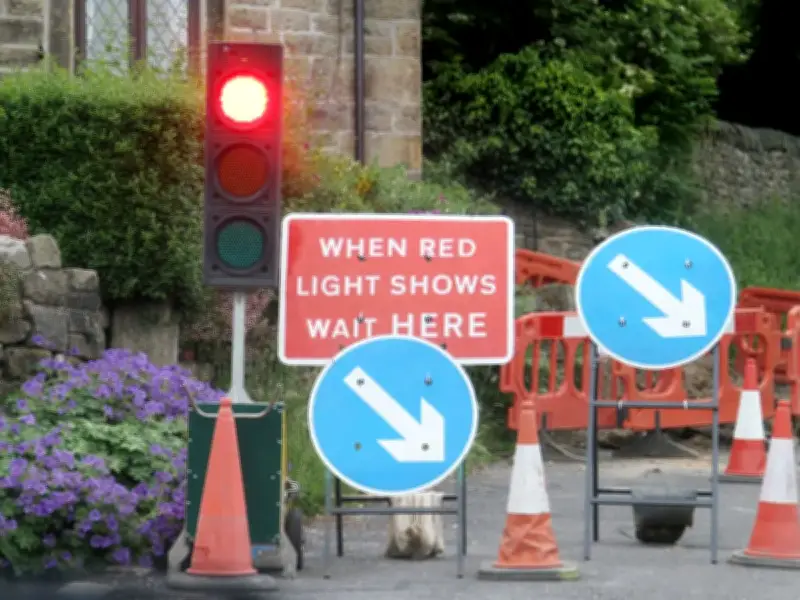
A barrister has explained what motorists can and cannot do if temporary traffic lights stay stuck on red, highlighting a potential legal grey area. Moving through a red light in these circumstances could leave drivers exposed to prosecution, although the Highway Code offers clearer guidance when the lights have stopped working altogether.
Two scenarios under the law
Barrister Daniel J. ShenSmith posed the question many drivers face when temporary lights appear stuck on red: Do you wait or drive on? He said the law is set out in Section 36 of the Road Traffic Act 1988, which states you must not contravene a red illuminated light.
He added that of the two scenarios that may arise, the one involving lights that have failed completely is "slightly easier" to navigate, as the position is clearly set out in Rule 176 of the Highway Code.

Entirely broken lights
Rule 176 reads: "You MUST NOT move forward over the white line when the red light is showing. Only go forward when the traffic lights are green if there is room for you to clear the junction safely, or you are taking up a position to turn right. If the traffic lights are not working, treat the situation as you would an unmarked junction and proceed with great care."
ShenSmith says this clearly covers situations where the lights aren't working at all: drivers should treat it as an unmarked junction and proceed carefully. But he adds it's not as straightforward when the set-up is more "nuanced".
Lights stuck on red
He set out a scenario in which the light stays red. It becomes clear the signals aren't working properly, especially if you've watched a couple of streams of traffic come from the other direction without your light changing.
Explaining on the BlackBeltBarrister YouTube channel, he said: "This is not entirely straightforward because a broken light in that way is still illuminated, and so it doesn't automatically count as not working under the Highway Code. And so the legal reality here is that it would still be a contravention of that traffic signal if you decide to proceed."
So if a motorist decides to move past a red light after determining that it's cycled through three times without changing, they'd "technically" still be contravening the red light, and it's "highly dangerous" due to potential oncoming traffic. "You might ultimately be liable for that, and there is, of course, no strict time limit after which you are permitted to contravene a red light. You are simply not allowed to do it, and the police can and quite likely will prosecute you for it."
Potential solutions and legal reality
As for a solution, ShenSmith says you will first have to wait for "several cycles" to determine, without question, that the light isn't working. Second, you must contact the site number on the sign to inform those responsible. You would have to do this "hands-free", because you cannot have your phone in your hand or you'd be committing a separate offence.
If you did decide to move past the red light, having determined that it was "absolutely clear" that it wasn't working and you had no choice, "you might still be prosecuted" if you're spotted doing so. ShenSmith says you could inform the police that you tried everything within your power, including calling the number. He says the broken red light scenario isn't defined in the Highway Code, but you could run it as a defence if prosecuted.
He added: "But apart from all that, the law is relatively clear. If there's a red light, you must obey it. So there's no law that says you can contravene it because you think it's broken, unless it's just not illuminated at all and it's not working at all, in which case you deal with it as an unmarked junction."
ShenSmith says it may ultimately depend on what happens in court. Driving through a red light is a strict-liability offence - meaning you can be guilty whether you intended to break the rules or not - but, as he puts it: "Is it in the public interest to prosecute you?"