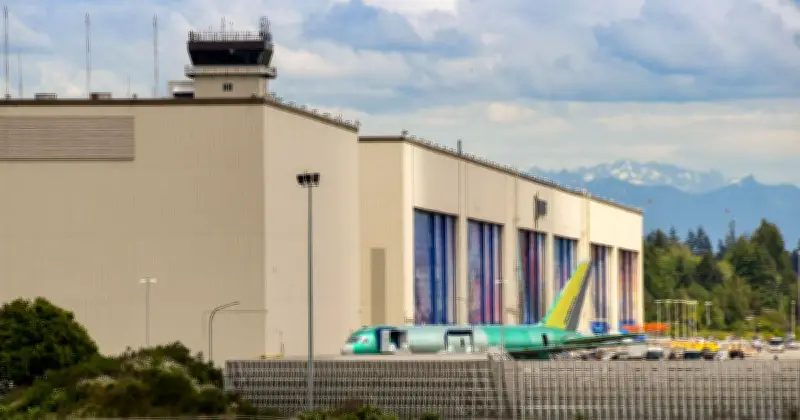
The Boeing factory in Everett, Washington, currently holds the title of the world's largest building by volume, spanning more than 472 million cubic feet. The enormous facility covers 98 acres, while the original Disneyland park in Anaheim, California, occupies around 85 acres. Since opening in 1967, the Boeing plant has been the birthplace of more than 5,000 wide-bodied airliners, making it one of the most remarkable industrial sites on the planet.
It even had its own weather; when it first opened, clouds would form just under its 90ft-high ceiling through a build-up of moisture. Now, though, air conditioning has prevented this from happening. Its world record size could soon be overtaken by SpaceX founder Elon Musk.
How does Terafab compare to the Boeing Everett Factory?
The planned Terafab is set to dwarf even some of the world's largest industrial buildings, with more than 100 million square feet of manufacturing space and an estimated internal volume of around 100 million cubic metres. It could stretch for three miles.
By comparison, Boeing's Everett factory in Washington encloses roughly 472 million cubic feet, or about 13.3 million cubic metres. Based on these estimates, the Terafab could have a footprint between five and 23 times larger than the Boeing facility and around 7.5 times its internal volume, making it one of the largest manufacturing buildings ever built.
What do we know about the Terafab?
SpaceX and Tesla are planning to build the facility in Grimes County, Texas, as they race to secure the enormous computing power needed for their future technologies. Terafab would cover an area equivalent to around 1,736 standard American football fields. The project's website says the facility is designed to "close the gap between today's chip production and the future's demand – a future among the stars".
The factory is expected to bring the manufacturing, packaging and testing of advanced logic and memory devices together under one roof. According to SpaceX, this could allow for faster improvements in its technology and accelerate the deployment of new computing systems. The chips are expected to be used across a range of Musk's projects, including Tesla's Optimus humanoid robots, self-driving Cybercabs and SpaceX's planned space-based data centres.
How much is it going to cost?
According to Reuters, a "May filing showed SpaceX has proposed an initial investment of $55 billion (£41 billion) to build the Terafab, with the total amount rising to $119 billion (£90 billion) if extra phases are completed". However, the project is also expected to create thousands of jobs.
Texas Governor Greg Abbott's office said the first phase will create 3,000 new jobs, with a $30million (£22million) Texas Enterprise Fund grant extended to SpaceX. Terafab also qualifies for the state's Texas Jobs, Energy, Technology, and Innovation (JETI) programme.
Musk said the project would bring advanced manufacturing to the US while creating thousands of highly paid jobs in Texas. He said: "The Terafab is bringing cutting-edge manufacturing to America, creating thousands of high-paying jobs in the Lone Star State."