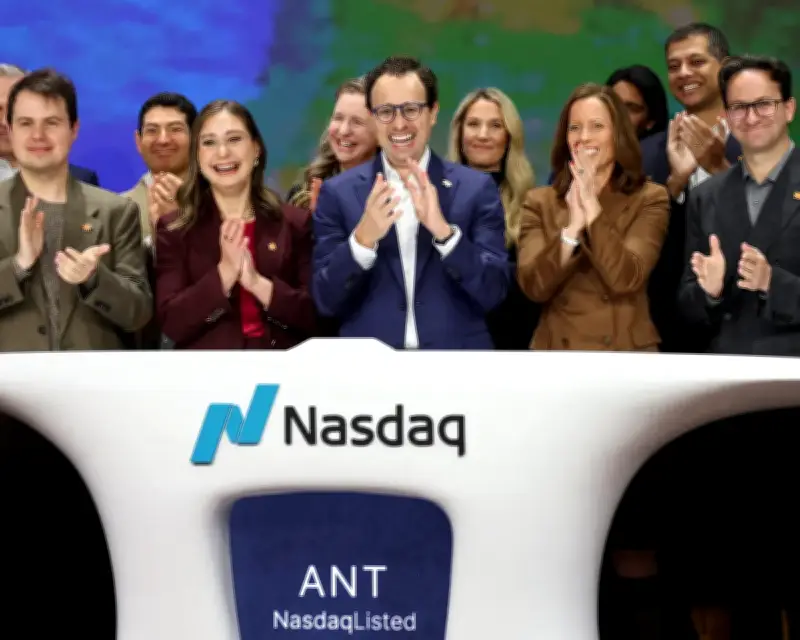
Anthropic's seven co-founders saw their combined paper fortunes exceed $180bn on Thursday as trading began in the company's shares at an opening price above expectations. The $111.50 per share price valued the stakes of co-founders including chief executive Dario Amodei and his sister Daniela at between $26.5bn and $27bn each.
The founders have pledged to donate 80% of their shareholdings in Anthropic to philanthropic causes, which would equate to roughly $150bn at the current share price.
Other investors and the public benefit fund
Other investors generating significant wealth from the float and the late share price surge include the actor Ashton Kutcher and Madonna's manager, Guy Oseary, whose venture capital firm Sound Ventures reportedly owns 0.5% as an early investor. That stake would be worth $10bn at the opening price.
Anthropic has also committed 5% of its shares to the Anthropic Public Benefit Fund, which will "explore large donations to traditional nonprofits or direct distributions to specific populations". The company has said some of the proceeds could be used to address AI's impact on the job market, though fears that the technology will lead to significant job losses have yet to be realised.
Effective altruism and the co-founders
Anthropic's IPO is widely expected to channel vast sums into the effective altruism movement, via the many millions of dollars that its 5,300 staff will have made from the flotation. EA, as it is known, crystallised on university campuses in the US and UK in the early 2010s. It encourages members to donate a substantial portion of their income to specific causes deemed high-priority, including pandemic prevention, biorisk, nuclear safety and, overwhelmingly, the risks posed by advanced AI.
Anthropic's co-founders are associated with EA. Dario Amodei took a pledge to donate his income through the organisation Giving What We Can, which is associated with the movement, though he now disavows his association and has said he does not consider himself an effective altruist. In 2023, he told The New York Times' Hard Fork podcast he was "sympathetic to a number of the ideas" promoted by EA, but against "dividing people up into tribes".
The co-founders' backgrounds
Dario Amodei, 43, was educated at Stanford and Princeton universities. He worked at the Chinese tech firm Baidu and then at Google before joining OpenAI, where he had a key position as vice-president of research. In 2020, Amodei left OpenAI, and it has been widely reported that his departure was due to conflicting views over safety. "It is incredibly unproductive to try and argue with someone else's vision," he said years later. He called for a slowdown in AI development in September after the resignation of an employee who cited concerns AI could wipe out humanity. Amodei has claimed that AI could eliminate half of all white-collar jobs by the end of the decade.
Daniela Amodei, 39, began her career in politics, working in Congress and on a congressional campaign, before switching to tech and taking a job at Stripe. She moved to OpenAI before co-founding Anthropic with her brother. She leads teams on AI model safety and alignment. She is married to Holden Karnofsky, a major EA donor who co-founded GiveWell and then Open Philanthropy.
Jack Clark, 38, a Brighton-born former journalist, has been catapulted into the list of richest Britons following the flotation. His paper wealth of approximately $26.6bn (£20.3bn) compares with £38bn for the Hinduja brothers and puts him above the £18.2bn fortune of Christopher Harborne and the £15.2bn of Jim Ratcliffe. Clark leads the Anthropic Institute. In a lecture at Oxford University this year, he predicted that an AI system will work with humans to make a Nobel prize-winning discovery within 12 months, and that tradespeople will be helped by bipedal robots within two years. He added that it would be better if humans could slow the development of the technology "to give ourselves more time as a species".
Jared Kaplan, 42, received a PhD in theoretical particle physics from Harvard before working as a researcher at OpenAI, then co-founding Anthropic. He is known for his work on scaling laws. In an interview with the Guardian last year, Kaplan focused on the risk of AI systems that can improve themselves, calling such systems "the ultimate risk".
Tom Brown, 39, chief compute officer, was a senior engineer at OpenAI. Speaking in September, Brown praised Donald Trump's social media post stating "let data reign". "He was pointing out that datacentres are just an enormous source of prosperity," Brown said.
Chris Olah, 34, dropped out of a maths programme at the University of Toronto, then took up a fellowship provided by Peter Thiel. This led to work at Google and OpenAI. Olah made headlines this year for his close relationship with Pope Leo, standing beside the pope in May when the pontiff unveiled his encyclical on the social implications of AI. Olah said he was "grateful to His Holiness and to the church for taking up this work of discernment". Behind the scenes, the two reportedly disagreed on whether AI could ever attain consciousness.
Sam McCandlish, 36, holds a PhD in theoretical and mathematical physics from Stanford, where he worked on quantum gravity. Before this, he worked as a researcher at OpenAI, and has published research on AI scaling laws and other aspects of AI alignment and safety.