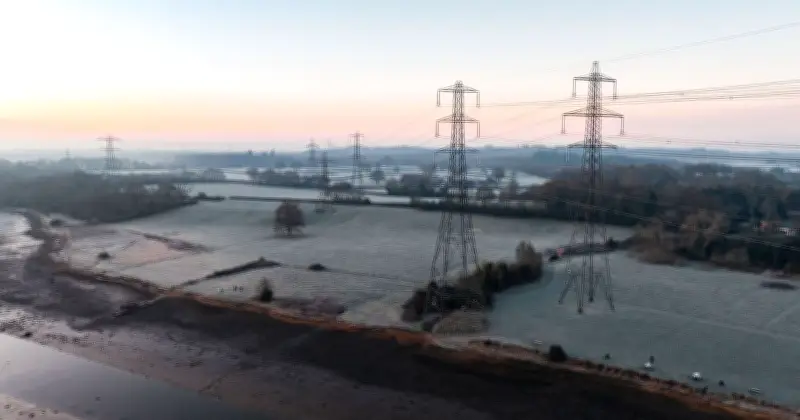
Britain's energy grid operator has issued another alert, marking the fourth consecutive day of electricity margin notices as network maintenance coincides with this week's cold snap. The National Energy System Operator (NESO) said it had issued two notices on Friday, following daily notices since Tuesday, with reports suggesting this marks a record-breaking run.
A total of 11 margin notices have been made in 2026, including the two on Friday, which is said to be more than the previous five years combined. NESO issues the notices when it would like a greater safety cushion between power demand and supply.
Reduced supply cushion expected
NESO said on Friday that there was a reduced supply cushion between 7am and 10am, when it expects a system margin shortfall of 2,500 megawatts. It added that there is also a 2,400-megawatt shortfall in the system margin between 2pm and 8pm on Friday.
An Electricity Margin Notice is issued when the energy system operator forecasts that the spare electricity capacity available may be lower than its preferred safety margin. The alert encourages power generators to make additional electricity available to help balance supply and demand.
No risk of power cuts
A NESO spokesperson said on Thursday evening: "We have issued an Electricity Margin Notice for tomorrow afternoon, as a routine and precautionary measure, giving market participants the opportunity to make additional generation capacity available.
"This is not a warning of power cuts, there is no risk to customer electricity supplies, and customers do not need to take action."
Ongoing engineering work is understood to be restricting the transmission of electricity across the grid, while colder temperatures have driven up demand in recent days.
Unprecedented situation
The four-day run of notices has reignited concerns about the resilience of Britain's energy system. Energy consultant Andrew Larkins, a former adviser to NESO, said: "This is an unprecedented situation."
He told BBC Radio 4's Today programme: "The challenge that we have is that we are generating a lot of electricity in the UK and are selling quite a lot of that to continental Europe, where there is a high level of demand.
"But we have a real problem in terms of transporting electricity from where it's generated to where it's needed."
He added: "Now we are in a situation where we have a large number of generators spread across the country and particularly off-shore wind farms and these need to have the energy transported to where it is needed.
"We are now in a situation where we can't get electricity to where it is ideally needed to make the best use of the low cost generation and wind farms at the moment."
Laura Fleming, Hitachi Energy UK and Ireland managing director, also said: "The power supply alerts this week from NESO are an important reminder of the importance of strengthening the UK's grid. This must be a national priority.
"As renewable generation expands and electricity demand rises, Britain's energy security depends not just on how much power we generate, but on how effectively we move and manage it.
"We need stronger transmission infrastructure, smarter networks and greater flexibility to balance supply and demand.
"That means accelerating investment in new infrastructure while harnessing digital technologies to unlock more capacity from existing networks."