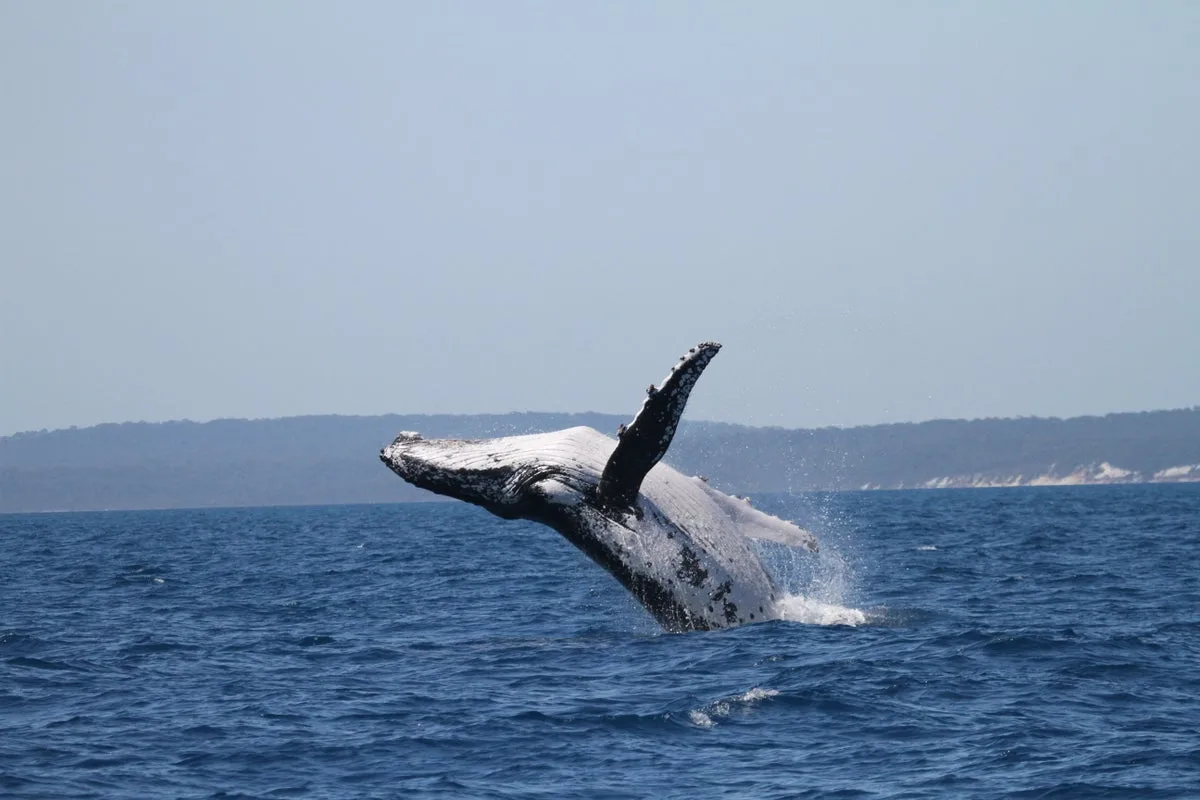
A humpback whale has completed the longest ever recorded ocean crossing, making a mammoth journey between Australia and Brazil. Scientists have documented the animal travelling between breeding grounds separated by thousands of miles of open ocean.
Record-Breaking Journey
The individual was first spotted in 2003 in a humpback whale nursery off the Brazilian coast of Bahia. Some 22 years later, in September 2025, it was seen again alone in Hervey Bay off the coast of Queensland in Australia. These locations are separated by approximately 9,383 miles (15,100km), making this the longest distance ever documented between sightings of the same individual humpback whale on record.
Another individual has also been recorded making the journey in the opposite direction, starting in Harvey Bay in 2007 and turning up off the Brazilian coast of São Paolo in 2019 – a distance of approximately 8,700 miles (14,000km).
Rare Events
Experts said the journeys were probably once-in-a-lifetime travel events, rather than a regular migration pattern. They warned the whales may have been forced to make the trip due to melting ice triggered by global warming.
For the study, a team from the Pacific Whale Foundation and Griffith University compared tens of thousands of photographs of whale tails. Every humpback whale has a unique pattern on the underside of its tail flukes, like a fingerprint, shaped by distinctive pigmentation and scarring. Researchers photograph these tail flukes and build catalogues they can compare across years and regions.
The team ran more than 19,000 photographs through an automated image-recognition algorithm. Then, they independently verified every potential match by eye, finding two humpback whales that had been photographed in both regions.
Extraordinary Discovery
'These whales were photographed decades apart, by different people, in different parts of the world, and yet we can connect their journey,' researcher Stephanie Stack, from Griffith University, said. Finding whales that have switched between populations on opposite sides of the planet is extraordinary, the researchers said, because the mammals are generally highly faithful to their breeding grounds.
Over four decades of data covering nearly 20,000 individual whales, only two such animals were found to have made the mammoth journey – representing just 0.01 per cent of individuals.
Importance for Conservation
Despite their rarity, these exchanges matter for the long-term health of whale populations, the researchers explained. Occasional individuals moving between distant breeding grounds can help maintain genetic diversity across populations and may even carry new song styles from one region to another. Humpback whale songs are known to spread culturally across ocean basins, much like music trends in human populations.
The findings also support what scientists call the 'Southern Ocean Exchange' hypothesis. This is the idea that humpback whales from different breeding populations occasionally meet on shared Antarctic feeding grounds, and that some individuals then follow a different migration path home — ending up, perhaps for the rest of their lives, in an entirely new breeding region. Climate-driven changes to the Southern Ocean, including shifts in sea ice and the distribution of Antarctic krill, the whale's main prey, may also make such crossings more likely over time.
Study Published
The study, published in the journal Royal Society Open Science, reads: 'The inter-basin exchanges documented in this study, even infrequent, have important implications for the conservation of Southern Hemisphere humpback whale populations, if the individuals are able to successfully breed in the new region. These rare individual movements may become increasingly important as environmental change continues to reshape the Southern Ocean ecosystem.'
Last year UK wildlife watchers were treated to an incredible spectacle as humpback whales made a splash in Britain's waters. The once-endangered whales were spotted along the Sussex coastline, all the way from Eastbourne to Hastings. Other whales made an appearance off the coast of Deal in Kent, while two more were spotted in Cornwall. Stunning videos show the 40-tonne mammals breaching above the waves in majestic leaps before crashing down with a splash. Whale experts say these sightings in the UK are not unheard of, but that it is very rare for humpbacks to travel up the east coast. Their sudden appearance has sparked hopes that the numbers of humpback whales could be rising after coming close to extinction in the 1990s.
Whale Song Explained
For a long time it was believed that whales sang solely for mating purposes. But some experts suggest the songs also help the mammals explore their surroundings. Researchers have recorded humpback whales changing their calls when they move to new pastures in order to match the songs of others around them. Learning these songs may help whales pinpoint one another and group together better when in unfamiliar waters. It is tricky for scientists to study how whales sing, as the shy beasts are notoriously difficult to observe, and each species vocalises differently. Humpback whales sing using folds in the vocal box that vibrate at low frequencies as air is pushed over them. It has been suggested they have special air sacs adjoining these vocal chords which connect to the lungs. These allow the whales to pass air between their lungs, the sacs, and the vocal chords without losing any of their precious air supply.