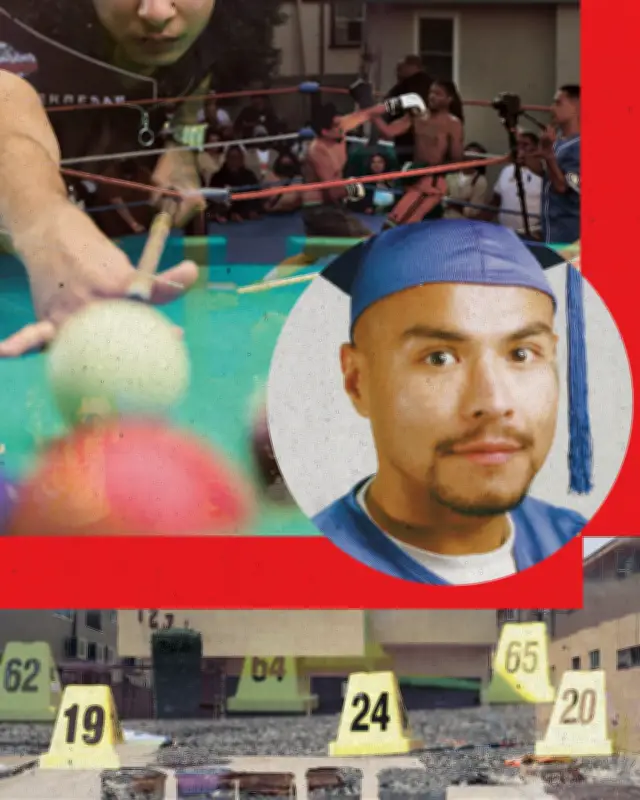
Francisco Villarruel, a former gang member who served 17 years in prison, now mentors at-risk youth in Los Angeles through boxing and dialogue, aiming to break cycles of intergenerational trauma and gun violence.
Villarruel and Gustavo Galvez sat in a park in Los Angeles reminiscing on their first boxing lesson together. They had gone to a big commercial gym, where they took turns hitting boxing pads and doing footwork exercises. They then started regularly training together.
For Villarruel, 40, working out together wasn’t really about boxing. It was about giving Galvez, 19, an opportunity to open up and to mentor someone whose pain he understands. “I think a lot of the traumatic scenarios that he went through are very similar to mine in my upbringing,” Villarruel said.

A shared history of trauma
Like Villarruel, Galvez grew up surrounded by gangs. He lost friends and classmates to gang-related gun violence, making him fear that he too would face a similar end. “Every day I think it’s my last day [on earth],” Galvez said. “Sometimes I still expect to be killed due to gun violence, even though I’m doing all these good things for myself.”
Thousands of Hispanic people in California are injured by guns each year, according to data from the state’s department of public health. Last year, half of the state’s 1,374 homicide victims were Hispanic. For many, shootings are the beginning of a cycle of violence; people who are victims of violent crime then become more susceptible to perpetrating violence themselves.
It’s one reason why mentoring – often through boxing lessons – has become part of Villarruel’s weekly routine. For years he worked with organizations in Los Angeles that help people recently released from prison reintegrate into society, and now, as a trained social worker, he’s built a name for himself as someone to call when a young gang member or a young person victimized by gang violence needs help. He doesn’t get paid for this work. But he says it’s important because he wants to help others break out of the cycle by unpacking the trauma that often steers them towards violence in the first place.
From trauma to violence
“If a gang member commits a shooting in a community, how many generations will that affect?” Villarruel asked. “If we’re going to find a way to subside that, intergenerational trauma definitely has to be addressed.”
Even before he was born, Villarruel’s life was shaped by gun violence. Villarruel’s father – also named Francisco – was a teenager during the Watts rebellion, the 1965 protests over police brutality in Los Angeles that escalated into days of rioting. The way the younger Francisco tells it, his family owned a bakery, and as rioters approached, his father and grandfather fired on them in a desperate attempt to defend their property. Rioters ultimately set the bakery on fire. These events had a profound impact on his family, Villarruel said; his father would later teach him that he could be hurt or killed if he failed to watch out for danger.
The first time Villarruel himself encountered a gun was when he was nine. He and his father were at a store when two robbers held them at gunpoint. The fear and helplessness he felt in that moment grew into trauma when his brother-in-law was shot and killed by gang rivals three years later. The thought of being killed like his brother-in-law hardened his resolve to be the one holding the gun.
Villarruel joined a gang as a teenager, and at 15 he went to juvenile hall for two years for gun possession and drug dealing. Not long after being released, he was sentenced to life in prison for kidnapping, carjacking and the use of a firearm. He served 17 years before being paroled in 2019. Villarruel said he wasn’t present at the scene of the crime, but under California law, gang members could be arrested and convicted for gang affiliation.
The role of intergenerational trauma
Villarruel recently told some of these stories at a gang rehabilitation workshop in Inglewood. The purpose of sharing his trauma, he says, is to help people understand the role it plays in community violence, and that gang members often turn to violence out of a lack of safety, belonging and self-esteem. “A child isn’t born to commit gun violence,” he said.

Alein Haro-Ramos, an associate professor of public health at the University of California, Irvine, studies the link between early-life stressors and physical and mental health outcomes among Latinos in the US. Trauma, she said, can be passed down through parenting under stress created by community violence, economic distress and systemic neglect. While many different communities struggle with trauma that persists across multiple generations, this kind of reoccurring pain often happens amid a backdrop of inequality. Almost half of all Latino youths in major cities live less than a mile from where a gun homicide occurs, and these homicides in the US are clustered within certain census tracts marked by poverty and racial segregation.
While Villarruel fell into a common cycle of violence, he also figured out how to break it. When he was 25, he was alone in his cell and thought about how he might die in prison and never see his family again. “It took that moment for me to question myself and question what I have been doing,” Villarruel said.
He left gang life behind at 30, became Christian and started therapy. He earned his GED in prison, enrolled in community college, earning his associates and bachelor’s degrees post-release. He also earned a master’s in social work from UCLA.
Breaking the cycle
With each new phase of his re-entry into society, Villarruel has confronted his own trauma that scarred him during his adolescence, and which he said was at the root of many of his bad decisions. Through therapy and his social work classes, Villarruel realized his father’s lessons about power and fear were a factor in him entering the gang lifestyle. Through this process, Villarruel recognized that his past actions hurt people and now strives to be a positive force. “This drives me and, at the same time, heals me,” Villarruel said.
How to break cycles of violence isn’t just a question for violence interrupters like Villarruel; it’s also something academics have been exploring amid the US’s epidemic of gun violence.
For more than three decades, Jorja Leap, an anthropologist at the University of California, Los Angeles, has studied different ways to stop gang violence from hurting marginalized communities. Through hundreds of conversations with gang members, she’s identified some consistent drivers of gun violence. Easy access to guns, sometimes from within a household, can lead to firearm injuries and deaths. Disinvestment in schools and in communities where poverty is high also contribute to an increase in violence, because neglect and a lack of financial resources can push youth toward negative pursuits that result in gun-related conflict.
Intergenerational trauma – the passing down of behaviors, emotions and mental unwellness within families – is another reason gun violence continues to harm Black and Latino families, Leap said. When people are traumatized by mental or physical abuse, they may inflict pain upon others, even family members. Gun violence becomes more common when violence is viewed as a problem-solving strategy, when guns are present in the household or when the underlying trauma remains unresolved.
While Latino communities are themselves diverse, and contain a variety of ethnicities, migration experiences and socioeconomic statuses, in some, certain views of masculinity within a family, like the desire to show off one’s power and control, combined with trauma and firearm accessibility, can also contribute to gun violence. “Guns were power, something for a household to feel safe,” Leap said. “As with so many other cultures, it is strongly related to machismo, a sense of control over one’s life.”
The most effective strategy in curbing gang-related gun violence in major metropolitan areas like LA, she says, is replacing the gang structure in someone’s life with long-term community support at home, in schools and in the streets. Investment in a gang member’s long-term mental and physical wellbeing can lead to the healing of trauma that persisted for generations.
For five years, Leap and her team collected data and stories of more than 300 people who sought services from Homeboy Industries, an LA-based non-profit that helps rehabilitate gang members and people who were formerly incarcerated. The study revealed that community support such as access to job training and mentorship helped reduce gang retention.
What also works is replacing old, dysfunctional relationships with newer, healthier community bonds. “These are relationships where people learn from one another, and these are individuals who have shared the experience of cross-generational trauma,” Leap said. “It’s the feeling someone else has gone through this, and that is what’s so powerful.”
Mentoring as a path forward
As part of his mentoring, Villarruel supports Galvez’s dreams of a career in healthcare. Galvez is now enrolled in community college studying nursing, and hopes to eventually become a mental health professional. Working through his fear and anxieties around being shot so that he can focus his energy on positive pursuits has been a slow process, but Galvez says having support helps keep him grounded and hopeful. Speaking openly about his traumatic experiences has helped him heal, but it’s also how he remembers his fallen friends. “Every day I carry them with me,” Galvez said.
Villarruel says his work with gang members and youth affected by gang violence has mostly been successful. By engaging them in activities like pool and boxing, he’s able to slowly start a dialogue that lets them open up about family trauma like addiction, violence and losing loved ones. Still, Villarruel says he can only do so much on his own. Healing from lifelong trauma is a difficult process, and he’s seen kids fall back into old, destructive patterns under the influence of friends and their old environment.
Unpacking this longstanding hurt, Villarruel says, should be a key part of community violence intervention work. While community gun violence intervention often focuses on resolving neighborhood disputes, unpacking intergenerational trauma is about healing longstanding, unresolved issues that may lead a person to become violent in the first place. He says bringing these strategies together is how cycles of violence can be broken. But the work doesn’t stop there. “I feel like to end one cycle, I have to start a new one,” Villarruel said, “and this new cycle is leading individuals in the right direction.”