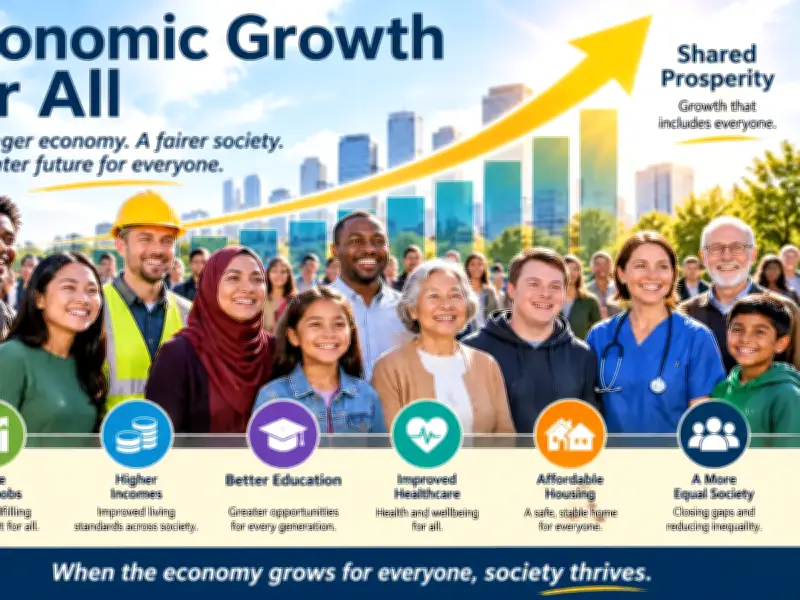
Frank Holmes argues that prosperity for all must be the measure of economic success, placing purpose ahead of statistics in the growth debate.
The Question of Why in Economic Debate
Holmes contends that much of the economic debate overlooks a fundamental question: why pursue growth? He suggests that the goal is not simply to produce larger statistics, but to create a society where more people can live healthier, more secure and fulfilling lives. Drawing on Simon Sinek's Start with Why, he argues that purpose should be established before debating the means, with prosperity for all as that purpose. Growth, he says, is indispensable but is the instrument, not the destination.
Innovation and Education as Foundations
Innovation matters because ideas become economically valuable when translated into products, services, enterprises and skilled employment. Artificial intelligence, robotics, advanced manufacturing and digital technologies can expand productive capacity. However, discovery alone is not enough; research must be commercialised, businesses scaled and new markets reached. Holmes notes that Britain's recurring difficulty is not a shortage of ideas, but the failure to retain the investment, production and rewards that follow them.
For Wales, the implication is immediate. Academic and industrial strengths are foundations, not finished economic outcomes. They require entrepreneurial ambition, commercial leadership, patient capital and a willingness to collaborate beyond borders. Education is central because technology does not generate prosperity independently of people. High standards in literacy, numeracy, science and critical thinking must sit alongside vocational excellence, digital competence and lifelong learning.
Inclusion, Health and Investability
Inclusion is essential because an economy that overlooks ability on account of background, income or circumstance squanders its own potential. Excellence and access are complementary ambitions, enabling everyone to contribute to a common prosperity. Healthcare should feature in an economic strategy because health is a precondition for participation. Recent global research estimates that nearly two-thirds of the avoidable disease burden identified could be addressed through prevention and early intervention, while many countries devote less than 2% of health budgets to prevention. These are modelled global opportunities, not forecasts for Wales.
Wales must also be investable. The proposition must be credible, with clear priorities, bankable projects, capable delivery institutions, appropriate infrastructure, commercial discipline and a predictable route from decision to execution. Public capital can help address market failures and attract private finance, but funding announcements are not substitutes for investable propositions. Prolonged uncertainty, fragmented responsibility and repeated reconsideration carry real opportunity costs.
The Test of Leadership
Holmes warns that it is dangerous to postpone plans until the landscape stops moving. With artificial intelligence compressing the cycles of invention and obsolescence from decades into months, competitive advantages will evaporate before prevaricating committees can convene. Pace, appetite for calculated risk and embracing the spirit of enterprise are the only way that the most adaptable will survive.
The test of leadership is whether productivity improves, businesses grow, earnings rise, educational attainment strengthens, avoidable ill health falls and communities become more confident and cohesive. These outcomes are interconnected: innovation creates value; education equips people to create it; healthcare sustains their capacity; integration widens participation; investment and connectivity turn ambition into delivery. Holmes concludes that prosperity for all must be the measure of success.