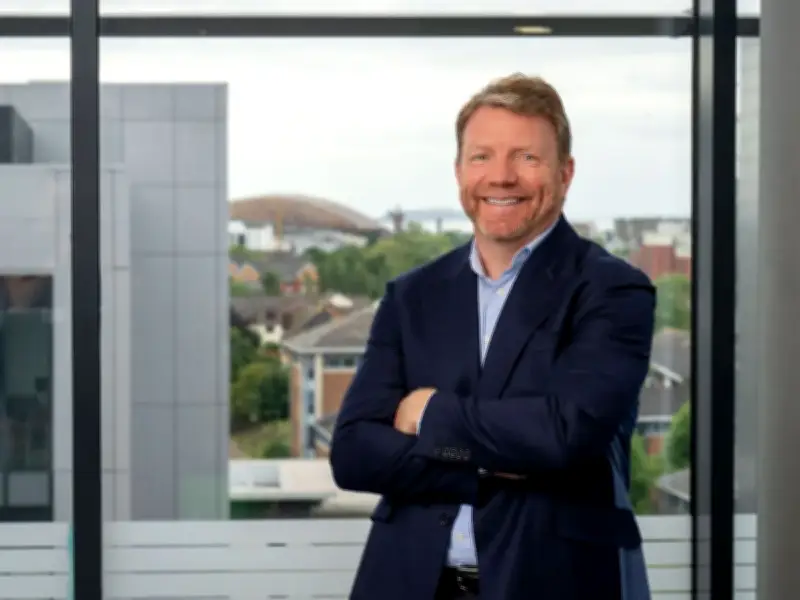
The Development Bank of Wales is looking to increase co-investment levels, with chief executive Giles Thorley arguing that Wales needs both public and private investment working together rather than choosing between them.
Writing in a personal opinion piece, Thorley said that access to finance is rarely the only ingredient businesses need to succeed, and that talent is often just as important as money. He highlighted the role of experienced investors who bring sector knowledge, customer introductions and an understanding of international expansion, helping management teams avoid mistakes.
Co-investment multiplying impact
Thorley said the ambition should not necessarily be to provide all funding up front, but to use investment to attract others, bringing additional finance, expertise and networks into Wales. He described the principle as straightforward: if the bank's involvement gives another investor confidence to back a Welsh business, the impact of its funding multiplies.
During 2025/26, the Development Bank invested £148m in Welsh businesses, which attracted a further £56.3m of co-investment. Thorley said these figures show that public investment can help unlock private capital that might otherwise not have reached those businesses.
He acknowledged that private investors have a lot of choice, with a disproportionate amount of investment focused on London and the South-East of England, making it harder to attract investors to Welsh opportunities.
New schemes and examples
Thorley referenced the £10m Wales Equity Co-investment Scheme, which can invest between £500,000 and £2m alongside qualifying institutional investors on the same financial and legal terms as the lead investor. He cited Cardiff-based firm Reclinker, which recently secured a £10m investment led by climate investors Clean Growth Fund and AP Ventures, alongside the Development Bank and others, to support expansion of lower-carbon cement production in South Wales.
He also pointed to the £12.5m Wales Angel Co-investment Fund, providing between £25,000 and £350,000 alongside angel investors and syndicates, contributing up to half an investment round. As an example, he highlighted Pelly, an Anglesey-based technology business, whose initial £355,000 investment round brought together a syndicate of ten angels led by Robert Williams, who invested £124,500, matched by a further £124,500 from the Development Bank.
Building investor relationships
Thorley said the opportunity is to build relationships with investors, understanding what they are looking for and making it easier for them to identify promising businesses. He noted that different businesses need different kinds of investors at different stages, and that the bank's role is to help bring the right people and the right capital together.
He concluded that using public capital to encourage more private investors to back Welsh businesses would strengthen networks, experience and confidence within the investment community, giving more companies the opportunity to start, grow and scale in Wales, creating jobs and keeping more value within the Welsh economy.