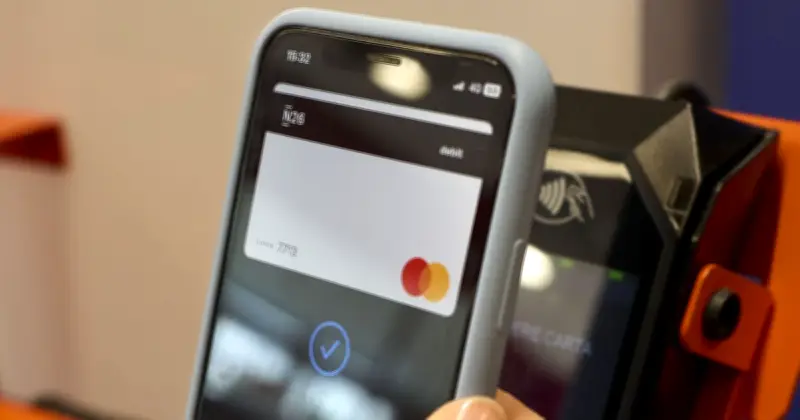
Contactless payment has overtaken cash, but campaigners warn there are risks. Cash is now used for just 12% of UK purchases, according to a parliamentary report from last year.
Andy Beverley, a tech-savvy IT entrepreneur and former Navy engineering officer, insists on paying with banknotes and loose change. He believes contactless payment is damaging society.
Cash refusal and the 'vicious circle'
Many self-service tills at major supermarkets such as Lidl and Tesco are card-only, meaning customers who want to pay cash must queue longer. An increasing number of shops refuse to accept cash at all, with contactless being the only way to pay. Apart from very limited circumstances, there is nothing in UK law that stops a retailer or public service from doing so.

“There’s nothing that makes me more angry than going into a place, putting a note in front of them, and them saying they don’t accept it,” says Beverley, who ran critical communications systems on aircraft carriers in his military days. He says his deep understanding of technology makes him more worried about a cashless society than most.
Now a leading voice in the grassroots Campaign for Cash, Beverley says: “There’s absolutely a danger of a world where we don’t have cash. Even though I’m a big proponent of technology, I’m also very anti a very concentrated marketplace. What I’m very anti of in tech is a very small number of large companies having control over that space. It’s exactly the same in the payments industry today. You’ve got a very small number of very large companies who have control over those digital systems. Cash is the antithesis to that.”
The Campaign for Cash believes hard money is “essential for maintaining a balance of power between the public and the banking industry”. Card operators charge small fees for every transaction, and while these are currently small, campaigners fear “banks could monopolise payments and raise fees” if cash were to die out.
Beverley warns of a “vicious circle”: “First of all, you can’t spend it, then you don’t get it out. Then, because you’re not getting it out, the cash machines go. Then the bank branches go. Then, because they go, the shops stop accepting cash because they can’t deposit it. People think that cash will always be there for the odd occasion they need it. But the reality is that cash needs a critical momentum, and once that critical momentum stops, it then becomes very difficult. It's the old use it and lose it thing – if you haven't got that critical momentum there, you're not going to be able to just get the odd £20 to play the babysitter.”
Convenience versus independence
Beverley believes cash is better than digital payments in every conceivable way, except convenience. Strategy&’s Payments and Open Banking Survey from last year showed that just 13% of Brits preferred cash payments, with mobile or card payments about 20 seconds quicker.
Greg Parker, landlord of The Old King’s Head near London Bridge, says: “I personally think cash is important because I don’t like using my bank card when I go everywhere. Sometimes I only carry cash around with me, and I can’t get what I want. But as a business, even though we do have cash and card here, we hardly get any cash now.”
Michael Blomquist, 72, runs a market stall selling eggs and honey in Newmarket, Suffolk. He says: “I think a lot of places are trying to do away with cash. I won’t have a card machine because you have to pay to have it, and I can’t see the point in that really. A lot of older people don’t want to use a card because of the scams. It’s so easily done with the elderly. That to me is a worry. Most people who come prefer cash.”
Martin Quinn, commercial lead for the Campaign for Cash, adds: “If you’ve got cash, you’re seen as the outlier – like you can go over there and queue up for ages, like some sort of Luddite paying with your cash. Or you say ‘oh, forget this, I only want a couple of things – I’m just gonna whip my card out’. There’s a lot of pressure coming from the banks, from the financial services sector, that we need to get everyone digitally savvy. Why have we got to be driven to this part of society? If I want to get my cash out and spend it wherever I like, I should be allowed to do it.”

Digital risks and fraud
Beverley believes “far more money is lost today through digital scams and fraud”, with over £1 billion stolen by con artists every year, according to UK Finance. Quinn also believes: “People should prepare for the worst. In the last 18 months, we’ve had power outages in Spain and Portugal. It affected everything, all the payments. Imagine going to a pub, and you’ve only got a Visa debit card, and Visa goes down. How are you going to pay?”
The Treasury Committee found there were at least 158 banking IT outages between January 2023 and February 2025, including a technical failure at Barclays which prevented payments for three days, including during the income tax self-assessment deadline. A debilitating cyber attack from Vladimir Putin knocking out digital payments or the internet could leave millions of Brits unable to pay for anything, even if they have money in the bank.
Even Sweden, widely considered one of the world’s most cashless societies, has done a U-turn and strengthened the legal status of cash due to escalating security concerns.
Government policy and calls for change
Ministers have told the Treasury Committee there are “no plans to regulate businesses, big or small, to compel them to accept cash”. The Government instead says it wants to make cash use easier, with the Financial Conduct Authority given regulatory powers to force banks and building societies to open more cash machines or banking hubs where needed.
Beverley believes the Government’s policy is “flawed” and that forcing shops and businesses to accept cash – as France does – is “fundamental” to Britain’s future. Alicia Coumbe has launched a petition urging the Government “ensure that all businesses and public services are legally required to provide alternative non-digital means for payment”. “Cash is meant to be legal tender and shops should accept it,” says the 67-year-old.
She is backed by Dennis Reed, of campaign group Silver Voices, who says: “Millions do not possess a smartphone, do not know how to download apps, or are not online at all, and are now being treated as second-class citizens.”
Beverley says: “The Government can do more to help. I really, really always try and refute that we’ve just got to have a little bit of cash just in case, for the old people and for the poor people. It affects everyone. It actually affects the young people more because they’re the ones that could have to live with this the rest of their lives. Digital cards, let’s be quite clear about this, are a very successful commercial product. And let’s remember they’re all American. We’ve got these very small number of very large corporate firms controlling our payment system. Cash is a facility provided by the state. Cash is more private, it’s more independent, it’s more reliable. It's got no intrinsic costs. We don’t need an internet connection. Even myself, it took me a long time to realise that cards are not an upgrade to cash. I think in the long term, without it we all stand to lose in one form or another.”
Simon Johnson, owner of Nancy’s Vintage Teashop, has a sign displayed encouraging use of cash. “We don’t do cash only. A lot of people do pay by card. But every time that happens, I’m not getting the full amount of money,” he reveals. “Through my card processing company, I pay £200-300 in charges, which to me is a lot of money that could be put back into the business. I feel it’s important people still keep cash, because it will get lost. £20 cash given to me is £20 going into my account.”
The Treasury Committee says “the Government must act to manage the decline in cash acceptance”. In its latest report, published last year, it concludes: “There may come a time in the future where it becomes necessary for HM Treasury to mandate cash acceptance if appropriate safeguards have not been implemented for those who need physical cash, and the level of cash acceptance begins to lead to widespread detriment. Cash acceptance levels in the UK must be monitored to ensure we do not sleepwalk into a loss of cash acceptance for those who need it.”