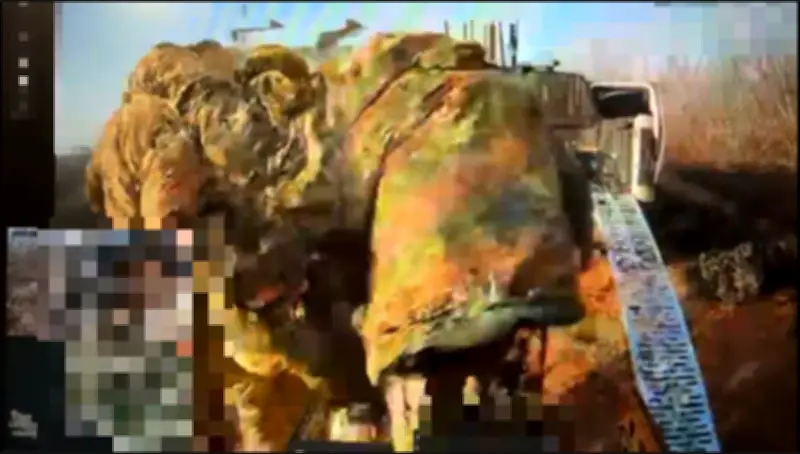
Two Ukrainian soldiers with blast injuries were rescued by an unmanned ground vehicle (UGV) in the frontline town of Pokrovsk, in an operation that began in darkness and ended in daylight. The wounded men, hit by a Russian kamikaze drone, were loaded into the remote-controlled vehicle and driven for several hours while an operator 15 miles away navigated around mines and Russian troops. Military medics eventually collected them in a pickup truck.
Robotic rescues on the frontline
The rescue is one of hundreds carried out by UGVs each month, according to former Ukrainian soldier Oleksii Konic, 43, co-founder of Trinity Robotics with business partner Svitlana Molodchenko. The company is at the forefront of Ukraine's effort to develop battlefield drones and robotic vehicles.
Konic told the Daily Mirror that robot wars are no longer a distant dystopia. "The way we fought the Russians in 2022 seems a long time ago and we could not do that now because they would not let us as there are drones now. Everything has changed because of drones," he said. "That is life and it is also how we will win this war by continuing development."

AI and autonomous weapons
Konic envisions a future without soldiers on the frontline. "I can see a future when there will be no soldiers on the frontline and the war will be completely different. Our drones will become robots that make decisions," he said. "Within several months with AI it will be semi-autonomous. That is the first step. The second step, we will make completely autonomous UGV and they will go this track by themselves and make all decisions like how UGV should avoid this obstacle or this obstacle by themselves."
The Konyk One UGV, which costs £16,000, currently has no weapons but is being integrated with a turret and a Browning 12.7 machine gun. "I believe some AI managing of the turrets will be very soon," Konic said. "So the UGV can make a decision on the route or the direction, and then the operator takes over the actual weapon. Konyk S can also be used as a Kamikaze weapon with explosives."
Rapid production and growing demand
Production of UGVs and aerial drones is accelerating across Ukraine. Trinity Robotics manufactured 70 UGVs in July, with projections of 130 in August and 200 in September. UGV deployments in Ukraine grew 650% between 2024 and 2025, and some brigades now conduct around 80% of frontline logistics using robotic systems. These platforms have reduced casualties by up to 30% in integrated units.
The company supplies 20 Ukrainian frontline units and has a partnership with Swedish investors. Konic said British companies have shown interest in production. "So far we do not have partnerships with Britain but that is what we need to scale up production. We will be in the UK in October and hope to meet with prospective partners from the UK and any help we can get from Britain would be very good," he said.
Security and the road ahead
Trinity Robotics operates from four secret locations in Ukraine, employing more than 100 screened workers, many of them war veterans. "We cannot produce at night because of the Russian attacks and of course security is important," Konic said. "If they knew where we are then they will attack."
The Konyk S (small) UGV, carried on the Konyk One, has a normal range of around 30 miles, extendable with extra batteries. Konic acknowledged Russian advances: "Unfortunately their technology is not bad and they are developing their own UGVs with several companies in Russia. But ours we believe is better." He added: "It is precisely technology such as this that will help us to win this war. Maybe after several years once we have won, maybe the Russians will change."