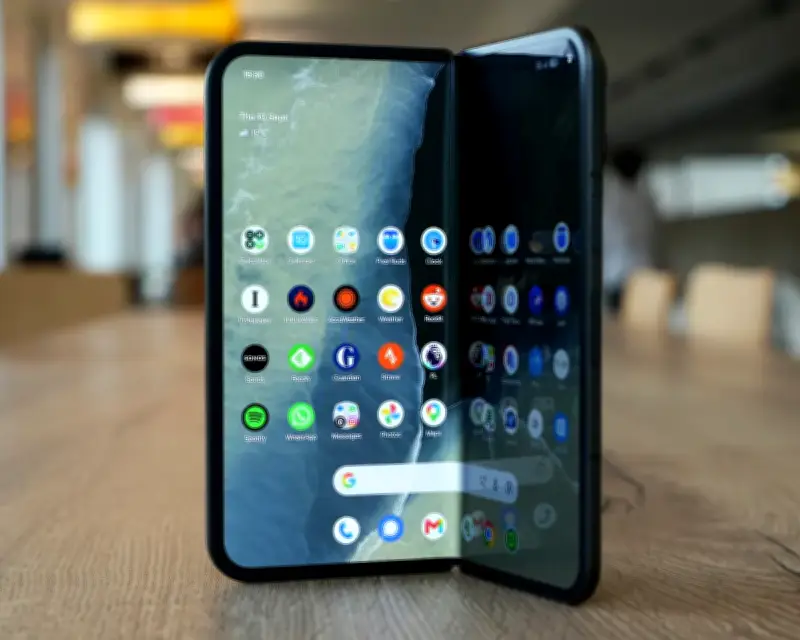
Google's Pixel 11 Pro Fold is a fourth-generation folding phone that sticks with the traditional phone shape when closed and an almost square screen when open. It faces new competition from Apple's squat iPhone fold and Samsung's slender Galaxy Z Fold 8 Ultra.
The phone costs from £1,799 (€1,999/$1,899/A$2,799), which is £50 (€100/$100/A$100) more than last year, as the pressure of RAMageddon continues to push up prices. It is one of the only foldables with a full water and dust resistance rating similar to standard slab phones.
Design and display
The 11 Pro Fold looks identical to previous models, but it is 19g lighter and fractionally slimmer in all directions, with a slightly larger outside screen. Unlike Samsung's Galaxy Z Fold 8 Ultra or Apple's iPhone Duo, the Pixel has the same ratio screen as Google's slab phones, so it handles precisely like them when shut, with a bright and smooth 6.5in display.

Opened up, the internal screen is essentially square, which allows you to run two full-size apps side by side but is less ideal for video. The display is very bright, crisp and smooth, but the crease where it folds is more visible and detectable with your fingers than the best rivals. Like all foldable phones, the screen is also delicate compared with standard hardened glass phones.
The back of the phone hides the excellent Qi2 magnetic charging and accessory support from last year, while Google's gimmicky HiLight notification LED, as seen on the other Pro Pixels, replaces the camera's flash.
Specifications and performance
The phone has a 6.5in FHD+ 120Hz OLED outside screen (399ppi) and an 8in 120Hz OLED inside screen (372ppi). It is powered by the Google Tensor G6 processor with 16GB RAM, and comes with 256GB, 512GB or 1TB storage. It runs Android 17, has a 48MP main camera, 10.5MP ultrawide, 10.8MP 5x telephoto, two 10MP selfie cameras, and connectivity including 5G, eSim, USB-C, wifi 7, NFC, Bluetooth 6, UWB, Thread, and GNSS. It has IP68 water resistance (1.5 metres for 30 minutes) and weighs 239g. Folded dimensions are 155.2 x 76 x 10.1mm, and unfolded 155.2 x 150.4 x 5mm.
The 11 Pro Fold has the same Tensor G6 chip from the other Pixel 11 models, which works very well for multitasking, remaining snappy and responsive with multiple apps on screen. It handles light gaming, but can't match rivals for raw performance.
The battery life is a little shorter than last year's model and rivals, lasting about 36 hours between charges when used on a mix of 5G and wifi with the screens in active use for about 2.5 hours each for browsing, messaging, apps and photos. Most will have to charge it nightly, but even on the heaviest of use days the Pixel managed to end the day without requiring a top-up. A full charge takes an hour and 40 minutes, hitting 50% in 37 minutes with a 30W or greater USB-C power adaptor (not included). It also supports 25W Qi2.2 wireless charging.
Software and AI
The Fold runs the latest version of Android 17 with all of Google's AI tools, including Gemini's proactive system, the new supercharged voice dictation feature, and six months of Google AI Pro subscription. Many of Google's more creative AI tools, including the Omni video creation tool, Circle to Search, and Gemini's information cards, benefit from the larger internal screen.
Google has made a number of modifications to Android to better fit the folding form, including a floating taskbar and a split-screen mode that can resize apps beyond the bounds of the physical display introduced last year. The bubbles system, primarily used for messaging apps, has been revamped to allow as many as five apps of any kind to be opened as floating windows on top of a single or split-screen apps and minimised to a little taskbar. But it isn't as flexible as Samsung's true desktop-like floating window system.
The 11 Pro Fold will be supported until August 2033 with operating system and security updates, making it one of the longest supported devices available.

Sustainability and camera
The battery is rated to last in excess of 1,000 full charge cycles with at least 80% of its original capacity. The phone is repairable by Google and third-party shops, and self-repair with manuals and parts is due to be available. The Pixel 11 Pro Fold contains 24% recycled materials by weight. The company breaks down the phone's environmental impact in its report and will recycle old devices for free.
The Pixel Fold has some of the best cameras on a foldable phone, including three on the back and two very good selfie cameras, one in each screen. The rear cameras include a new 48MP main camera with a larger sensor, matching that in the regular Pixel 11, which captures better detail and has significantly better lowlight performance than its predecessor. The 10.5MP ultrawide camera is the same as last year and is still as solid this year. The 10.8MP 5x telephoto is also the same and shoots good photos that meaningfully reduce the distance to objects. It has a solid digital zoom that stretches up to 30x magnification, but not the generative AI zoom of the Pixel 11 Pro.
The Fold also has the new software features from the other Pixel 11 phones, including Camera Looks, which allows you to customise the processing of your photos for different styles. Magic Capture shoots video and photos automatically with one button, while the Creator suite helps you storyboard, trim and produce video content for social media. The camera also has tricks to make use of the folding form, including modes to shoot when propped up and the excellent Made You Look feature that displays an animated character that reacts to your kid's smiling to help take better photos.
Price and verdict
The Google Pixel 11 Pro Fold costs from £1,799 (€1,999/$1,899/A$2,799). For comparison, the Pixel 11 costs £879, Pixel 11 Pro costs £1,079, the Pixel 11 Pro XL costs £1,279, the Samsung Galaxy Z Fold 8 Ultra costs £1,899, the iPhone Duo costs £1,999 and the Honor Magic V6 costs £1,499.99.
The Pixel 11 Pro Fold is a fairly minor hardware update for Google's folding phone line, which makes it slightly lighter, smaller, brighter and faster, while keeping its overall look and feel the same. It has great AI tools, slick software and some of the very best cameras. The inside screen is super bright and crisp, but the crease down the middle is more noticeable than rivals, the battery life is a bit short, and it is thick and heavy compared to the best from rival Samsung. As with all foldables, the inside screen can be permanently marked by a fingernail if you press hard enough, so you must still be careful with it compared with a standard Pixel. But if you want a folding phone to be exactly the same as a regular one when closed, the Pixel Fold is the one to get.
Pros: just like a regular Pixel when closed, good tablet screen, dust and water resistant, Qi2 magnetic accessory and charging, good performance, great cameras with 5x zoom, great software packed with cutting-edge AI, six months of Google AI Pro included, seven years of software updates. Cons: very expensive, more fragile and costlier to repair than a regular Pixel, thick and heavy, cameras can't match regular Pixel 11 Pro, battery life could be better.