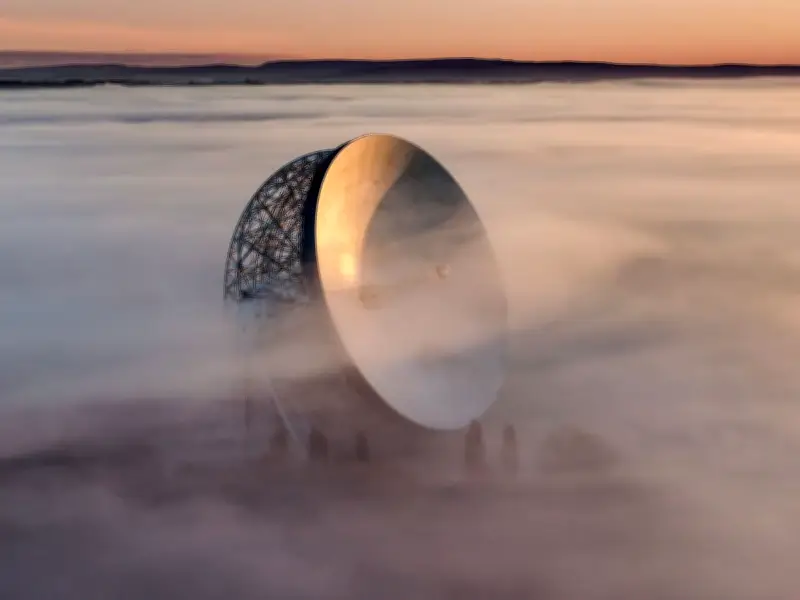
It was as if a whole new world was opening up, the Manchester Evening News reported. Suddenly 'regions of the universe millions of miles beyond the present reach of man's knowledge' were within our sights. The source of this leap was a muddy farmer's field in the Cheshire countryside.
Jodrell Bank Observatory was first launched by University of Manchester scientist Dr Bernard Lovell in 1945. Three years later, in one of the first mentions in print, the M.E.N. described its radar: 'A wire mirror, over 200ft in diameter, sends radar discharges towards the stars and receives echoes from particles the size of a pin's head 60 miles up and travelling at 100,000 miles an hour.'
From Interference to Discovery
Convinced that random signals on a cathode ray tube were caused by radiation from space, not Nazi aircraft, Lovell began developing a theory that would usher in the space age. After the war, he tested his ideas with a makeshift dish of scaffolding and wire, but interference from electric trams in Manchester hampered his work.
On a freezing December day in 1945, Lovell packed his kit and drove 25 miles south-west to a farmer's field near Macclesfield owned by the university. The quiet, remote location proved perfect. He set up his radar outside the gardeners' hut and soon peered into the heavens. He saw not cosmic rays but meteors.
The Largest Telescope Ever Built
The accidental discovery led Lovell to conceive a full-scale, moveable dish – the largest the world had ever seen. Speaking at Stockport Luncheon Club in April 1952, he said: 'With the new telescope we hope to maintain the pre-eminent position Great Britain has in astronomy and add a great deal to the prestige of the British scientific effort.'
The Mark I Lovell telescope almost didn't get built. Construction took nearly a decade, with the original £300,000 budget more than doubling due to rising steel costs, industrial action, and unprecedented technical obstacles. Several engineering firms declared the project impossible. Only engineer Charles Husband was prepared to take on the 3,200-tonne challenge.
Saved by Sputnik
The Armed Forces saw the telescope's potential military uses. Last-minute charges demanded by military chiefs for tracking inter-ballistic missiles drove costs higher, but Whitehall bureaucracy meant the Air Ministry could not fund the work. Lovell faced calls for his head over the costly 'white elephant'. He was saved by the discovery of the Sputnik satellite.
Just before midnight on October 12, 1957, the near-complete Mark I pinpointed the rocket that had carried the intercontinental ballistic missile. It was the only telescope outside the Soviet Union capable of doing so. Overnight, the project – and Lovell's career – were saved.
Space Race and Cold War Role
Jodrell Bank played a key role in the Space Race. In 1966, the first images from the Moon's surface, transmitted by the Soviet Luna 9 probe, were intercepted at Jodrell Bank and published in the British press before being officially released by the Kremlin. In 1969, it tracked Apollo 11 and listened as Neil Armstrong and Buzz Aldrin walked on the Moon.
At the same time, the observatory had a covert Cold War role. For five years at the height of tensions, Jodrell Bank was relied upon to give the four-minute warning of an impending nuclear attack.
Decades of Discovery
In the decades since, Jodrell Bank has studied distant galaxies and helped discover objects like black holes, quasars, pulsars, gravitational lenses, and the fading glow of the Big Bang. In 2019, it earned Unesco World Heritage status. The Lovell Telescope is a Grade I listed building, still a working instrument, and the third largest of its kind.
It has been immortalised in popular science fiction, from The Hitchhiker's Guide to the Galaxy to Doctor Who. Today, the observatory is home to the e-MERLIN array, a network of seven radio telescopes across the UK. It also provides the backdrop for the Bluedot festival, with performances by Kraftwerk, New Order, Gary Numan, the Flaming Lips, and Bjork.
Future Under Threat
Despite its history, Jodrell Bank now faces closure due to UK Research and Innovation's decision to withdraw its annual £2.8 million funding. The observatory's future is under threat, but it remains pivotal to modern astrophysics.
Sir Bernard Lovell, knighted in 1961, once told the M.E.N.: 'The engineers who built it said if I was lucky it might last for 15 years. It is marvellous that it is still around after 50 years. I realise now that I was asking for what was barely possible at the time.' He died in August 2012 aged 98.