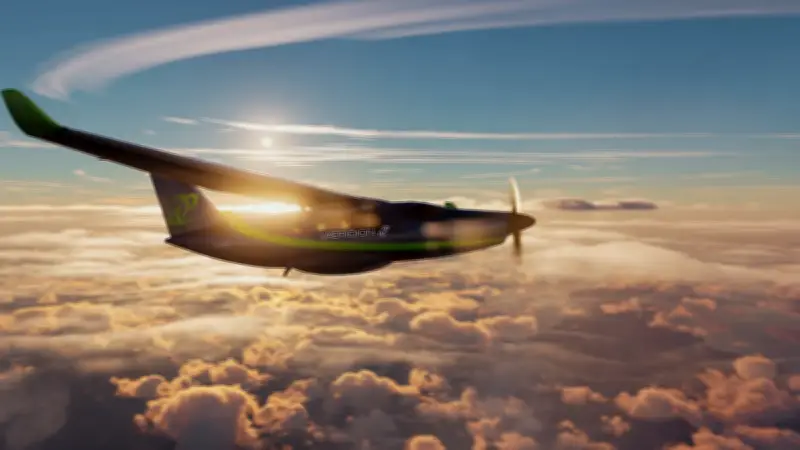
Electric passenger planes could be flying short-haul routes between Britain and nearby European destinations by 2030, according to companies developing the technology. Vaeridion, a European firm building a nine-seat electric aircraft, says the first commercially viable planes could enter service as early as 2030.
First-generation electric aircraft
Otto Verhoeff, chief business officer of Vaeridion, said the planes would not replace Boeing or Airbus jets on routes like London to Lisbon or Madrid. Instead, the first generation will be smaller, flying shorter distances and carrying a handful of passengers. Based on current battery performance, the aircraft should carry nine passengers, their luggage and two pilots for 400 kilometres. With a reduced load of four passengers and one pilot, the plane can fly up to 550 kilometres — enough to travel from Heathrow to Düsseldorf.
The planes resemble traditional fuelled aircraft but have larger wings to house the batteries. Verhoeff suggested high-demand routes could include Dublin to Liverpool, Jersey to Cardiff, London to Dublin and Amsterdam. He noted that 3,500 regional airports could accommodate the aircraft, many of which are not currently served by traditional carriers.

Industry readiness and challenges
Vaeridion says it already has 132 aircraft lined up through letters of intent from eight companies across European countries, including the UK and Ireland. Around 80 per cent would be for passenger use, with the remainder as cargo aircraft.
Tom Taylor, aviation policy manager at environmental campaign group Transport & Environment, said progress has been rapid in recent years. More efficient motors and designs incorporating batteries into wings mean electric aircraft could carry passengers on these journeys between 2030 and 2035, provided legislation keeps up. He stressed that airports need to be ready for electric flight, including installing charging infrastructure, and that the whole industry must move with it.
Taylor also highlighted that airport charges are often linked to aircraft weight, and battery-based planes are heavier than kerosene-burning equivalents. This creates "perverse situations where electric flights are being charged more than a kerosene flight."
Future prospects
Government could intervene by mandating a proportion of flights use alternative fuels, such as electric or hydrogen-powered planes. Public service obligation routes linking remote parts of Britain, including Scottish islands, could be an obvious starting point. Private jets, which often cover distances of 500 to 800 kilometres in Europe, could provide another early proving ground, with wealthy customers more willing to pay a premium.
Electric motors should be significantly quieter than conventional aircraft. Verhoeff claims Vaeridion's aircraft will produce "at least 50 per cent less noise," which could benefit communities near major airports. Taylor believes it is a case of when, not if, electric planes take to the skies: "It's just about that next step of bringing that technology into a market and into the mainstream."