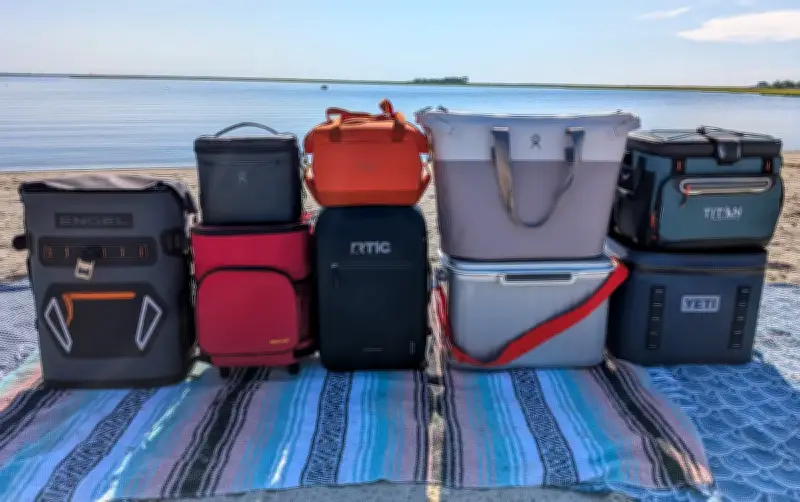
When shopping for a cooler, you'll find plenty of giant, hulking chests designed to keep a family fed for a week or a frat party buzzing until the cops show up. But most of the time, all you need is a grab-and-go box to keep a couple of cans of soda cold for a road trip, or to get some popsicles to the beach without turning into puddles.
Don't endanger your back and spend a small fortune on a plastic coffin that makes you feel like you're packing for an expedition into uncharted territory. The right portable cooler can be convenient, lightweight and not need three bags of ice to get it cold. I tested 15 to find the best you can buy.
At a glance: Best overall portable cooler
- Yeti Hopper Flip 18 Soft Cooler – $300 at REI
- Best cooler for cold retention: Oyster Tempo Cooler – $475 at Oyster
- Best ultraportable cooler: REI Campwell Folding Cooler 18L – $39.95 at REI
- Best budget portable cooler: Titan by Arctic Zone Zipperless Hardbody – $68.99 at Kohl's
- Best backpack cooler: Engel Roll-Top High Performance Backpack Cooler – $189.99 at Amazon
Why you should trust me
I have been testing and recommending consumer products professionally since 2008, designing testing processes and objectively reviewing everything from pool cleaning robots to running shoes. I have used coolers for grocery shopping in cities, road trips, camping, beach days and boat trips – and I know how important it is to keep your lettuce unwilted, your ice cream frozen, and your beer frosty.
How I tested the portable coolers
Every manufacturer publishes cooler dimensions, but I meticulously measured every review unit to ensure accuracy. Since shape can affect usable capacity, I also filled each with as many 12oz cans as they could carry and easily close.
To test how well they kept their contents cold, I filled each cooler with a load of ice equivalent to a quarter of its 12 oz can capacity. The coolers were then closed and placed in a dark room maintained at 76F (24C) and the temperature inside each cooler was recorded every 15 minutes over a 24-hour period.
I also used each cooler in everyday life, for picnics, road trips and beach days – it's a tough job but someone has to do it – to see what each is like to use, and identify any pleasant surprises or annoying frustrations.
Best overall portable cooler: Yeti Hopper Flip 18
The Yeti Hopper's sharp looks, generous capacity and excellent cold retention made it the well-rounded option I always found myself reaching for first.
At a fraction of the weight of the hard coolers, the soft-sided Hopper is a practical option when you need to haul it far from the car. It benefits from both a comfortable shoulder strap and a helpful second handle at the base of the lid, so you can carry it one-handed even when the top isn't zipped shut. While the zipper is a bit stiff, the lid felt like it was closed enough to keep the contents cold without having to fully zip it back up, making it easy to access the contents one-handed.
A soft-sided cooler like this can't match the cold retention of the Oyster Tempo or even Yeti's own hard-sided Roadie 8 model, but it still landed in the top-tier: only three models performed better. Prechilling would help when you really need to draw out the ice life, since the initial temperature from the ice fill didn't drop as low as some other models, impacting performance in the tests.
It's also an attractive cooler with a flat-enough lid to use as a makeshift table if needed, although the top handle stops it being the kind of fully flat practical surface you get on some hard coolers.
It's a shame that … The Hopper Flip is undeniably expensive. If you need a more affordable alternative, look at the Titan Zipperless Hardbody below, which costs just a quarter of the price.
Capacity: 30 12oz cans; Weight: 4.50 lbs; Insulation type: Closed-cell rubber foam
Best cooler for cold retention: Oyster Tempo Cooler 23L
If you demand maximum cold for the longest possible duration, the vacuum-insulated Oyster Tempo is in a literal class of its own.
Not only did the Tempo drop the temperature lower than all the others on test (26F), it kept it shockingly cold throughout the whole 24 hours, gaining only 11F during testing. It does this (and without the need for any prechilling) by using an aluminum body and a vacuum-sealed insulation layer, like a Thermos, which no other cooler in this test uses.
With a slick design that calls to mind an Airstream trailer, this is also a beautifully made cooler. It can be quickly opened and closed one-handed, for easy grabbing without leaving the cooler open to hot air. Clips on both sides of the lid can also be detached to lift the lid off completely, making it easier to empty or fill.
It comes with two different handles: a soft fabric (my preference) and a hard metal option, as well as two ice packs – a perk none of the other candidates include.
It's a shame that … It weighs 12lbs empty, making it over twice the weight of any of the other coolers we tested. While it is bigger than some of the others, its weight gives it the second lowest capacity per pound, only carrying three soda cans per pound of weight. In contrast, the Yeti Hopper delivers seven cans per pound.
At $475, it is also undeniably a super premium product, even with the inclusion of two handles and ice packs.
Capacity: 36 12oz cans; Weight: 12.3lbs; Insulation type: Vacuum-sealed aluminum
Best ultraportable cooler: REI Campwell Folding Cooler 18L
If you just need a small, convenient cooler to toss in the car for a roadtrip or bring a lunch to work, this folding option from REI is a superb choice.
Weighing just 0.72lbs and carrying 10 cans, this folding cooler boasts the best weight to capacity ratio of all the coolers we tested. Despite its relatively thin insulation layer, it kept everything below 40F for seven and a half hours. In the first six hours, we recorded a temperature gain of just 4.6F, making it a perfect pick for short jaunts.
Besides being light, it folds down flat when empty, making it a great choice for camping or just storing in a crowded apartment. As the cheapest cooler we tested, it's a great bargain too.
It's a shame that … It's not the easiest to quickly access. To open the zipper you will need two hands, but that's fairly standard for coolers of this size.
Capacity: 10 12oz cans; Weight: 1.14lbs; Insulation type: Recycled polyester
Best budget portable cooler: Titan by Arctic Zone Zipperless Hardbody
Like the Yeti Hopper 18, Titan's Zipperless Hardbody provides great balance rather than excelling at any one thing, and makes a practical cooler ideal for beach days or picnics.
Rather than a zipper to seal its lid, the Titan relies on Velcro, making it exceptionally easy to access one-handed, but still secure enough to keep the contents cool. The inside, as the name alludes, is a hard plastic compartment that also comes with a removable shelf so you can easily keep some things separate from any ice in the cooler. There are also multiple pockets around the outside and a bottle opener on a strap.
Like the Yeti Hopper, it fits 30 soda cans, but its lighter weight gives it one of the best weight-to-capacity ratios in our test – especially for one that delivers good cold retention. In our tests, the Titan took a while to drop the temperature, so it would definitely benefit from prechilling, but it held temps reasonably steady over the first 12 hours.
It's a shame that … It doesn't include a central grab handle for one-handed lifting: you have to rely on the longer shoulder strap or side handles to move it, especially when loading it into or out of a car.
Capacity: 30 12oz cans; Weight: 3.47lbs; Insulation type: Deep freeze performance
Best backpack cooler: Engel Roll-Top High Performance Backpack Cooler
Some backpack coolers are just regular bags with a waterproof and insulated pocket built in, but this pack from Engel is very much a cooler first and foremost, with the performance to back it up.
In the cold retention tests, the Engel was the best-performing soft cooler I tested. Temperatures stayed below 40F for nine and a half hours, thanks to its rather thick insulation. This chunky padding does add to its weight and limits capacity, but the comfortable straps mean it doesn't feel like a burdensome cooler to lug around.
A large opening makes it easy to fill and empty and an included bottle opener is a nice touch.
It's a shame that … The roll top makes it a bit annoying to quickly dip in and out of for a drink, but this is an issue I've found with all the backpack coolers I have tested. Whether it's stiff waterproof zips or snap fasteners, none of them tend to be easy to use one-handed.
Capacity: 22 12oz cans; Weight: 3.5lbs; Insulation type: Closed-cell foam
The best of the rest
Best for a regular backpack with a cooler included: RTIC Ultra-Dry Backpack Cooler
Think of this less as a cooler and more as a backpack that also happens to offer a large, waterproof compartment for ice. A second main compartment with a laptop sleeve and front section for other items makes it practical for use as a regular backpack, and a decent set of straps and unassuming look means it's comfortable and won't look out of place either in a city or on a hike.
Thoughtful touches, such as tabs to grip while pulling the stiff waterproof zips, also make it a lot easier to use.
It didn't make the final cut because … It really struggled to hold much cold at all due to its lack of insulation. It quickly stabilized at about 57F where it stayed for around six hours, keeping things slightly cooler but not cold enough for food storage.
Capacity: 15 12oz cans; Weight: 3.15lbs; Insulation type: Watertight sealing
Best wheeled cooler for city grocery shopping: Dbest Ultra Compact Cooler Smart Cart
Dbest's Smartcarts rose to fame thanks to a 2017 appearance on Shark Tank, where their inventor dramatically demonstrated their 110lb capacity. This folding cooler version brings all the best features of the folding roller cart with some added insulation.
Between its light weight and decent set of wheels, it's ideal for getting perishable groceries home on public transport. The ability to fold it up small makes it perfect for city living.
It didn't make the final cut because … The small wheels are good for sidewalks, but they struggle with more difficult terrain such as sand, making them unsuitable for beach days and possibly picnics.
Capacity: 24 12oz cans; Weight: 3lbs; Insulation type: Polyester
Best cooler for lunches: Hydro Flask Insulated Lunch Bag 5L
This small Hydro Flask cooler is an ideal size for a lunch bag, providing a decent level of insulation without making it a lot bigger than it needs to be. It kept the temperature consistent for a good six hours and provided a decent capacity for its weight.
It didn't make the final cut because … While it did keep the temperature consistent, it didn't drop to the temperature I would want to see. You also don't get a lot of cooler for the price.
Capacity: 6 12oz cans; Weight: 0.6lbs; Insulation type: Polyethylene vinyl acetate
Best tote cooler: Hydro Flask Day Escape Soft Cooler Tote 26L
Hydro Flask sells a tote and backpack version of its Day Escape coolers. Both perform well, have comfortable straps and aren't too heavy. I favored the tote version, which has very good capacity for its size and weight without the chunky feeling of some coolers.
It didn't make the final cut because … Cold retention, while good, couldn't quite match some of its rivals. Stiff zippers coupled with a narrow opening made it harder to take things in and out than other coolers.
Capacity: 35 12oz cans; Weight: 2.92lbs; Insulation type: Polyester
What other products did the Guardian test?
- Hydro Flask Escape Day Escape Soft Cooler Pack
- CleverMade Pacifica Collapsible Cooler Bag
- AO Coolers Expedition Canvas 24-Can Cooler
- Stanley All Day Julienne Mini Cooler
- RTIC Ultra Dry Duffle Pack
- Yeti Roadie 8 Hard Cooler
What you need to know about buying a cooler
What are the key factors to look for?
Capacity: Most coolers give capacity in the number of 12oz cans it can hold, but bear in mind you will want to save some space for ice or cold packs to keep it cold.
Weight: The quoted weight is the cooler when empty; ice and cans of drink add significant weight.
Dimensions: If it needs to fit into another bag or be packed into a vehicle check the dimensions as some small capacity coolers can be a lot bigger than you think, thanks to thick insulation.
What size cooler do I need?
About six to eight cans is a good size for a lunch box, 20 cans accommodates a picnic for two, and 30 or more cans is a party.
Do I need to prechill a cooler?
Prechilling a cooler with either ice or cold packs before you intend to use it will definitely increase cold retention, although how much will depend on the type of insulation and cooler it is. The thicker the insulation, the more it benefits. A vacuum-insulated cooler doesn't require prechilling as there won't be any residual heat in the insulating layer to cool down.
Soft v hard coolers: which is best?
The biggest difference between soft and hard coolers tends to be the type of insulation used: hard coolers tend to use polyurethane foam while soft coolers use less-effective polyethylene foam. In general hard coolers will have thicker more insulating walls that result in better cold retention but are heavier and have lower capacities than their more flexible, lighter soft-sided equivalents.
Tim Gee has worked as a consumer journalist on both sides of the Atlantic, reviewing beach chairs, trail running shoes, hiking pants, swimming pool robots and even some things that don't sound like he was just trying to make having a good time his full-time job. After decades of experimenting with the best way to assess durability, he has discovered that handing each product to his children for five minutes is a much tougher test than pushing it down the stairs.