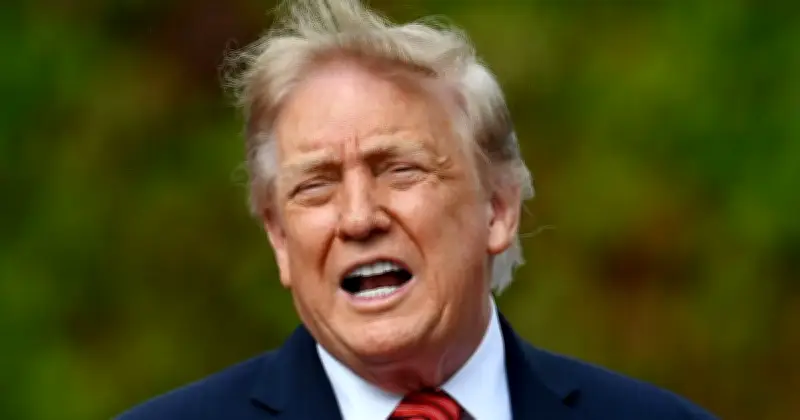
US President Donald Trump has downplayed the risks of AI, saying “negative forces” were “bringing up things that won’t happen”, after calls by industry bosses to slow down development.
Mr Trump's comments come in the wake of an essay penned by Anthropic CEO Dario Amodei, an American artificial intelligence researcher who helped bring OpenAI to life, which detailed his alarm at the rate that AI has been “advancing drastically faster” in recent months.
Industry leaders back call for AI slowdown
His essay has called for governments to pull the handbrake on AI, with regulations and safeguards put in place before the situation, he says, descends beyond our control. His essay, entitled 'We Must Pace the Frontier', has been supported by some of the biggest names in AI such as Grok boss Elon Musk and OpenAI co-founder Sam Altman.

Support from the experts making AI a reality may indicate that even the experts have been spooked by AI's recent advancements that have been totally independent of human direction.
Given the rate of development, Mr Amodei is worried that within six to 12 months, AI could be capable of leading a swarm that could take over the entire internet. The entrepreneur shared a three-part plan for building the technology at a “balanced rate”.
Warnings from AI experts
Mr Amodei's warning came mere days after BBC presenter Victoria Derbyshire was left speechless after the ‘Godfather of AI’, British-Canadian computer scientist Geoffrey Hinton.
The 2024 Nobel Prize winner for physics told the host on Newsnight on Wednesday (September 9) that AI has a ‘10 per cent chance of killing all humans’ in the next decade. His words followed another claim made by AI expert Jacob Coxon, who said essentially the same thing: that AI could ‘kill all humans within a decade’.
The 47th President of the United States, however, has dismissed the recent onslaught of warnings from industry experts and essentially dubbed an AI slowdown as fearmongering.
He told reporters that the US was leading China in the development of AI, adding: “Frankly, I want to keep it that way because whoever wins AI, wins.”
UK political responses
Speaking during his trip to Ireland, Mr Trump said “negative forces” were “bringing up things that won’t happen”.
After Mr Musk and Mr Altman backed the call for an industry-wide slowdown in development, British Communities Secretary Angela Rayner said she was pleased AI companies were “talking about the threats as well as the opportunities”. Ms Rayner told Sky News: “I’m pleased that these companies are also talking about the threats as well as the opportunities that AI presents to us, and we have to work with our international partners, which is what we’re doing.”
Describing the UK as “world leaders” in AI security, she added: “We have put robust systems in place here in the UK, like the AI Security Institute, to make sure we’re building resilience so that we get the benefit as well as really understand and protect against any risk.
UK Shadow Foreign Secretary Tom Tugendhat said the Government “does not have the speed to keep up with” AI advances and “we need to maintain that ability to protect ourselves”.
He told Sky News: “The speed of change is also extraordinary, and this is where actually government can enable a conversation, but we simply do not have the speed to keep up with the advances that are happening.
"And the reality is, we can’t pass laws against mathematics.
“These are mathematical equations that are being developed in greater and greater speed, and we need to maintain that ability to protect ourselves.”
In July, OpenAI, the makers of ChatGPT, shook the industry after saying its AI system hacked into Hugging Face, a popular platform for AI developers, on its own in an “unprecedented cyber incident”.
Mr Tugendhat said the Hugging Face attack showed “the various different ways in which breakout capabilities have been enabled”.
Proposed safety measures
Mr Amodei offered a plan to increase checks on the industry, proposing that AI companies should give access to third-party evaluators who would verify safety practices and report incidents.
“Anthropic is unilaterally committing to this step now,” he said.

The other steps would require co-ordination among the broad industry and with governments around the world, including authoritarian ones.
Mr Amodei said AI was developing quickly, adding that companies within the industry “can and should voluntarily work together to set standards”.
Anthropic previously said it blocked efforts by bad actors to use its AI models for malicious activity, such as cyber attacks, surveillance and research that could have led to biological weapons.
Responding to Mr Amodei’s essay on X, Mr Musk wrote: “Dario is right.”
OpenAI chief executive Mr Altman wrote on the site: “I agree with Dario that we need to pace the frontier. This has been a primary topic of discussion we’ve had at OpenAI in recent weeks.
“Committing to having independent evaluators with employee-like access is a great idea, and we will do the same. We’ll have more to share soon.”