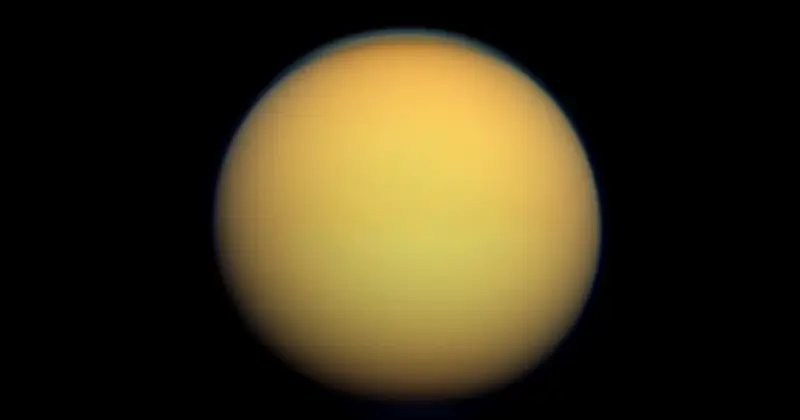
Astronomer Chris Lintott has said the search for alien life should look beyond Mars, with Saturn's moon Titan potentially offering a far more revealing glimpse into the chemistry that could lead to life. Prof Lintott described Titan as the Solar System world he is "so excited" about, highlighting its lakes, rain, seasons and atmosphere – despite the fact that its environment is radically different from Earth.
The Sky at Night presenter said: "Titan is the place, really. It's this world that's quite Earth-like: it rains, it's got lakes, it's got seasons, it's got an atmosphere. But obviously, it's completely alien."
Titan's unique chemistry
Titan is Saturn's largest moon and is the only moon in the Solar System known to have a substantial atmosphere. Rather than water, its clouds and rain are dominated by hydrocarbons, while its surface contains seas and lakes of liquid methane and ethane.
For Prof Lintott, that combination makes Titan particularly important in the hunt for the origins and possibility of life beyond Earth. He said: "It rains hydrocarbons, and the seas have these weird bubbly islands that appear and disappear, and it's a completely alien chemistry.
"I think it's got a lot to teach us."
NASA's Dragonfly mission
The astronomer has a personal connection with the world, recalling how he was at Mission Control when the first pictures were received from the surface of Titan from the Huygens probe in 2005. The European Space Agency probe descended through Titan's thick atmosphere before landing on the moon's surface, giving scientists their first direct glimpse of its landscape.
More than two decades later, NASA is preparing to return with Dragonfly – a nuclear-powered robotic rotorcraft designed to fly between locations on Titan and investigate its surface and atmosphere. Prof Lintott said he was particularly excited about the mission, describing Dragonfly as "a little helicopter that's going to bounce around the surface".
Life's building blocks
While Titan may not harbour familiar forms of life, he believes it could reveal something important about how life emerges. "If we want to learn about life, Titan's sort of right on the edge," he said. "You might get complex chemistry that's a bit like life, but nothing as complicated as a bacteria."
Prof Lintott's comments come as he prepares to speak at New Scientist Live, where he will discuss some of the biggest unanswered questions in astronomy and the discoveries being made with the James Webb Space Telescope.
He also pointed to another major source of potential discoveries – the small bodies scattered throughout the Solar System. The Vera C Rubin Observatory in Chile is expected to transform scientists' understanding of asteroids and other small objects, potentially revealing fossils left over from the formation of the planets.
Prof Lintott highlighted NASA's OSIRIS-REx mission to the asteroid Bennu, which returned samples to Earth that contained amino acids, explaining: "It seems clear that at least the building blocks for life exist in these things." He further suggested that asteroids may have delivered some of those ingredients to the early Earth, saying: "We know they bombarded the Earth early on, so it's possible we got a starter kit. Rather like the life equivalent of taking one of those bags with ingredients right at the beginning of the Earth's time."