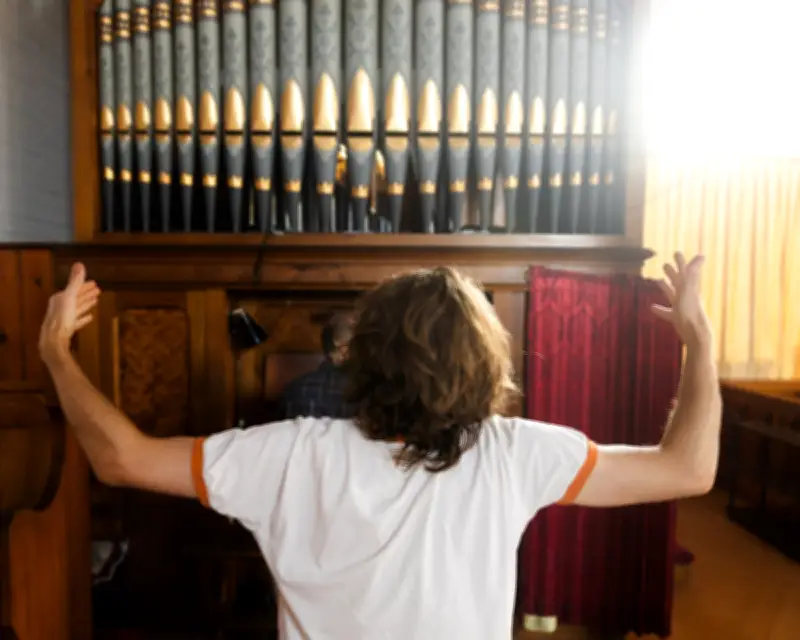
Musician Jake Nicoll appraising the pie organ in St Andrew's Anglican Church in Fogo, Fogo Island, Newfoundland, Canada. Photograph: Noah Bender
Musician Michael Cloud Duguay's new album was born from a mission to capture the sound of the majestic yet increasingly rare instruments.
Michael Cloud Duguay and his band of collaborators were nearing the end of their pipe organ tour of Newfoundland when they encountered a hitch in Aguathuna, a town of about 400 people on a craggy peninsula that juts out from the Canadian island's south-western edge. For the past week, they'd been showing up at old churches in remote communities like this one, preparing their solar-powered mobile studio, and recording instruments both humble and monumental, whose complex systems of keys, stops, hand cranks, foot pedals, bellows and reeds were designed to vibrate the air around them until it approximates the sound of God.

This was all in service of music that was still taking shape in Duguay's mind. It would eventually form the basis of the Ontario composer's new album, Kingdom Come, Kingdom Go, a collection of quietly elegiac pieces that doubles as a sort of audio documentary about Newfoundland's organs and the congregations to which they belong. The music is collaged from recordings that Duguay made on that trip in July 2024, of the organs (which the team documented and will be available as Midi instruments later this summer) but also of church leaders and ordinary congregants talking about their lives, as well as saxophones, flutes and whatever other sounds happened to go by while the tape was rolling. Listening in headphones on a spring day can be mildly hallucinatory: are the bird calls, the rustling wind and the chattering people part of the music or the world outside?
Duguay chats with a church warden as musician Dave Grenon carries speakers into Cupids United church in Cupids, Newfoundland, Canada. Photograph: Noah Bender
When Duguay and his crew got to Our Lady of Mercy, the century-old church in Aguathuna, the locals told them there was no organ there. That came as a disappointment to Duguay, who'd coordinated the visit in advance with someone at the church, though planning the excursion had required such a quantity of cold emails and phone calls to strangers that this crucial detail could have gotten lost in the shuffle. The churches were generally small, with hardly any presences online. Finding them had taken extensive sleuthing; at one point, he was searching through Facebook pages for photos that looked like they might have an organ in the background. 'They were like, 'What organ?'' he recalls, wearing a Grateful Dead T-shirt while speaking from his home in Peterborough, Canada. 'I was like, 'This is what we've been talking about. This is what we're here to do.' And they're like, 'We've never seen an organ in this space.''
Then a teenage volunteer piped up: wasn't there something like that in the balcony? Sure enough, surrounded and covered by old church junk – dusty nativity figurines, outdated hymnals – there was a keyboard and two Leslie cabinets, vintage motorized speakers whose horns spin in circles to better emulate the flutter of air through pipes. This was an electronic organ, unlike the instruments that Duguay and his team had recorded so far on the trip, but an organ nonetheless. They later learned it hadn't been used since the 90s. They set up a couple of microphones for recording, depressed one of the keys and powered it up, hoping for sound.
Duguay experiments with the Hammond organ in the balcony of Our Lady of Mercy Heritage church in Aguathuna, Newfoundland, Canada. Photograph: Noah Bender
What they heard became Pond 1, the first track on Kingdom Come, Kingdom Go. A single note comes on more abruptly than you might expect, given the decades of disuse. It wavers slowly with the movement of the Leslie speakers, then sputters and restarts itself a couple of times. Gradually Duguay depresses another key, and then another, and it grows from one voice into a wistfully ambiguous chord. 'We recorded the sound of this organ coming back to life,' he says. 'There's these outcomes of making records in this way that are so special and kind of sacred to me. I'm never going to hear that exact sound again, and it was an incredible sound.'

Musician Andrew MacKelvie plays the pipe organ at St Andrew's Anglican church in Fogo, Fogo Island, Newfoundland, Canada. Photograph: Noah Bender
Duguay grew up in Catholicism, but his current spiritual practice is a 'self-constructed' one, developed in recovery from a long period of addiction, neglect of music-making, and occasional incarceration. Though he doesn't share his interviewees' Christianity, he wanted to capture the organs within their spiritual and social contexts, just as he might turn a microphone on a creaky floorboard or a dog barking outside to capture the instruments' physical surroundings. Scattered among the drones and arpeggios of Kingdom Come, Kingdom Go are interviews with church members that Duguay conducted while the recording crew was setting up. 'The general question was: 'What do you think is going to happen to these instruments?'' he says. 'And the response, again and again was: 'They're going to stay here forever because this church is going to be here forever.' Because even though not a lot of people are coming to church right now, people are going to come back.'
These people often talked to him about the biblical idea of the remnant: a small community of believers who remain faithful as the rest of the world turns its back on the church. 'We were seeing these remnants of two or three elderly people working in these churches, diligently maintaining them daily, painting everything, and as soon as they're done, they just start again,' he says. 'It's all this idea of service to their community, service to God and service to the people who have not yet arrived. These spaces are uniquely forward-looking.' With the climate crisis and totalitarianism raging, one needn't be a believer to be moved by their optimism.
MacKelvie plays saxophone while Dugay listens in the sanctuary of St Stephens Anglican church, Greenspond Island, Newfoundland, Canada. Photograph: Noah Bender
Duguay, whose background is in punk and indie rock, is not a trained organist. He had never touched one before starting work on Kingdom Come, Kingdom Go. His willfully simple approach to the instrument is best illustrated by a track called Damnable Island. For six and a half minutes, you hear a note that flickers and warps as it sustains, an effect the composer attained by recording an E flat on all seven of the organs he visited and layering them atop each other. Some of the instruments were in perfect tune; others hadn't been maintained for years. The micro-variations in their pitches contribute to a sound richer and stranger than any one could produce on its own.
This was typical of Duguay and his team's process: they were always recording material without knowing precisely what they'd do with it, or how it would interact with other organs they hadn't heard yet. Sometimes, they didn't know for sure whether the other organs existed at all. In a way, the experience of recording Kingdom Come, Kingdom Go helped Duguay to be more like the people whom the album is about. 'We had to think about how to arrange the music if we wanted multiple organs on the same piece,' he says. 'OK, we're gonna record these next parts on either the organ we encounter tomorrow or the day after, and we're just going to have to accept whatever that is.' We couldn't even guess what they were going to sound like. We just had to practice a sort of faith.'
Memorial United church in Bonavista, Newfoundland, Canada. Photograph: Noah Bender
Kingdom Come, Kingdom Go is out on 10 July.