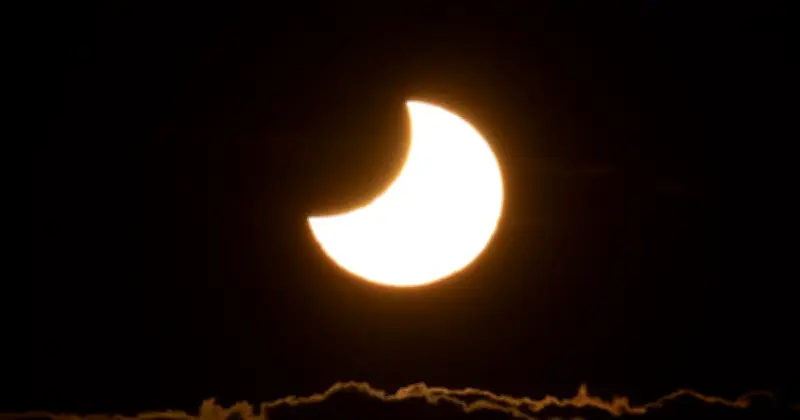
Millions of people across the UK are expected to look to the skies next week as a rare partial solar eclipse will transform the horizon. But experts have issued an important warning ahead of the celestial event to ensure people do not do permanent damage to their eyesight.
The partial solar eclipse will be visible across the UK on Wednesday, August 12, with those in south-west England expected to see the greatest proportion of the Sun covered by the Moon. According to Royal Museums Greenwich, it will be the greatest amount of solar coverage visible from the UK and Ireland since the famous 1999 eclipse.
Health officials have warned that even cloudy skies do not make it safe to look directly at the Sun during the eclipse, urging people to take the necessary precautions.

Where will the eclipse be visible?
The partial solar eclipse will be visible across the whole of the UK, although the best views are expected in south-west England, where the Moon will cover the greatest proportion of the Sun.
The eclipse is expected to begin at around 6.15pm on Wednesday, August 12, reaching its maximum between 7.05pm and 7.15pm, before ending shortly after 8pm, although exact timings will vary depending on location.
As many people are expected to spend time outdoors waiting for the event, NASA is also reminding skywatchers to wear sunscreen, a hat and protective clothing to protect themselves from ultraviolet radiation while enjoying the spectacle.
Why experts are warning people
The UK Health Security Agency (UKHSA) has warned that although the Sun appears dimmer during a partial solar eclipse, it remains dangerous to look at without appropriate eye protection.
The agency says the reduced brightness can override the body's natural reflex to look away, allowing harmful solar radiation to damage the retina without causing immediate pain.
Following the 1999 total solar eclipse, the Royal College of Ophthalmologists reported around 70 cases of people experiencing vision problems, with around 40% having looked at the Sun for less than a minute.
Experts say 'do not' rely on sunglasses
Health experts are also warning people against using ordinary sunglasses to watch the eclipse. During a partial solar eclipse, the Moon moves between the Earth and the Sun, blocking part of the Sun's face but never covering it completely for observers in the UK.
The UKHSA said: "Ordinary sunglasses – no matter how dark – do not provide adequate protection for viewing a solar eclipse."
It explained that while sunglasses reduce glare and make it feel more comfortable to look towards the Sun, they still allow harmful solar radiation to reach the retina.
NASA has issued similar advice, stressing that standard sunglasses should never be used in place of certified eclipse viewers. The space agency says it is never safe to look directly at a partial solar eclipse without proper eye protection because part of the Sun always remains visible.
Never use cameras or binoculars
NASA has also warned people not to look at the Sun through cameras, telescopes or binoculars while wearing eclipse glasses. The space agency said the concentrated rays of the Sun can burn through eclipse filters and cause severe eye injuries if optical devices are used without the correct front-mounted solar filters.
It advises anyone planning to use cameras, telescopes or binoculars to seek expert advice and ensure the correct solar filter is securely fitted to the front of the equipment before observing the eclipse.
Experts also recommend checking eclipse glasses before use and discarding them if they are torn, scratched or otherwise damaged. Children should also be supervised when using eclipse viewers to ensure they are worn correctly throughout the event.
How to watch the eclipse safely
Experts say there are two safe ways to view the eclipse. People who want to watch it directly should only use genuine eclipse glasses or handheld solar viewers that comply with the international safety standard ISO 12312-2:2015(E).
The UKHSA advises buying eclipse viewers from reputable retailers and says anyone unsure whether a product is properly certified should not use it. It also recommends avoiding eclipse glasses if the lenses are scratched, torn or otherwise damaged.

Anyone without specialist equipment can instead use indirect viewing methods, including a homemade pinhole projector, projecting the Sun's image onto paper, or observing crescent-shaped projections created through the holes of a kitchen colander or gaps between tree leaves.
The Royal Astronomical Society has also published practical guidance on safe ways to observe the eclipse using indirect viewing techniques.