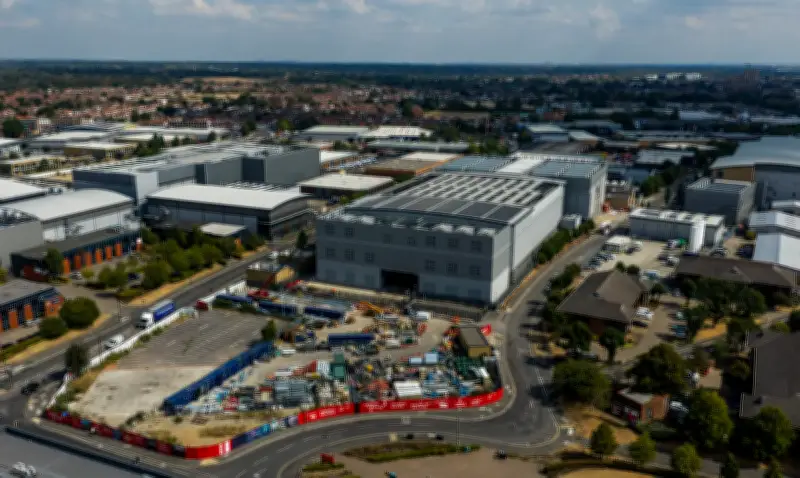
Slough, a town 20 miles west of London, has become Europe's largest data centre hub, with 40 facilities in and around the trading estate as of 2026. But residents are pushing back, forming a campaign group to protest the continued expansion.
Why Slough?
Geography plays a key role in Slough's appeal. Its position gives operators easy access to the City and Canary Wharf while offering more space than areas closer to London. The town sits directly on top of the internet fibre-optic cables that run across the Atlantic from the US, through Ireland and the UK to mainland Europe.
Slough borough council's planning documents highlight the combination of proximity to London, fibre infrastructure and resilience, and available land. "Strategically, it's one of the most important areas in the world," James Tyler, UK managing director of data centre giant Equinix, told the BBC.
On a global scale, the Berkshire town is second only to Ashburn, Virginia, as a data centre hub. The facilities handle everything from cloud computing to financial transactions and generative AI.
Residents organise
A campaign group, Slough Against Data Centres, has been protesting the arrival of big tech. Dr Ambily Banerjee, a former research fellow at University College London who moved to pharmaceutical giant GSK, founded the group after becoming worried about the impact on residents and the environment.
"We have almost 40 data centres and more planning applications are being submitted," she says. "We are simply asking the council to conduct a cumulative assessment of their impact. I love Slough — it has so much going on, it's diverse and there's a real community here. It would be a shame if that was lost."
Banerjee says she acts as a voice for residents, many of whom "don't have the time or resources to ask burning questions". She adds: "We're concerned about the 'heat island impact', on noise pollution and the possibility of long-term health issues on residents, such as pollutants being pumped out into the air by diesel generators. These power-guzzling centres use a lot of water too. And they're being built on green-belt land."
Local concerns and official responses
John and Linda Willis, former television engineers, moved to the outskirts of Slough in 1982. They live near where Microsoft is planning to build a data centre in the former Langley business centre, a 17-acre site close to the Elizabeth line and Windsor College. Consultation is ongoing, and the proposals were discussed at a council meeting on September 24.
"Is there really nowhere else to build these structures, somewhere a little farther away from people?" asks John. "For a long time, there were building works happening behind my home. They've finished now and the geese have returned. I can hear the birds, the rustle of the grass. I don't want to hear the whir of a data centre. And where is all this energy coming from to power them? It seems to me like we're building for the future, but killing the present."
A Microsoft spokesperson said: "Microsoft is working closely with local authorities and residents through an ongoing community consultation and we welcome their feedback through our drop-in sessions and website."
A spokeswoman for Slough borough council said neither electrical nor water supplies would be affected by new data centres. "The council is of course mindful of the potential environmental impacts of data centres within the borough, as we are of all industries and developments, and must, and do, consider them at great length when proposals are presented to us," she said. "We thoroughly assess proposals and seek to mitigate and ensure the best environmental (and wider) benefits associated with these developments."
She added: "We are also incredibly aware of the Government's position which supports the significant growth of this industry, having recently made the decision to approve a hyperscale data centre in the east of the borough which we remain disappointed with."
The hyperscale data centre was approved in June. Developer Manor Farm Propco Limited will use a 20-acre green belt site in Slough for the project, which includes battery power storage and a generator. Planning minister Matthew Pennycook, who made the decision on behalf of then housing secretary Steve Reed, cited the need for development, a lack of suitable alternative sites and "the needs of the market" as significant in approving it.
The Labour government plans to triple data centre output by 2030. There are already 500 in Britain, with one in 10 in Slough Trading Estate. Campaigners face a difficult task as Slough appears set to host much of the nation's data in the internet age and with AI booming.