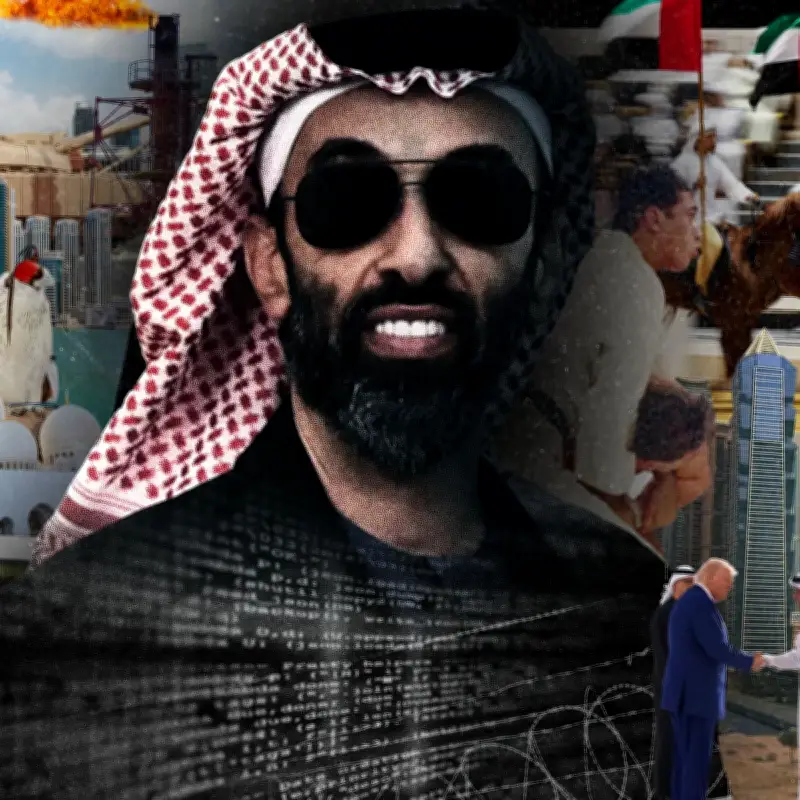
Sheikh Tahnoon bin Zayed Al Nahyan, the UAE's royal fixer, reclusive spymaster and financial behemoth, has amassed an economic empire estimated to be worth about $1.5tr, as large as the entire economic output of Indonesia or Turkey. Now, as one of the most important AI financiers on the planet, he is rapidly embedding himself within the infrastructure that will underpin our digital future: its information pipelines and its microchip foundries, its datacentres and the enormous energy plants needed to power and cool them.
Tahnoon, who never gives substantive interviews and prefers to remain in the shadows, oversees the country's largest sovereign wealth vehicle, First Abu Dhabi Bank, its largest lender, and Alterra, the biggest climate investment fund in the world. In the UK alone, he oversees healthcare providers and property giants, and controls investments in public utilities such as Thames Water.
From jiu-jitsu student to family powerbroker
In the early 1990s, a young man calling himself Ben enrolled in a Brazilian jiu-jitsu academy in San Diego, California. His classmates assumed he was a butler or bodyguard to a rich Englishman. After more than a year of training, Ben revealed he was returning to Abu Dhabi, and later invited his instructors and classmates to the UAE, where they discovered his father's face on billboards and banknotes. The training centre he established was one of his family's palaces.
Tahnoon, who really did enrol in the class under a pseudonym and went on to become a jiu-jitsu black belt, grew up as one of the bani Fatima, the sons of Sheikh Zayed bin Sultan Al Nahyan's third wife. Following Sheikh Zayed's death in 2004, Tahnoon's reputation as the UAE's top money man grew. He founded the Royal Group, now worth $300bn, and took on the role of national security adviser, becoming the country's spymaster-in-chief.
Security empire and Project Raven
Tahnoon's security apparatus has been linked to enforced disappearances, secret detention sites and reprisals against dissidents. In 2018, British academic Matthew Hedges was arrested at Dubai airport, accused of spying, and sentenced to life in jail after a five-minute hearing with no defence lawyer present. He was later granted a royal pardon. Hedges said he was subjected to interrogations lasting up to 15 hours a day and threatened with rendition. The UAE government insisted he received proper care and was never tortured.
Under Tahnoon's stewardship, Project Raven, a digital wiretap operation staffed by former US National Security Agency spies, scaled up its hacking and surveillance activities. It targeted dissidents, journalists and politicians worldwide. In 2019, a Reuters investigation exposed the operations, and Tahnoon officially shut down DarkMatter, the state-linked company that ran it.
G42 and the AI revolution
Tahnoon then refashioned DarkMatter's ruins into G42, an AI-focused company named after the number 42 from Douglas Adams's The Hitchhiker's Guide to the Galaxy. G42 aims to build an "intelligence grid" - AI as foundational infrastructure like water or electricity - growing out of a nation state's intelligence apparatus. Its marketing promises "real-time threat defence" and predictive tools encompassing "suspect profiling" and "behavioural analysis".
Microsoft has invested $1.5bn in G42, and its vice-chair Brad Smith sits on the board. G42 and its specialist AI investment fund are investors in or partners of Anthropic, xAI and OpenAI. Sam Altman, OpenAI's CEO, calls Tahnoon "a dear personal friend". G42 denied that its origins lay in cyber-espionage, stating it "was established as an AI and technology company focused on cloud and AI infrastructure" and operates under applicable laws.
US ties and global ambitions
Donald Trump has hosted state banquets for Tahnoon and reversed a Biden-era restriction on AI chip exports to the UAE, authorising the transfer of hundreds of thousands of advanced chips. The deal was announced two weeks after one of Tahnoon's investment vehicles acquired $2bn-worth of cryptocurrency issued by World Liberty, a Trump family company. Senator Elizabeth Warren called the entanglement "corruption, plain and simple". The White House and World Liberty denied any connection.
G42 is constructing an AI campus on the UAE's coastline with a projected 5GW power capacity, up to 250 times the size of the largest hyperscale datacentres today, and is helping to finance a $500bn rollout of new datacentres in the US. The company has acquired several construction firms involved in the project.
Concerns over surveillance and control
Critics worry about the concentration of AI infrastructure in the hands of a man with a police state's arsenal. Ahmed Mansoor, an Emirati dissident, was hacked via a malicious email attachment that sent his private data to a server registered to Sheikh Tahnoon's personal office. He was sentenced to 10 years in jail and remains in solitary confinement in al-Sadr prison, located about 10 miles south-west of G42's AI mega-campus.
Ronald Deibert, founder of The Citizen Lab, said: "For the last 20 years, democracy has been in decline. That happens to coincide with an enormous expansion of digital surveillance capabilities for both commercial and national security purposes. The epicentre of a lot of this is the UAE. And where do all roads lead in the UAE? They lead to Sheikh Tahnoon."
In February, Tahnoon chaired a board meeting at G42's AI investment fund on the night the Iran war began. Tehran bombed two AI datacentres in the UAE and published a list of "legitimate" military targets including US tech company offices. By mid-June, Tahnoon had reportedly struck an agreement providing billions of dollars for the Iranian government and bringing Iran's strikes to a halt. The US commerce department then removed the last export controls on advanced AI chips to Abu Dhabi.
His daughter, Sheikha Fatima bint Tahnoon, signed a memorandum of understanding with G42, suggesting she is being primed to assume a commanding role in the UAE's tech-security empire. Tahnoon himself stayed far from the public eye, having outmanoeuvred his doubters once again.