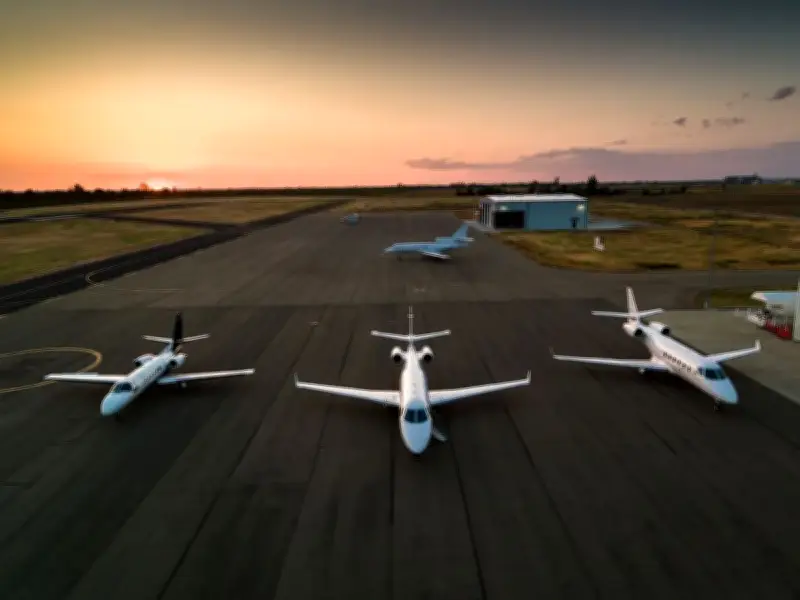
Private jets can be up to 30 times more polluting than commercial air travel per person, but experts say an outright ban is not the most effective solution. Instead, they suggest market-based measures like landing fees and tax reforms.
Emissions comparison
Stefan Gössling, professor of Tourism Research at Linnaeus University and Human Ecology at Lund University, told the Daily Star: "Comparison in emissions is possible at the systemic level, where private air transport is 15.6 Mt CO2 (direct) compared to about 800 Mt CO2 from commercial (for the year 2023)."
Alethea Warrington, Head of Aviation, Energy & Heat at We Are Possible, says private jet emissions are "a relatively small proportion of total aviation emissions" - around half a million tonnes in the UK, compared with roughly 39 Mt for UK aviation overall.
Inequality and short flights
Prof Gössling points to the extreme inequality of the footprint: "An hour of flying private can emit more than an average human per year (all activities)." Ms Warrington puts it even more bluntly on the efficiency gap: private jet flights can be "up to 30x more polluting than ordinary commercial flights, due to the incredibly low occupancy rates."
Many private jet journeys are short - sometimes absurdly so. We Are Possible’s 2025 report found the most common UK private-aviation route in 2022 was London to Paris, despite the Eurostar link. She said: "The shortest used UK route for private aviation with 10 flights or more is… Farnborough and Blackbushe - a mere 7.41 km away. Those passengers could cycle that!"
Ban vs market measures
A ban would cut a chunk of luxury flying - but some passengers would switch to commercial flights, rail or car. Ms Warrington argues the net benefit would still be meaningful because private flights are so carbon-intensive and so often replaceable. She said: "Most of these flights are to destinations that are very well served by other transport modes, e.g. Eurostar."
Nevertheless, the experts are sceptical that an outright ban is the most achievable lever. "I am not sure bans are ever realistic or effective," Prof Gössling said. "I believe in market-based measures, however."
Pricing and tax
His preferred option is sharp, simple pricing at the point of use. He explained: "Landing fees. If there were landing fees at a level of say €5,000 (£4,300), we'd see a significant decline… as these are often used as taxies for distances that can be replaced with cars - or even fly empty as shuttles."
Ms Warrington also focuses on tax - especially because private flyers currently pay remarkably little relative to the luxury cost. She says: "Private jets pay zero tax on their fuel, unlike ordinary drivers who have to pay tax on fuel for their cars." Her group’s research found private passengers can pay far less Air Passenger Duty as a share of ticket price than economy travellers: roughly "0.1–0.8% for a private flight from London to Paris, versus the 54% APD paid on a cheap economy fare on the same journey."
Prof Gössling added: "I cannot see that there would be any dramatic consequences economically - though I am sure the wealthy will beg to differ." Warrington argues most of these flights are "largely to leisure destinations" and "aren't for business travel or to create jobs".
Exemptions and fairness
As for exemptions - medical, emergency, heads of state - both point to political choices. Prof Gössling says it’s "up for politicians to decide, or society". Warrington notes that the existing APD structure already exempts "medical, humanitarian and emergency services".
Ultimately, both return to the politics of fairness. Prof Gössling argues public debate often "bows to the wealthiest' importance". He added: "We all need to live in balance climatically, not just some of us." He also warns private aviation is only part of the luxury-emissions ecosystem. He said: "Superyachts consume far greater amounts of fuel, and they are often served by [private aviation] - i.e. used by the same people."