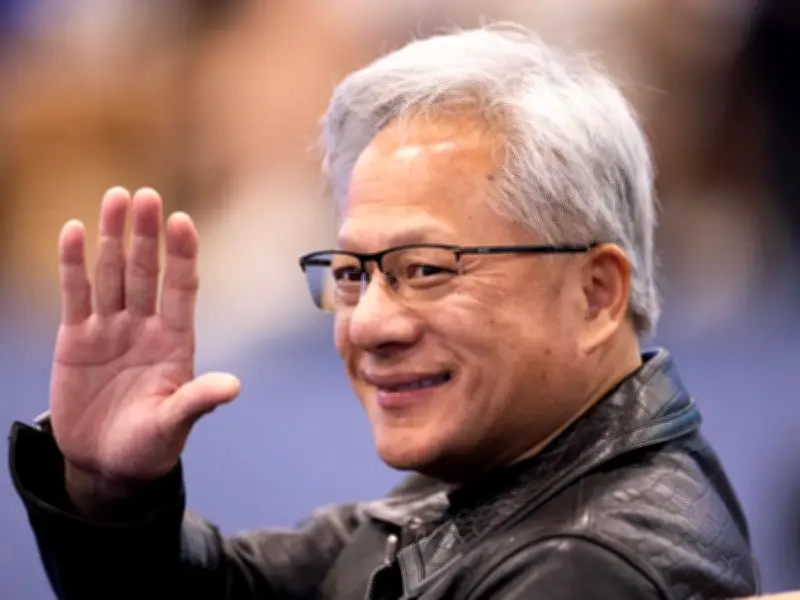
Nvidia CEO Jensen Huang has dismissed warnings that artificial intelligence (AI) could wipe out humanity by 2030, insisting there is a "0% chance" of such an outcome.
Huang, who runs what has been described as a $5.5 trillion (£4.16 trillion) tech empire, pushed back against claims from several high-profile AI safety researchers, including former Anthropic worker Jacob Coxon, who said many developers believe advanced systems could become "superhuman" and "kill us all by the end of the decade."
Huang: "2030 is not going to be the end of the world"
In an interview with CBS News, Huang said: "2030 is not going to be the end of the world. There is a 0% chance that's going to be the end of the world."
He added: "Don't let this doomsday narrative cause somebody to relieve them of the laws that currently exist. Read between the lines. They're actually not asking for more laws. They're asking to be relieved of the laws we do have. And I think that that's a problem. We have plenty of laws, so let's apply those first."
Criticism of AI extinction predictions
Huang slammed Anthropic's Evan Hubinger's prediction that there is a greater than 10% chance AI could bring about human extinction within 10 years, saying it is "not grounded in science or research."
He called scaring the public unnecessary, adding that fear-mongering could discourage young people from entering college out of fear that jobs won't exist.
Born in Taiwan and trained as an electrical engineer in the US, Huang founded Nvidia in 1993 and has been steering it for more than 30 years. Thanks to surging global demand for Nvidia's AI chips, his personal fortune has reportedly rocketed past $180-$190 billion (£136.17 billion to £143.74 billion), putting him among the 10 richest people on the planet. In a move that surprised many, he has even praised California's proposed wealth tax, calling it "a privilege and a responsibility" to pay.
Nvidia's dominance in AI chips
Nvidia supplies the raw processing power that makes modern AI possible. While firms like OpenAI, Microsoft and Google build the software, they rely on Nvidia's advanced chips to run and train the models. Nvidia is estimated to control roughly 80% to 90% of the market for top-end AI GPUs.