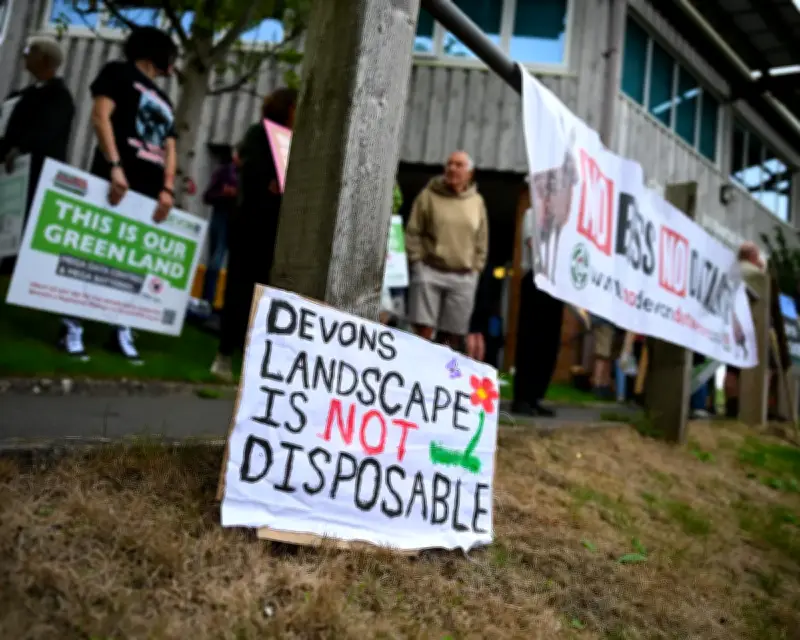
A planned hyperscale AI data campus in the middle of a globally protected landscape in north Devon has sparked a fierce local backlash. The proposal by the British company Xlinks would house a 1.5GW AI datacentre, one of the largest in Europe, and a 1.8GW battery energy storage system (BESS) on about 344 hectares (850 acres) of countryside in the Unesco biosphere reserve around Great Torrington.
Community campaign and tactics
The campaign against the project has drawn in tens of thousands of people, uncovered what campaigners say is evidence of secret deals, and adopted tactics used by activists in the US such as Erin Brockovich. A recent public meeting in Great Torrington was hosted by Elizabeth Humphreys of the US campaign group Not in My Valley, who was behind achieving a permanent datacentre ban in Coachella, California.
“We’re fighting the largest companies that have ever existed in the world, and that is scary but we are all fighting this together,” Humphreys said. “This is a global issue; we are all connected. People across the world are standing up and fighting back.”
Secret discussions and FoI findings
The proposal was first announced to the public this summer, but documents released under freedom of information (FoI) requests revealed the company had been in closed discussions with council officials since March 2025. In April, the council issued a letter of “in-principle support” before any environmental statement or public consultation, and more than a year before the proposal was made public.
Torridge district council told the Guardian the pre-application process was standard practice and confidential, and was not confirmation of any proposal. FoI requests also uncovered a detailed site plan not released to the public, showing the two largest buildings would measure 335 metres by 267 metres and cover approximately nine hectares (22 acres) of ground footprint each.
Emily Clark, of the Devon Datacentre and BESS action group, said: “Email exchanges and private meetings spanning the past 18 months reveal some officers treating the project as a foregone conclusion. Community frustration is understandably at boiling point.”
Scale and environmental concerns
The campus would also house a 1.8GW BESS involving 1,720 containerised units, dwarfing the largest operational BESS currently in Britain, such as the 100MW Bramley facility in Hampshire. The UK urgently needs vast BESS facilities to balance electricity supply and demand as wind and solar power generation increase, but research by the House of Commons Library shows the government does not hold data on projected land use, has no specific policies for their location, and has no definitive estimate of the number of operational BESS facilities or their current total capacity.
Those rallying against the proposal cite its proposed location in a globally protected environment, water consumption, wastewater runoff potentially containing toxic Pfas, air pollution, high background noise, safety and fire risks associated with the BESS, and the industrialisation of open countryside. After the hottest summer on record, north Devon remains under a hosepipe ban.
Xlinks says the data campus will be self-sufficient in water terms, recirculating it to absorb heat and topping up mainly from rainwater. But an FoI answer revealed that under extreme conditions, annual water consumption could reach approximately 2.9bn litres. Xlinks told the Guardian that the design on which that estimate was based had been superseded by a new design to be released during public consultation.
Political and community response
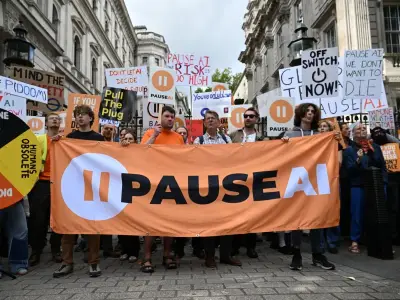
In the last few weeks 30,000 people nationally have signed a petition launched by Cheryl Cottle-Hunkin, the cabinet member for rural affairs for Devon county council, calling on the government to pause all datacentre and BESS plans outside designated AI growth zones. “Proposals like this outside AI growth zones are highly problematic, because they may seek to evade regulation and government scrutiny,” said Cottle-Hunkin.
Community tensions erupted this week when protesters rallied outside a Torridge district council meeting. Doug Bushby, the chair of the council, responded by threatening to call the police over “unsubstantiated and unfounded allegations, abuse, harassment and intimidation”. Meanwhile, PR agents for Xlinks are contacting parish councils for private conversations; Monkleigh parish council refused an invitation to a closed meeting with Coast Communications on behalf of Xlinks.
Xlinks said in a statement its £13.8bn AI and BESS project would bring significant economic investment, between 600 and 1,200 jobs and clean energy infrastructure to the region. “We will ensure that the Devon data campus is designed sensitively for local people and the environment,” the company said. An environmental impact assessment was under way, and a spokesperson for the Department for Energy Security and Net Zero said the government had commissioned the national energy system operator to develop the first ever strategic spatial energy plan.