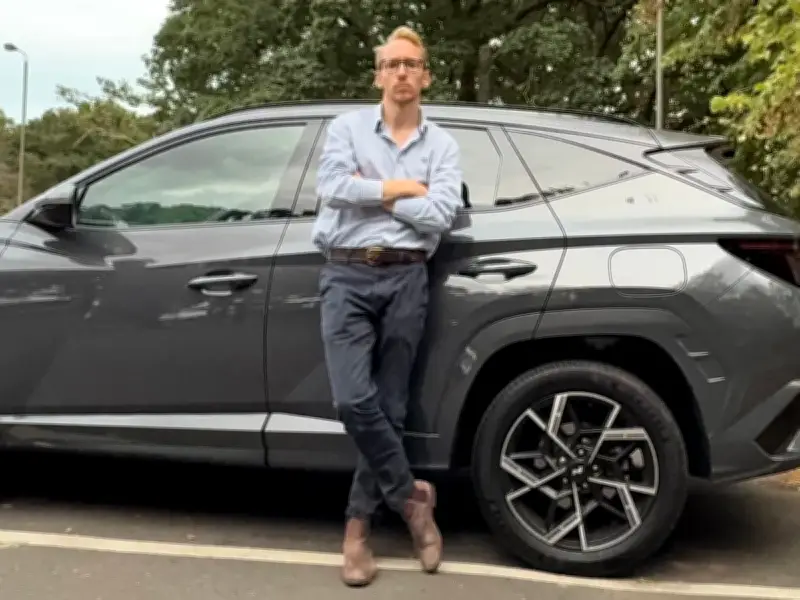
Christopher Sharp has tested the Hyundai Tucson N-Line against its top-selling SUV rivals, the Kia Sportage and Nissan Qashqai. The Nissan Qashqai emerged as the winner with a score of 8/10, beating the Sportage and Tucson, which both scored 7.5/10.
Hyundai Tucson N-Line Review
The Hyundai Tucson is a hybrid SUV measuring 4.5m in length and approximately 1.8m in width. It features a 1.5 litre four-cylinder engine delivering 235bhp and 265Nm of torque, capable of accelerating its 2,190kg mass to 62mph in slightly over eight seconds. The interior accommodates five occupants with 616 litres of luggage capacity when the seats are upright and 1,795 litres when folded.
The Tucson features haptic touch pads controlling the air-conditioning and heated seats, complemented by a sizeable touchscreen above and a handful of physical shortcut buttons, plus additional controls on the steering wheel. The steering wheel remains traditionally circular, eschewing the flat-bottomed design found on the Sportage. Positioned ahead of the main dashboard are two USB-C charging ports, two cupholders and a wireless charging pad.
On the road, the N-Line proves itself a capable motorway companion, with the hybrid system transitioning between electric and petrol power more smoothly than its Sportage rival. Engaging Sport mode is something of a superfluous exercise, as the car handles it admirably but it's wholly unnecessary. For an SUV with sporty pretensions, it's impressively comfortable in standard mode, offering ample rear seating for three adults and a boot capacious enough to accommodate their luggage.
Kia Sportage Assessment
The Kia Sportage, priced at £31,395, was previously evaluated by Sharp against the Ford Puma. His assessment was that the Sportage performed considerably better than its American competitor. In this comparison, the Sportage was defeated by the Qashqai by half a point.
The Sportage featured a welcoming and family-oriented cabin with physical controls to complement the touchscreens and supportive seats to offset the angular steering wheel. While driving, its angular posture meant it felt secure yet agile. Its powertrain in sport mode felt somewhat vocal, but it was otherwise a relaxed drive on motorways and country lanes. It proved capable and visually distinctive, simply not Sharp's preference between the two.
Nissan Qashqai Verdict
The Nissan Qashqai, priced at £30,635, is the SUV that sparked a transformation two decades ago with the Mk1 model. It remains a formidable proposition, proving straightforward to get accustomed to, simple to master, effortless to handle and uncomplicated to use.
This was the SUV in which Sharp felt most comfortable most quickly. Similar to the Sportage, it boasted athletic styling yet maintained a laid-back character; one-pedal driving while on the move through its hybrid technology was remarkably easy. It was that hybrid technology which gave it the edge over the Sportage and competitors from Ford and Jaecoo. The vehicle felt somewhat more practical overall, which offset the marginally budget feel of the cabin when compared to the more upmarket Sportage.
When comparing the Qashqai against the Tucson, the Tucson variant tested was aiming for a sportier character than the Nissan, which wasn't. Given this context, the Nissan was always likely to deliver superior comfort overall, which it does. Regarding practicality, they're virtually level being comparable in size, though the Nissan still edges ahead thanks to its marginally superior hybrid technology.