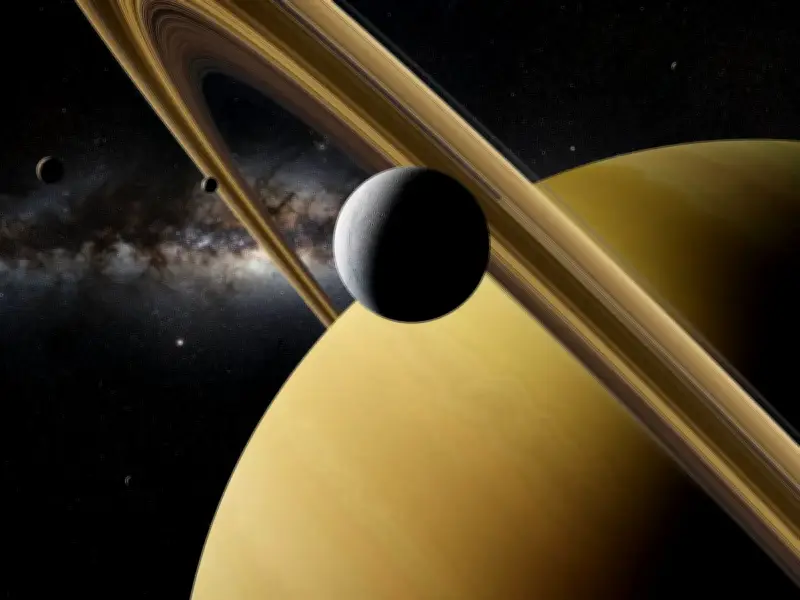
One of Saturn's icy moons could be harbouring life within its vast subterranean ocean, according to remarkable new findings that could completely transform our hunt for extraterrestrial life.
Scientists have long known that Enceladus contains liquid water beneath its frozen surface, yet until recently, experts believed conditions were far too severe for microscopic life to survive. Now, however, researchers have successfully replicated the chemical conditions and discovered that a deep-sea microorganism found on our very own planet could withstand such an apparently inhospitable environment.
Microorganism withstands moon's conditions
Methanothermococcus okinawensis is typically found near deep-sea hydrothermal vents in the Pacific Ocean, where it feeds on carbon dioxide and hydrogen while producing methane.
Groundbreaking research conducted by German scientists at Freie Universität Berlin has demonstrated that these microorganisms could indeed survive within the moon's subsurface ocean, which is known to contain complex organic molecules, reports the Express. The research team drew upon data gathered by NASA's Cassini spacecraft and a series of laboratory simulations.
Geological activity could aid search
The scientists also propose that the geological activity on Enceladus could prove crucial in the ongoing search for life. By separating and concentrating organic materials, such activity could help researchers identify potential life forms during future exploratory missions.
This prompts a further question beyond whether organisms could exist there: how might evidence of such life actually be identified. The findings address both the potential for a habitable environment and the possibilities for its investigation.
Implications for future missions
The ocean's chemical composition is fundamental to the question of survival, while the concentration of organic material could prove relevant to efforts to find signs of life. Combined, the studies question assumptions about the icy moon's inhospitable conditions without confirming that it harbours life.
Their importance rests in indicating that microbial survival may be feasible and that the moon's own geological activity could assist the search. Future missions could draw on these discoveries when exploring Enceladus. For the time being, the findings bolster prospects for discovering extraterrestrial life while leaving unanswered the crucial question of whether any actually exists in the moon's concealed ocean.