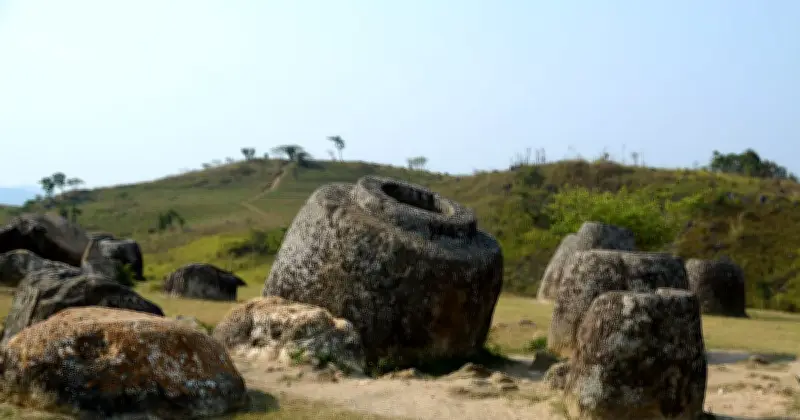
Archaeologists have uncovered the intact, unburnt remains of 37 people inside a massive 1,000-year-old stone jar in Southeast Asia, a discovery that challenges long-held theories about the ancient site's purpose.
Stunning find in Laos
The Xieng Khouang Plateau in northern Laos is known for its Plain of Jars, a landscape dotted with thousands of megalithic stone vessels. Previously, researchers suspected the jars were used in cremation rituals, based on findings of ash and charred bones.
However, during an extensive dig between 2022 and 2024, a colossal four-foot-high, seven-foot-wide container known as "Jar 1" yielded something unexpected: the remains of 37 people, showing no signs of burning.

Generations used the same site
Dating techniques suggest the jar was actively used between A.D. 890 and 1160, indicating that generations of ancient people returned to the same site over several centuries.
Nicholas Skopal, an archaeologist and lead author of the study, expressed his excitement: "We were very excited because it was the first time we found non-burnt bones inside a jar," according to National Geographic.
Artefacts and offerings
Inside the vessel, large bones and skulls were carefully arranged around the edges. Excavators also found an iron knife, a copper bell, and intricate glass beads, which experts believe were placed as funerary offerings or necklaces for the deceased.
Despite the breakthrough, the mystery is far from solved. Kelly Brandão, an archaeologist with the University of São Paulo and the Mamirauá Institute, noted: "We can't know for sure if the vase was really made with the burial objective in sight. This finding alone would be astonishing, but it would be equally astonishing to find out they were made for other uses."
A complex burial process
Skopal's working theory suggests the site was part of a multi-stage burial process: bodies were initially placed in individual vessels to decompose, then the bones were collected and packed into the larger central jar as a communal ossuary.
However, the jar contained significantly more human teeth than skulls, a major anomaly. "That's a really interesting factor," Skopal added. "We have no idea of who these people were and where they lived. The problem is getting DNA [at the Plain of Jars] is really hard due to the tropical climate - but fingers crossed!"