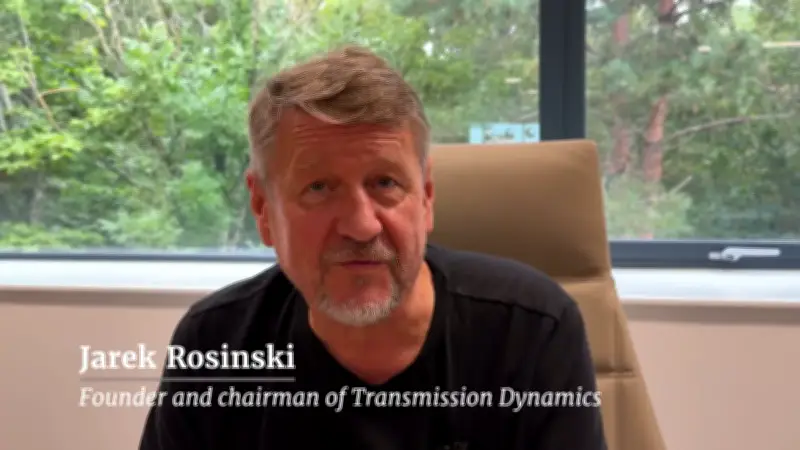
Transmission Dynamics, based in Northumberland Business Park in Cramlington, is spearheading the North East's 'new industrial chapter' through its work with artificial intelligence and advanced robotics. The company, inspired by the region's industrial heritage, has become a leading force in its field.
Company origins and growth
Founded in 1996 by Professor Jarek Rosinski and originally named JR Dynamics, the company first did specialist engineering consultancy work associated with Newcastle University. After a home office expansion in 2001, Rosinski established a new identity and location for Transmission Dynamics in 2006 in Cramlington, where it remains today.
In the decades that followed, an increase in consultancy contracts, investment into product development, and financial support from grants allowed for the design and construction of 1 Innovation Way, the modern £4.5million headquarters of the company.

Partnerships and accolades
Partnerships with Network Rail and institutions in the USA, Australia, and India have taken the reach of the company to a new level. Transmission Dynamics has received accolades such as The King's Award for Enterprise for Innovation and was a finalist for the Royal Academy of Engineering's 2026 MacRobert Award, often referred to as the Nobel Prize for engineering.
Chairman Professor Rosinski said: "Transmission Dynamics develops sensors, electronics, software and artificial intelligence for demanding sectors including rail, defence and power generation. We give machines the ability to sense what is happening to them and around them, interpret that information and warn people when something important is developing - ideally before a failure occurs."
Practical AI applications
An example of the company's work is the rail industry, where its PANDAS-V roof-mounted AI camera system monitors train pantographs and overhead line equipment, alerting the right people if a fault may occur. This practical application of AI, known as edge processing, is a large part of the work Transmission Dynamics does.
Rosinski said: "Railway maintenance has traditionally depended heavily on skilled people physically inspecting assets on or alongside the railway. That expertise will always be essential, but we can now give those engineers far better information before they go out."
He added: "If a train travelling every day can effectively inspect the infrastructure as it goes, recognise something unusual and tell an engineer exactly where to look, that completely changes what is possible. For us, that is the exciting part of artificial intelligence, it is not AI for its own sake, it is about making difficult industries safer, more reliable and more efficient."
Zomet the humanoid robot
In recent weeks, a humanoid robot named Zomet, bought by the company as an experimental platform, has captured attention on social media. The project, in its very early stages, has been described as a "blank canvas" in the form of the advanced robot.
Rosinski said: "Much of our existing work is about giving machines senses and intelligence. Zomet presents a fascinating new question: what happens when that intelligence is given arms and legs? We want to teach him to see, understand and respond to the world around him. Ultimately, we want to discover whether machines like Zomet could undertake useful, clearly defined tasks in environments that are dangerous, difficult or simply impossible for people."
With the work the company does already putting the region in pole position to push boundaries on practical uses of AI, and this technology making a significant difference in the lives of people in the North East, Transmission Dynamics is set up for an exciting future.
Professor Rosinski added: "The North East has reinvented industry before, we should have the confidence to do it again. We are not interested simply in watching the future arrive. We want to have a hand in building it."