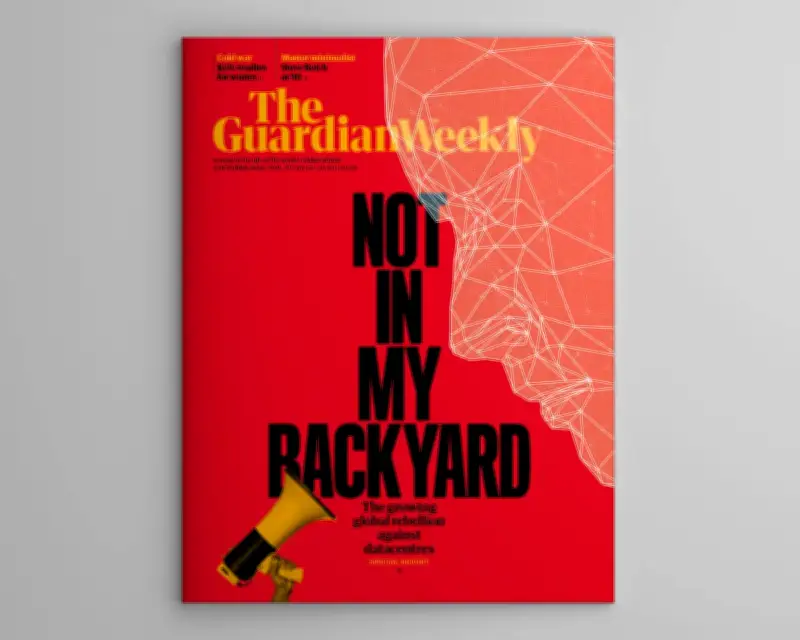
As alarm bells ring louder over the potentially existential threat of rapid AI development, people far from Silicon Valley debates about the future of the artificial intelligence revolution are voicing more immediate, tangible worries about the construction of the vast datacentres that power these entities. This week's cover story, written by economics and political writer Eduardo Porter, analyses why communities are pushing back against AI and the future that big tech plutocrats want to create. These fears, based on environmental concerns over resource use and rapid societal change, are, he argues, far more complex than luddite attitudes or nimbyism.
Stories from two rural communities
The position is exemplified by reporting from two rural communities in India and the UK where vast datacentres are already under construction or being planned. As Hannah Ellis-Petersen and Aakash Hassan find out, the villagers of Tarluvada, in Andhra Pradesh, feel that government promises of a “golden age” that a hyperscale Google datacentre would bring them have been broken. Meanwhile, Sandra Laville meets protesters in Great Torrington, Devon, who sense that they are being kept in the dark about plans for an AI campus, one of Europe’s largest, in a Unesco-designated nature reserve.
The US campaigner Elizabeth Humphreys, who joined a meeting in Great Torrington, told villagers: “This is a global issue; we are all connected.” And it felt like an issue where Guardian Weekly could bring together our journalism from correspondents across the world to highlight a subject that connects and affects us all.
Other highlights in this week’s edition
Five essential reads feature in this edition. Charlotte Higgins reports on how Kyiv residents are preparing for winter, stocking up on food and determination, as Russia increases its attacks on energy infrastructure. María de los Ángeles Orfila finds out what the Patagonian town of El Chaltén at the foot of the Torre glacier can do to avoid an event similar to the disaster in Nepal. Hettie O’Brien explores just how radical Andy Burnham’s policies could be as the first Labour conference with him as prime minister takes place. Steve Bloomfield discusses Emmanuel Macron’s final speech to the UN, in which he told the world how to stand up to Trump. Finally, as he prepares to celebrate a milestone birthday, Steve Reich tells Flora Willson how he developed his musical ideas and why he wants others to take up the baton of performing his works.
What else we’ve been reading
When Arsène Wenger was appointed Arsenal manager 30 years ago this week, football was a very different sport to what it is today. This professorial French coach brought new methods and great success to north London and is rightly described in this piece as “arguably the most seismic managerial appointment in modern English football history”. Anthony Naughton, assistant editor, enjoyed the story of a broadcaster bonding with his adult son over playing video games as he captures the nostalgic joy and emotional bonding that gaming can bring, before he and his son move to different parts of the world. Bowie Qiu, marketing manager, also noted this.
Other highlights from the Guardian website include a video of the official trailer for NAZA, a documentary produced by the Guardian, directed by Yuval Abraham and Rachel Szor; an audio piece by Marina Hyde on Trump, tech bros and Taylor Swift; and a gallery of the endangered native ponies of Eriskay in the Outer Hebrides.