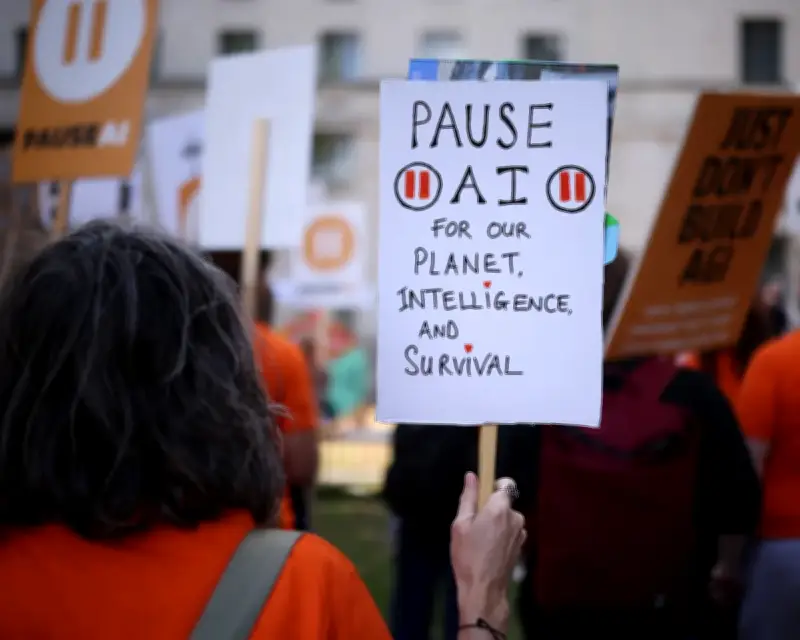
The rapid expansion of artificial intelligence within the UK government is numbing departments to its profound threats, and the shift from human civil servants to AI bots is eroding the trust on which government ultimately runs, according to a civil servant writing in the Guardian.
The author, who works for the UK civil service, argues that repeated apocalyptic warnings about AI have desensitised both ministers and the public to the risks, comparing the familiarity of AI threats to the routine of a bowel cancer screening kit that gets ignored.
Government actions and contradictions
Prime Minister Andy Burnham has spoken at the United Nations about Britain's prospects of leading the drawing-up of international rules for AI. However, one of his first acts after taking office was to abolish the Department for Science, Innovation and Technology (DSIT), the department that had been leading work on AI safety.
The Institute for Government has warned that this move will cause "real harm", and former government AI adviser Matt Clifford has said it "wastes time and energy that's desperately needed for the actual substance". The author notes the irony of failing to regulate AI at home while seeking to coordinate its regulation elsewhere.
Civil service experiences and experiments
The median age of civil servants is 43 years, meaning many have lived through technological shifts from fax machines to email and the introduction of Clippy, the early AI assistant. The author suggests it is possible that civil servants of this vintage might still be around when departments like the Department for Work and Pensions (DWP) or HMRC contain more AI agents than human officials.
Ministers, convinced that harnessing AI will help keep Reform at bay by offering the possibility of slashing civil service jobs, have been enthusiastic about giving AI more tasks. Civil service unions have expressed concerns that the government is moving too quickly, citing Fabian Society research finding that only 29% of those surveyed said they had been consulted about AI tools in their workplace.
Before DSIT was deleted, its permanent secretary, Emran Mian, reportedly had plans for AI to eventually replace almost every departing civil servant in his department. The DWP has been experimenting with AI across the welfare state, directing machine-learning systems to identify supposedly high-risk universal credit claims. In response to "serious concerns" about transparency and the handling of personal data, the DWP has insisted that humans retain the final decision and that AI does not determine entitlement.
Trust and accountability at stake
The author argues that reassurances from AI minister Kanishka Narayan to the parliamentary business and trade committee sound increasingly hollow after recent AI incidents. Civil servants in public-facing departments are acutely aware that saying "a human remains in the loop" is not the same as saying "a human remains in charge".
The commodity on which every government ultimately runs is trust, including the trust that the British public still has in the civil service, which is being jeopardised by inadequate transparency and weak standards on AI, according to the public accounts committee. The author cites the Little Britain catchphrase "computer says no" and the Post Office's Horizon scandal as examples of what happens when human discretion and accountability disappear.
The real warning from Whitehall may not be about killer robots, but that governments might quietly surrender thousands of small human judgments to a swarm of digital bureaucrats because doing so is cheaper, quicker, and can be passed off in a ministerial speech as "transformation", even if it will not feel like that to the public.