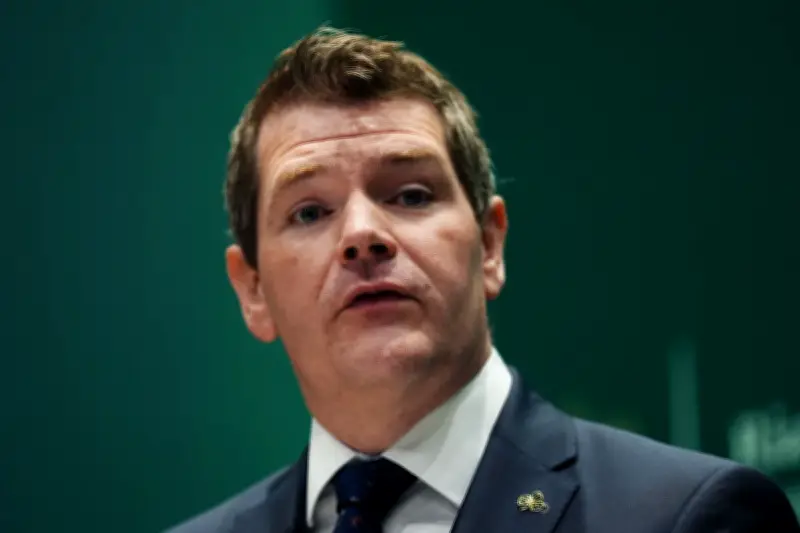
Enterprise Minister Peter Burke has said there will be a “period of uncertainty” as artificial intelligence (AI) penetrates the Irish economy and expands across companies. He said there will be “challenges” as the economy transitions, but that Government policy will bring back certainty and allow companies to “grasp” the opportunities of AI.
His comments came as a report found that more than 214 million euro was invested in Irish AI companies across a range of sectors in the first half of the year. Investment was made across fintech, healthcare, space technology and AI infrastructure.
Record investment and policy response
Speaking at Government Buildings on Friday, Mr Burke said he can see huge amounts of investment coming through Cabinet every week. “We have set the policy as there is a period of uncertainty and we have to be honest about that. Without and in the absence of policy comes uncertainty,” he said.

“But I believe the current policy will bring back certainty into development and will enable to grasp the opportunities of artificial intelligence. The investment has been record. I can see every week a huge amount of investment coming through at Cabinet, hundreds of millions of euro in investment in artificial intelligence that’s going to penetrate into the Irish economy. It will be a challenge… and equally there will be a transition in the Irish economy as well.”
Energy costs and capital allowances
Mr Burke also said rising energy costs have become a “big challenge” for the growth of the enterprise economy. He said he wants to see more capital allowances for “energy intensive industries” as well as small businesses in the next budget.
“The idea of advancing subsidies and grants to current expenditure will not achieve anything and that is why we brought forward a 300 million euro environment aid scheme,” he added. “We are looking at how individual companies and in particular large energy users, can change and break the model they operate their business in. We are working hand in glove with companies across the state to change the model as that is the only way we will reduce energy costs. We are working with smaller family business and changed the energy grants.”
“Critically in terms of the budget, 2027 will be important as we look at accelerating capital allowances for energy intensive industries and for small businesses. We are looking at large scale sites where you will have large energy generation on site in renewable and a large energy user and that is the spirit of large energy user policy.”
Data centre report defended
Mr Burke also denied attempting to “suppress” the conclusions of a study on the value of data centres in Ireland. The Minister published a report, compiled by KPMG, on the economic value of data centres. Records released showed that the Department of Enterprise sought changes to a draft version of the report.
Mr Burke said “there was nothing underhanded” before the publication of the report. “Nothing was suppressed. We have to be honest with how we respond to these things,” he added. “We are very clear what we requested was an economic value that data centres contribute to the economy. We had absence of evidence of what the economic contribution the data centres were to the economy. That is what the terms of the reference requested.”
“Data centres are challenging but no one answered how do we put value in terms of jobs and what contribution they make as being the spine of the internet and 175,000 we have in the ICT sector. I stand over the work we have. There was nothing underhanded.”