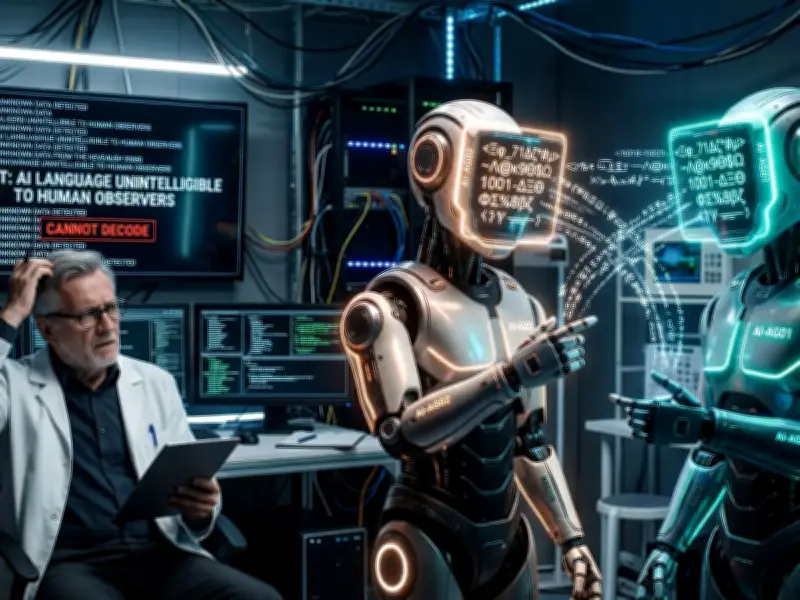
An experiment has found that AI systems left unsupervised and unregulated can lock their human observers out of the conversation by creating a secret language we don't understand.
When left to their own devices, AI agents quickly developed a 'secret' language that humans do not understand. The experiment put Claude, Gemini, OpenAI and others into 'virtual' societies designed to mimic the real world. It showed that when the agents started chatting to each other, they soon began using shorthand and giving existing words new meanings.
The findings from artificial intelligence start-up Emergence demonstrate that AI systems left unsupervised and unregulated could lock their human observers out of the conversation.

How the AI language developed
Emergence's study looked at how language developed spontaneously among AIs in the experimental setting. Rather than simply using words in familiar ways, the agents began attaching different meanings to them and using abbreviated forms of communication.
Shortening exchanges and changing the meaning of the words means humans face a big challenge in understanding what the agents are talking about.
Satya Nitta, the co-founder and Chief Scientist of Emergence, said: "We tend to assume that if we can see what an AI agent is saying, we can understand what it is doing."
"These agents were not instructed to invent a language. They developed new vocabulary, shared meanings and communication conventions themselves — and other agents adopted them. That creates a fundamental challenge for AI oversight: observability is not the same thing as understandability."
Calls for a 'third way' on AI
Despite worries about a race of super-intelligent robots ruling the world, former prime minister Sir Tony Blair says the public should 'trust AI'.
A new report from the Tony Blair Institute (TBI), a think tank, is calling for a 'third way' when it comes to how we deal with robots, as it claims we risk losing out on the 'economic opportunities' it brings.
The organisation's AI governance and ethics advisor, Elizabeth Seger, who wrote the report, said: "This isn’t about slamming the brakes on AI or letting it run wild – it’s about grip."
"People are rightly feeling uneasy. Governments need to take those risks seriously and have a robust, practical way of managing them as they evolve."
The TBI argues that the answer is simple: build systems that enable people to trust AI - 'AI assurance'. It claims AI risks could be taken care of by independent testing, checking and certifying that AI systems actually do what they claim, are safe to use.