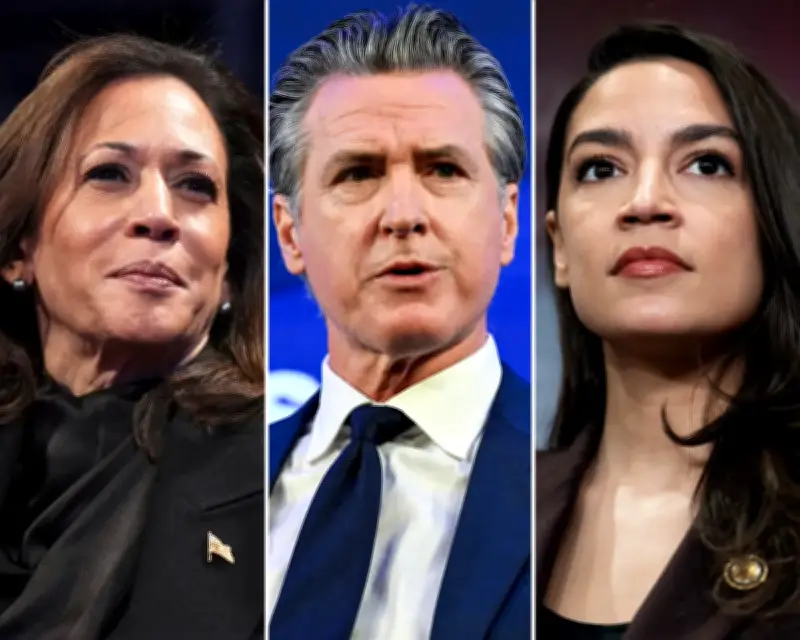
The debate over artificial intelligence development, how to regulate it and the construction of datacenters that power the technology has become a buzzy topic for potential 2028 Democratic presidential candidates.
Already, concerns were mounting over the environmental and energy impact of datacenters, which consume vast amounts of resources to power AI. But worries about the rapid development of AI came to a head in mid-September when tech executives issued a flurry of dire warnings that the technology could harm humans.
A recent New York Times/Siena College poll found that 61% of voters opposed the construction of datacenters, while an SSRS/CNN poll found that 71% of Americans believed the government wasn’t doing enough to regulate the growth and development of AI.
Diverging approaches among Democrats
Donald Trump has brushed off concerns, insisting the US must lead the world in AI development – and the early crop of potential Republican candidates are mostly following the president’s lead. Democrats, meanwhile, are calling for guardrails, with some embracing calls for a slowdown.
Here’s how the potential 2028 Democratic rivals are positioning themselves on AI regulation and development.
Kamala Harris
Former vice-president and the 2024 Democratic presidential nominee. Harris has long advocated for guardrails around AI while also promoting growth in the US, but she has more recently echoed calls for a slowdown in development.
As vice-president, Harris led the Biden administration’s efforts to understand and mitigate the risks of AI. In 2023, she had voiced concerns about the short-term risks posed by AI, such as the threat to democracy through disinformation and dissemination, as well as privacy. On 14 September, Harris reiterated the need for stricter federal regulations around artificial intelligence after tech executives called for a slowdown in AI development.
Gavin Newsom
Governor of California. Newsom has pushed for stricter AI regulation in his state, where many tech companies, such as OpenAI, Anthropic and Google, are based.
Though the governor has promoted AI advancements in California, he has incrementally added safeguards: requiring large companies to publish best practices, adding whistleblower protections, including safeguards for young users, mandating a study to help companies retain employees rather than replace them, and more. In September, Newsom signed an executive order urging companies to consider creating a “kill switch” after tech executives voiced concerns over the possibility that AI could harm humans.
Josh Shapiro
Governor of Pennsylvania. Shapiro has taken a middle-ground approach to AI development and datacenter construction, advocating for technology investment with clear regulations to reduce harm.
“I want to be clear: I am not a doomer. I don’t think it is inevitable that AI is going to take over the world or that someone will misuse it to kill us or do harm. But I do have real concerns, as do many Pennsylvanians and many Americans,” Shapiro said at an AI summit in September. Shapiro was an early adopter of AI development, championing AI investment in his state in 2024. But he called for stricter federal regulations around the technology in September and signed an executive order in August to ensure datacenters are meeting stricter environmental and energy usage standards.
Andy Beshear
Governor of Kentucky. Beshear has enacted policies in Kentucky to regulate the construction of datacenters and recently called for stronger federal oversight on AI.
In August, Beshear signed an executive order requiring datacenter developers to ensure they won’t have a detrimental impact on the environment and taxpayers, among other necessities, before building. He also called for the end of taxpayer incentives.
Mark Kelly
Senator from Arizona. Kelly has called for safely implemented AI in the US through congressional action and called for protections for workers whose jobs are affected by AI.
Last year, Kelly published a roadmap suggesting the government create an “AI Horizon Fund” backed by AI companies, that would finance education and training tools, support energy infrastructure and assist displaced employees. “I do believe there are benefits, and they could be significant,” Kelly told Politico in September. “I also see the national security implications of not getting this right and not being the leader.” Kelly told Politico he planned to introduce legislation establishing the fund.
Alexandria Ocasio-Cortez
Congresswoman from New York. Ocasio-Cortez has had concerns about the economic impact of AI and datacenters and voiced skepticism about the rapid expansion and integration of the technology.
“We’re talking about a massive economic bubble,” Ocasio-Cortez said during a House hearing last year. In June, the progressive representative introduced companion legislation alongside senator Bernie Sanders that would temporarily prohibit the construction of datacenters until Congress produces legislation to create guardrails for the environmental, safety and economic impacts of AI.
She has also voiced opposition to harms caused by AI such as deepfake pornography. Ocasio-Cortez also pushed back on Trump’s claim that only those who are “backwards and poor” would oppose datacenters being built in their communities. “How about we put one in Mar-a-Lago?” Ocasio-Cortez responded.
Ro Khanna
Congressman from California. Khanna, a progressive Democrat who represents Silicon Valley, has called for stricter federal regulations on AI, specifically suggesting that the US reach an agreement with China on basic guardrails.
“The American people are deeply concerned about the future of AI and the potential risks,” Khanna said in a statement to the Guardian. “We urgently need an agreement with China on basic inspections and safety standards.” Khanna has compared winning the AI race to “winning a nuclear war” and said basic safety and misuse standards should be put into place before the US and China compete. But he has also resisted calls from progressive leaders like Sanders to impose a moratorium on the expansion of AI datacenters.
Pete Buttigieg
Former secretary of transportation and mayor of South Bend, Indiana. Buttigieg has voiced concerns about AI’s harms for years, but more recently criticized the federal government for not moving fast enough to regulate the quickly evolving technology.
As early as 2017, Buttigieg warned AI could hurt US jobs or have other negative implications. Last year, Buttigieg published a Substack calling on US leaders to take AI dangers more seriously, saying the US needs to “summon at least as much economic and political imagination today, as it took to handle the everyday impacts of the Great Depression, World War II, or the invention of electricity and later the Internet”. He recently reiterated his concerns about officials not moving quickly enough on AI, accusing Congress of “sitting on its hands” rather than regulating AI.