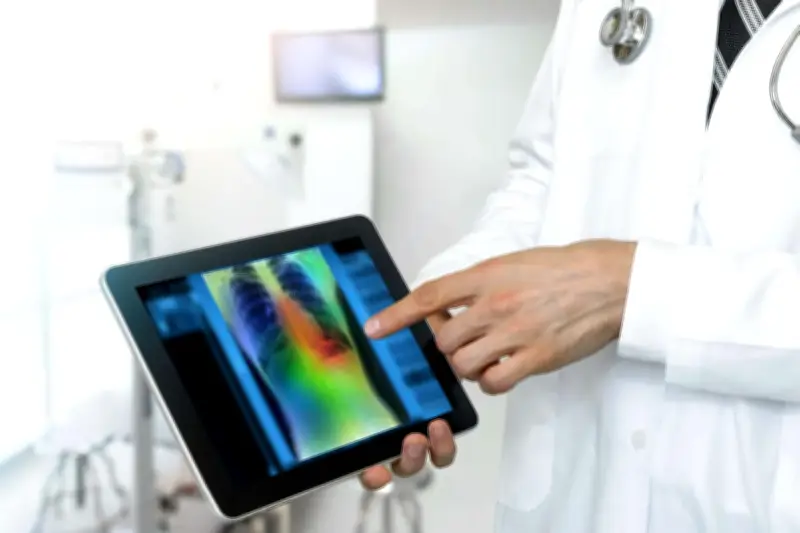
Artificial intelligence could transform the future of medicine by helping scientists understand how life works, according to experts at the Francis Crick Institute. Writing in a commentary, James Briscoe, Deputy Research Director, and Charles Swanton, Clinical Director, argue that while AI already supports diagnostic screening and accelerates drug discovery, its true potential lies in revealing what keeps people healthy, what causes disease to start and progress, and why patients with the same diagnosis can experience different treatment outcomes.
Urgent need for earlier intervention
The need is urgent, they say, as an ageing population and rising incidence of chronic disease, including cancer, dementia and heart disease, place an increasing burden on society. Long-term conditions account for around 70% of health and social care spending in England because too much of modern medicine is spent managing disease once it is established. AI could help shift the focus earlier, to the biology that sets disease in motion.
This next frontier is AI that learns from biology and nature, revealing and predicting patterns in living systems. The UK, with its world-class universities and research institutions, national health datasets, medical research charities, burgeoning biotech sector and collaborative ethos, is uniquely positioned to lead this revolution, the scientists write.
Predicting disease risk and subtypes
Many human diseases evolve over decades, and AI could help explain why risk and resilience differ between people based on genetics, sex, age, infections and exposures. Cancer is a good example: by age 60, the average person can harbour over 100 billion cells with cancer-linked mutations, yet almost none become a tumour. Identifying what keeps most cells in check could unlock new avenues for prevention.
At the Francis Crick Institute and University College London Hospitals, researchers used machine learning to analyse blood plasma protein data from more than 48,000 UK Biobank participants, identifying a unique protein signature that can predict lung cancer risk more than five years before diagnosis. In Parkinson's disease, researchers at the Crick and UCL Queen Square Institute of Neurology, working with Faculty AI, showed that machine learning can accurately predict subtypes of the disease using images of patient-derived stem cells.
Biology-first science with AI in the loop
Life is hard to predict, so the scientists call for biology-first science with AI in the loop, helping scientists make unanticipated connections, design experiments and validate results across scales, from single cells to whole bodies. Within a mile of the Crick's labs are Google DeepMind, Isomorphic Labs, OpenAI, Anthropic and many small biotech firms, allowing ideas to move from lab to company to clinic.
Turning that proximity into progress requires sustained public and charitable investment in discovery science, researchers trained across biology, medicine and computing, and partnerships that link London's concentration of science, clinical insight and AI talent with research excellence, data resources and innovative companies across the UK.
The goal is not merely to deploy AI but to reimagine how health and disease are studied, enabling a shift from reactive disease management to proactive prevention and true precision medicine. That could mean routine blood tests that flag risk years before cancer appears, or a patient's own cells being used to understand which treatments are most likely to help.