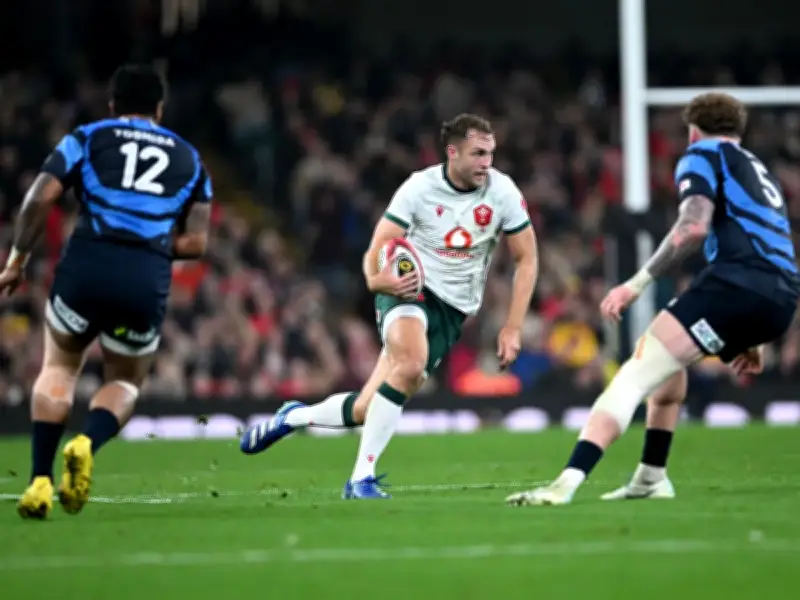
Wales' midfield pairing of Max Llewellyn and Eddie James showed promise in the autumn opener against Japan, even though many fans believe the two should swap positions. The combination, which marked a departure from the ball-playing inside centre that had been a hallmark of Wales' 17 Test matches since Matt Sherratt took over, brought a more physical edge to the side.
Shift to a Physical Midfield
Since Sherratt arrived, Wales had consistently used a ball-playing inside centre, with Ben Thomas and Joe Hawkins sharing the jersey. When Thomas was ruled out of the autumn through injury, Aneurin Owen was called up, but it was Llewellyn who was selected at 12 for the Japan match, three years after his only previous start there. This change, from what some call a "rapier" to a "bludgeon," saw a combined 33 stone of midfielders on the field.
Reaction to the new combination was mixed. Many believe James is better suited to 12, while Llewellyn plays most of his club rugby for Gloucester at 13. However, Llewellyn has stated his preference for inside centre, saying, "I just think that's probably where I could get the best out of myself going forward. I enjoy playing both of them and they both have different opportunities. I just think definitely the physical aspect of the game. There's more of that at 12 and I think that probably just suits me a little a little bit more."
Llewellyn's Familiar Role
Llewellyn broke through at Cardiff under Sherratt as an attack coach, playing at 12 alongside Rey Lee-Lo. He was used as a gainline carrier from first-phase and as a first-receiver, a system he knows well. "That's what has been quite nice, the similarity of me being at Cardiff with Matt Sherratt and then obviously him being in here," he said. "I probably haven't played too much of it at the moment at Gloucester, but to be able then to transfer and come into here. It's already a system that I know. So I think that's what kind of gives the confidence as well to the coaches to to select me there."
Early against Japan, Llewellyn was used as a distributor, feeding ball from Sam Costelow to the wider channels, which helped create Louis Rees-Zammit's early line break. This allowed James to use his footwork in wider channels, taking a short ball from Tomos Williams and stepping back inside.
Potential in the New Shape
While James could be more destructive at 12, using him strictly as a north-south runner would lose his lateral movement and footwork. His work for Rees-Zammit's try showed this, as he took the ball laterally, bounced off a tackler, and offloaded to Blair Murray, who set up the score.
Wales' attack struggled to maintain a threat through phase play, partly due to a malfunctioning lineout. However, there were signs of promise, such as Llewellyn running a hard line off Tomos Williams and Wales sweeping around late to catch Japan's defence out of position.
As Gwyn Jones noted, Wales look caught between being a possession team and a kicking team. Choosing a direction is a priority, but whichever way they go, the midfield has potential to grow if given time. Bigger tests lie ahead, with this week likely to test their credentials.