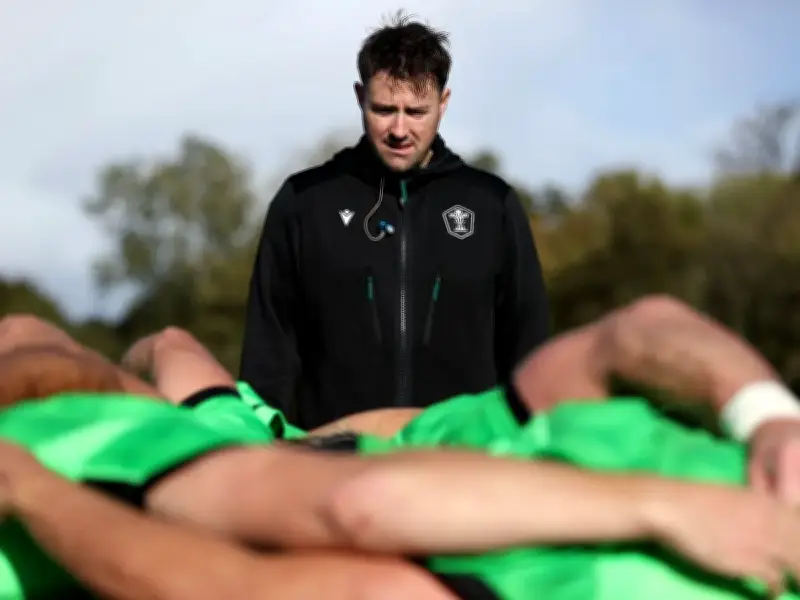
Ben Whitehouse has taken up a full-time role with the Welsh Rugby Union, making him the first coach dedicated to officiating that Wales have had. The appointment was made last month, and this autumn campaign marks the first time Wales have had such a full-time role.
Referees being in and around camp is nothing new. Nigel Owens, the former international referee, used to go into the Welsh camp quite often when he was refereeing. Ben, as well as Craig Evans, Ben Breakspear and Adam Jones, would have been going in a lot over the last couple of years too.
What the role involves
As officials, referees go in when they are needed to referee contact sessions and help with preparation as part of their role as professional referees. Owens would also go around the professional clubs when required, including a lot at the Scarlets under Phil Davies' leadership, as well as the Ospreys on many occasions.
Other countries have similar setups. Andrew Brace will be in with Ireland, Christophe Ridley does the same with England, and the other international referees in pretty much every country would be doing the same. Only France and South Africa had turned it into full-time roles before Wales followed suit.
The difference with a full-time role
Previously, when Owens would head in to help, he would have been in a refereeing camp for a few days before a campaign. The most recent one took place at the end of last month, discussing things like the hip-drop tackle. Coming away from that camp, officials would understand and know how they were going to referee any new laws or phases that they had been told to be stronger on during that campaign.
Then it would be the job to go into camp, dealing with the likes of Warren Gatland, Rob Howley, Neil Jenkins and Robin McBryde on the different areas of the game, telling them how certain things would be dealt with.
What is good about that setup is that you are actually still an active referee at that level, and you are in those camps, having those conversations and taking charge of Test matches. But when you are still officiating, you cannot be part of the scrutinising process of the officiating of the match. That would not be right in Owens' view, as you would then have to work with the referee whose performance you took apart for feedback to the coaches and World Rugby.
Pros and cons of the new role
If you are no longer refereeing at that level, you can and will be expected to do that, but you are perhaps just giving your own view, which will have come secondary from somebody else as you are no longer in that World Rugby refereeing group. So Ben is perhaps now removed from that situation. On the flipside, he will be able to go more in-depth and take more of a part in the feedback process to the referees.
If the Welsh camp are not happy with referee decisions, it will be Ben that will be bringing that up now. Owens does not know whether Ben is responsible for the communication with World Rugby referee manager Joel Jutge, or if that remains with Steve Tandy or his coaching team.
Obviously, if he were still an active referee within that group of officials, it would not be right or fair for him to do that because he would be refereeing with them. Being removed from that situation, you are able to scrutinise a referee. Ben will probably be able to tell the coaches, "Look, the referee's got this wrong on his video" or whatever, and then that goes back to World Rugby. You cannot really do that role if you are still actively refereeing.
Jaco Peyper with South Africa and Jérôme Garcès with France both retired from international refereeing and duly went into that. The plus point is that you can scrutinise in that way, and you can give the Welsh coaching setup some information around how the game is going to be refereed by that appointed official. So Ben will basically be preparing the team for the referee on what he will be strong on and what he may not be, so they can then take advantage of the situation.
The downside is that you are out of exactly how things are working, you are not in those camps and those conversations. There are pros and cons to it, but obviously they have decided that this is a full-time role.
Owens would imagine Ben will also be around on matchdays to provide live feedback on decisions and how the referee is seeing things, as well as helping Wales on the discipline side of things, like keeping the penalty count as low as possible.
Owens' own experience
Owens was offered a full-time role with South Africa doing this for six months leading up to the 2023 World Cup, but family commitments at the time did not allow. He noted he would have had a World Cup winners medal if he had. He did something similar with Wales a couple of years ago, as a favour for Warren, because he has a huge amount of respect for him. He would be there on matchdays, in the changing room before the game, and then sit there giving feedback to the coaches on what the referee was doing, so he could go back for further clarity.
Owens would not have wanted this type of role on a full-time basis, though. He has other bits and pieces coaching referees, Whistle Watch for World Rugby, while he does media work with the BBC in the Six Nations. With one win in the bank from last week, he hopes there is another one around the corner, but he is not sure whether it will be today. He wished best of luck to the team, coaches and Ben in his new role.