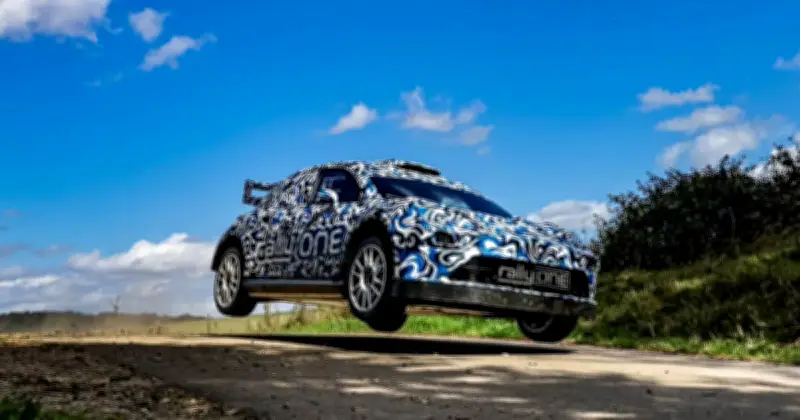
The World Rally Championship will introduce a brand new car from the 2027 season, marking the end of the current Rally1 category (2022-2026) and the start of a new technical regulations cycle designed to lower costs and attract more manufacturers. The move has already succeeded in drawing Ford back to top-flight rallying as a works-backed entry from 2028.
New regulations aim to cut costs and boost manufacturer interest
The new rules are intended to stem soaring expenses, with teams currently spending well over £850,000 per car. Under the new package, the WRC's 27 models, also set to be known as Rally1, will be capped at £300,000 (€345,000) per model. The trade-off is a much simpler design, with extreme aerodynamics, rear diffusers, and massive wings being removed.
M Sport boss Richard Millener told The Express: "There was a perception that the costs were getting a little bit too crazy, a bit too high. It comes with the level of technical regulations we have… by reducing the costs and changing those regs we've gotten rid of the barriers to entry for OEM's who want to come into the sport."
Affordability at the heart of the new rules
Emilia Abel, FIA's Road Sport Director, said one of the biggest talking points of the new rules was affordability, with the cost cap rules centred around how much teams can save. Emilia told the Express: "We have to admit to be honest that the top category has been limited over the last generation of Rally1 cars. We have had a maximum of 13/14 cars and also Rally1 is limited to WRC only. National rally championships could allow this car, it was never picked up, probably mainly for the cost reasons... They are, as cars, exepnsive but also very expensive to run."
Emilia explains that F1 has financial regulations which regulate the cost of the parts, although, the cap in the WRC is the maximum that the manufacturer or constructor has to sell the car for that price.
Greater flexibility and design freedom for builders
For years, the WRC has prided itself on its connection to road cars, with models like the Toyota Yaris, Hyundai i10, and Ford Puma appearing in the top category. However, this could change for 2027 as officials allow greater flexibility. Independent tuners can now register as constructors, with no requirement for models to be based on a real-world production car. Builders can benefit from almost total design freedom, but must ensure they are capable of supplying at least 10 customer cars per year.
Emilia says that manufacturers are "most likely" to still design cars around their road-going models for marketing reasons, but M Sport boss Rich Millener explains teams will prioritise winning. Rich said: "It's an interesting question because ultimately do you want a winning car or do you want a good-looking car? So there's probably a compromise in the middle somewhere."
Performance trade-offs and driver reactions
The changes will inevitably lead to lower performance, with the new regulations expected to deliver up to 300 horsepower, down on the 400hp on most Rally1 machines. M Sport's Josh Macerlean said he thinks that the new 2027 cars will be closer to the feeling of a current Rally 2 car.
Jari Matti Latvala, who has driven in both categories for Toyota, said: "The biggest difference with the Rally1 is for sure the power and the downforce. With Rally1 you can attack so much more through the corners because you have the downforce and of course then you have the power on the engine. With the Rally2 you don't have power, the driving is lets say, you have to be very precise, very clean to keep the speed on all the time. The car is a little bit easier to stop."
British WRC star and 2026 World Champion Elfyn Evans told The Express: "When you're a competitive driver and you take away a quarter of the power then of course you're not going to be happy about that." The new cars will make their competitive debut at January's Monte Carlo Rally, with the WRC also set for a new promoter, a British world champion, an event in Scotland for 2027, and free-to-air BBC TV coverage.