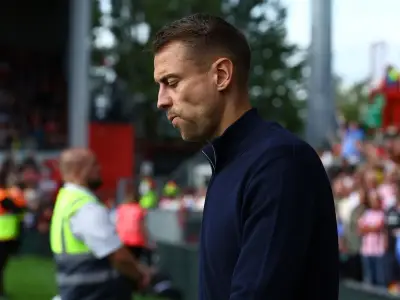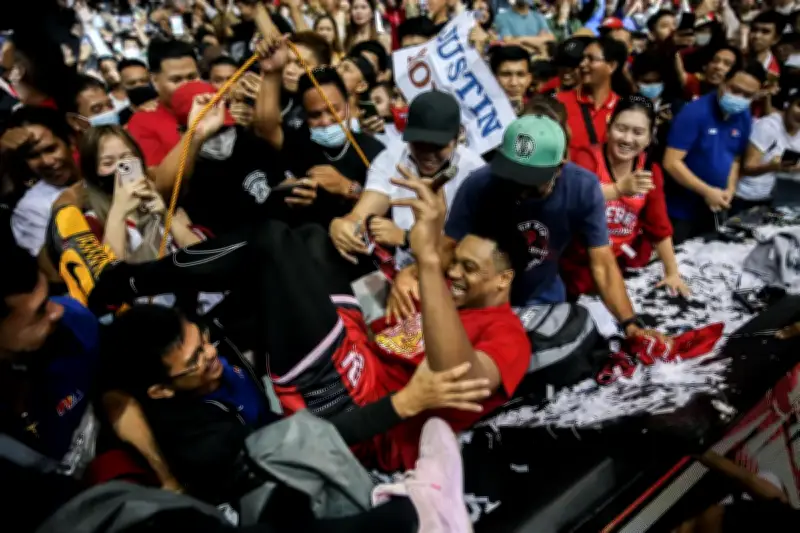
Jamie Malonzo arrived early, one of the first players to enter. He knew the 55,000-capacity Philippine Arena was something else entirely. As he warmed up for Game 7 of the PBA Commissioner's Cup, fans filed into the stands, yelling and waving their arms. This game, he knew, would be unlike any other.
“For me, warming up in there was not about trying to warm up my body. It was more about practicing cancelling out the outside noise – it was like practicing a different part of your brain,” the Seattle-born forward says of the game in January 2023.
A deafening atmosphere
When the game started, things didn't get easier. “It was definitely hard to hear,” the 30-year-old says. “I remember that being a problem.” Malonzo and his team had to invent hand signals to combat the fan volume.
“When you were on the court and you look up and you see these people way, way, way, way, up there in the upper bleachers cheering – it was crazy,” he says.
Most professional basketball arenas today seat between 10,000 and 20,000 people. Madison Square Garden, for example, holds 19,812 for New York Knicks games. The Philippine Arena seats nearly three times that. Until this month, it was the largest indoor arena in the world, before the KJC King Dome in Davao City opened on 1 September, also in the Philippines, holding 75,000 people.
Basketball's hold on the Philippines
“In other places, soccer is the biggest sport,” says Malonzo, whose mother was born in the Philippines and moved to Seattle as an adult. “But that same enthusiasm other places have around the world for soccer is equaled in the Philippines for basketball.”
Malonzo spent four years playing in the Philippines before moving to Japan. “If you look at the poorest streets of the Philippines, if you look at the richest streets,” he says, “anywhere from the poorest to the richest area codes – you're always going to see a basketball hoop kids can play on.”
Basketball grew in the Philippines during the American colonial period in the early 1900s. Founded in 1975, the Philippine Basketball Association (PBA) was Asia's first pro basketball league. It has hardcore fans, teams with names from the Magnolia Chicken Timplados Hotshots to the Rain or Shine Elasto Painters, and specific rules, such as height limits on foreign players in certain competitions. The national team has also featured acclaimed NBA players, including former NBA sixth man of the year Jordan Clarkson.
A record-breaking Game 7
Malonzo found success in the league, notably in that raucous Game 7 in 2023, when he scored 22 points and grabbed 17 rebounds, earning the Best Player of the Game nod. “I'm pretty familiar with the place,” Malonzo says, with a laugh. “It was the arena I won my first championship in the Philippines, which meant a lot for me.”
Originally slated for 13 January, that Game 7 was pushed back two days because of ticket demand, and it became the most attended PBA game in history. Malonzo's Barangay Ginebra San Miguel beat Bay Area Dragons – a guest team from Hong Kong that season – 114-99 in front of 54,589 people, breaking the previous PBA record of 54,086 fans set six years prior.
“It was for sure nerve-wracking,” Malonzo says. “When you think about how many people are there watching you – it's so intense. Any little movement you make is noticed by that many fans.” The O'Dea High School graduate, taken second overall in the 2020 PBA draft, says it took a few good plays to settle in.
Soon, he realized most fans were cheering for his team, wanting the team from Hong Kong – who boasted two former NBA players – to lose. “When you realize the fans are with you and cheering you, it makes it special, for sure,” Malonzo says. “It was really important that we got the win in front of our crowd. To this day, I've never even come close to a crowd that capacity. It was huge!”
Idols and community
Malonzo was a star in the Philippines, where fans treat players like idols – literally. “That's the word they use all the time,” Malonzo says. “Idols.” Eldridge Recasner, who played in the NBA with teams like the Atlanta Hawks and Houston Rockets, later played in the Philippines in 1992. “As soon as I walked off the plane, everybody knew who I was,” Recasner says.
Chris McCullough, drafted by the Brooklyn Nets in 2015 and played 59 NBA games, agrees. “The way they love basketball out there, it's unheard of,” says McCullough, who won a PBA championship in 2019. “It's more than in America – they live and die with it.”
Malonzo chose to play in the Philippines over Europe or the NBA's G League, to honor his roots. “I felt like I wanted to do something meaningful,” he says. “I felt like going back to my mom's home country – that meant more to me than playing in a place like Europe.” He played for the national team for several years before signing to play in Japan this year. But it was while playing in the Philippines that he suited up in the 55,000-person venue a second time, a month after that Game 7. “Carmelo Anthony was at that game,” Malonzo says. “He's my favorite player of all time. Yeah, that arena is a special place for me.”
In the Philippines, players almost can't fathom their impact, Malonzo says. Impoverished people spend their last bit of money on tickets and travel far, often by rickety bus, to watch. “Some of these people don't have anything,” Malonzo says. “So, if you're able to give back to some of them at the games – if they ask for pictures, autographs, I try to always stop. I just want to be able to give back.”
Malonzo remembers a key play in that Game 7: early on, he got the ball and took it to the rim for the game's first dunk. The crowd erupted. “You could feel how crazy it was,” he says. “It's safe to say you could actually feel the crowd.” But in the Philippines, that's just how it goes. “That's the beautiful part about it,” Malonzo says. Basketball brings people together.