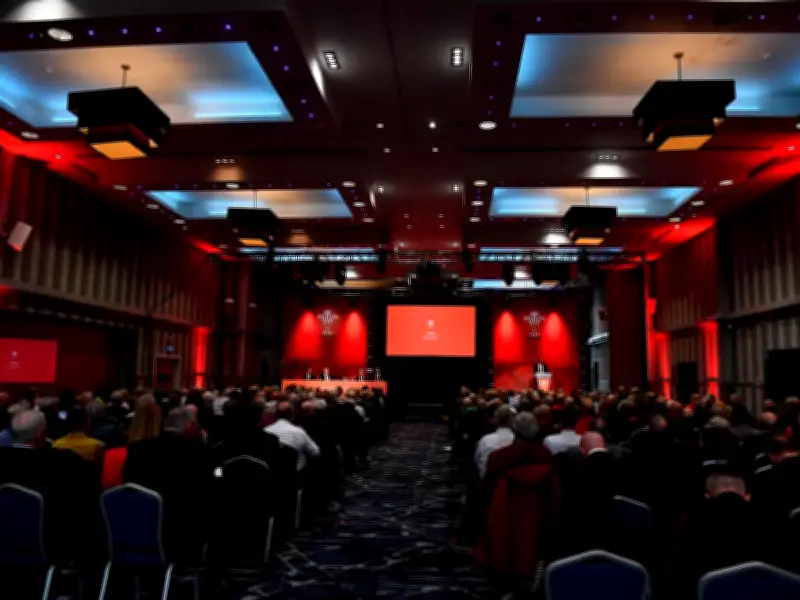
A key figure in the campaign to oust the Welsh Rugby Union board says she is confident there is already enough support among member clubs to trigger an Extraordinary General Meeting with a motion to remove the entire board.
Hayley Parsons, founder of price comparison firm GoCompare, said the decision to cut a region and have just one team in west Wales needs independent assessment, with the union providing all supporting data and analysis on why it concluded that maintaining four regions is now “unsustainable”, even under a new unequal funding model.
Coalition demands pause on region reduction
The so-called “coalition of the willing” is calling on the WRU to pause plans to reduce the number of regions from four to three until its decision-making rationale is independently scrutinised. Other members include former chief operating officer of Principality Building Society and Legal & General, Rob Regan, and technology entrepreneur Glenn Melford-Colegate.

The WRU has indicated it will shortly publish data on that decision, as well as the scoring criteria if the Scarlets and the Ospreys decide to enter a competitive bid process for the one WRU licence for west Wales. However, the coalition’s position is that the union cannot be selective about what is made available, and that an EGM would offer clubs a de facto referendum on whether a region should be cut.
EGM process and motions
The deadline for a motion to be submitted for the WRU’s annual general meeting this autumn has passed, so the focus of the coalition, which is in dialogue with a number of clubs, is an EGM. A motion, which if passed would see the current board having to stand down with immediate effect, would not include the chief executive of the WRU, Abi Tierney, who, while on the board, is an employee of the union and cannot be dismissed by the clubs.
Under section 62 of the WRU’s articles of association, a no-confidence resolution would require just a majority of clubs voting at the EGM to be passed. To be quorate, it would require 95 members in attendance. Proxy and remote electronic voting would be permissible. For the EGM to be held, it would first need the backing of 10% of the 282 member clubs. If the threshold is achieved, the union would have 21 days to formally acknowledge the request and schedule the meeting, usually around a month later.
If the board were ousted, a temporary board would have to be created, made up of representatives from the districts—but not those currently on the board. They would not need club approval to bolster their ranks by bringing in external people with commercial expertise. However, what is being considered by the coalition, based on initial legal advice and discussions with club representatives, is another possible motion to change the articles of association, which would require a 75% majority, so that any temporary board would have external members from the outset. This could be voted on at the EGM before the vote of no confidence.
WRU’s position and financial context
The WRU would be confident of seeing off any no-confidence motion against the entire board. If the EGM was called, it would lobby hard, making the case for three regions and a commitment to invest £28m in the pathway development of the game over the next five years.
Last year, with lower attendances than projected at international games at the Principality Stadium, the WRU’s original revenue forecast was blown off course by around £6m. If that were to be repeated this autumn—although the Six Nations home games against England and Ireland should sell out—their argument that four regions is financially unsustainable would be amplified.
The governing body has drawn up a shortlist for a new chair. It is understood that a number of potential candidates ruled themselves out due to an expectation of having to endorse the four-to-three strategy. If an EGM is called, the WRU is unlikely to pause announcing the new chair, even if there is a possibility that they could be removed along with all other board members.
Coalition’s plans for a temporary board
Swansea Council has also restarted its legal action against the union over its plans for just one region in west Wales, while effectively protecting the Dragons and Cardiff, which they own. They could be joined soon by other interested parties.

Ms Parsons said: “We have clubs contacting us and, from those conversations, we are confident that they have more than enough clubs for an extraordinary general meeting. So, we have the numbers now, but we will be looking to put the EGM to the WRU in a few weeks’ time. We have some really impressive people, literally from around the world, contacting us and offering their support free of charge.”
She said the temporary board could involve some of the figures supporting the coalition of the willing, but there is also scope to bring in external advisory board members to support the WRU going forward in sustaining four regions—although she said that, after a review period of around six months, the conclusion could be that three is the right number.
She said: “So, what we do need is fresh, independent people. I don’t think we could have anyone involved before, as that just wouldn’t work. What we need is the right group of people, and there is a right group of people to do this. At no point have I ever said I was going to be putting my name forward for the chair role. I would be involved in the short term, because I think it would be the right thing to do, not because I would want any involvement long term. And I think that is quite important, as one of the problems I think you do have in rugby is that some people are in it for their own self-interest. What we are proposing for board members is no salaries or expenses.”
The temporary board would at some point give way to a new permanent board based on three-year terms. If there is an EGM and the motion to oust the board is lost, she said: “I don’t think there would then be anything that people could do, and we would just sit back and watch our game die over the next five years.”
However, if there is a new direction, there is time to fully examine the case for maintaining four regions. The WRU plans to have three teams in the United Rugby Championship for the start of the 2028-29 season.
Ms Parsons said: “There is time here to look at generating new revenue lines. If you look at the latest statement [from the WRU on three regions], it is a defeatist attitude. But in that time we could bring in people to secure additional investment and look at things differently. We also need to think more about what could be done with the stadium, the hotel, Cardiff Rugby, etc.”
However, even if the board are ousted and the new one looks to support the WRU executive in seeking to drive revenues to maintain four regions, there are no guarantees it will result in a significant uplift.
Financial alternatives and community funding
A social impact rugby bond would require regulatory approval. It would need to appoint a fund manager to raise funds and invest in conventional assets such as shares and bonds. Investors could forego an element of projected returns for investment into the game. This could be hypothetical in specific areas, such as the community and women’s game. But to have an impact, the funds under management would have to run into the tens of millions, which, even if achievable, could take years to reach.
Previous WRU regimes considered a sale-and-leaseback of the Principality Stadium and securitisation deals by drawing down capital against future income from rugby matches and other events such as concerts. However, things like a sale-and-leaseback, while providing a huge upfront sum, would have to be repaid, with a profit margin for the lender(s) over the duration of the arrangement. The stadium is a valuable asset, although it requires continuous investment. Any sale-and-leaseback would also need approval from Cardiff Council, as it is a shareholder in the WRU subsidiary company that owns and operates the stadium, Principality Stadium Plc.
There is certainly scope, with rugby touching all communities in Wales and rugby clubs also serving as community hubs, to secure more funding for the community game—which could be separated from the governance of the professional game—in the form of grant funding from the Welsh and UK governments. While the WRU is in receipt of government funding, it could learn from how the Football Association of Wales has, in recent years, secured millions of pounds in funding for the growth and infrastructure of the game, especially at grassroots level. But this will take time and investment.
The coalition of the willing are also exploring the tax benefits of all community clubs acquiring charitable status. But, like their position on the WRU plans, this would need to be challenged and tested.
Regan calls for transparency and club vote
On the WRU’s decision to publish data, Mr Regan said it had to do so for every scenario assessed. He added: “Just sharing data to show that one could work with a set of assumptions doesn’t change anything, as it doesn’t answer the question of how do we know that is the only one. While constitutionally they can do this, ultimately they should give the choice to the clubs. So, if they are confident this has support, then give the rugby public (member clubs) their vote.
“So, we continue as planned (EGM). Our interest is to ensure that decisions about the number of pro clubs in Wales, that have distracted so many for so long, sucking energy, focus and money out of the game, are made based on evidence and data and in an open, transparent and engaging way.
“We have been building a long list of people who would be prepared to step in and support an interim transition with a transparency mandate. We are looking to maximise breadth of capability for a core group of 8-10 people, with an advisory panel supporting. We have set out principles that this should be short-term, pro bono work with no conflicts.
“We want to plug core gaps in current board capabilities. We want to engage the entire rugby family in creating a credible, capable, values-driven group who bring deep understanding of Wales’s rugby heritage and culture, as well as strong commercial skills. More collaboration, less ego. A genuine desire to listen, learn and build relationships. We imagine a transition and support period of at least six months, where we’d be looking for people to be able to dedicate a couple of days a week to public scrutiny of current plans and governance documents while we build a new board with a new mandate.”
Parsons’ history with Cardiff Rugby
Ms Parsons was on the board of Cardiff Rugby for six years before it collapsed into administration and was acquired in a pre-pack deal by the WRU with the joint administrators from PwC. Also on the board at the time was current WRU board member and former chief executive of FTSE 100 company Halma, Andrew Williams.
Following the death of former chairman and long-term benefactor Peter Thomas, the club needed new benefactors to fulfil the then funding agreement with the WRU. Helford Capital, a Jersey-based special purpose vehicle with no assets, owned by co-directors Neal Griffith and Phil Kemp, became majority owners of the club. However, they failed to inject the required benefactor funding agreed, and the club’s board had no alternative but to put the business through administration. The board were seduced by the promise of major investment, via Helford, from the Middle East, but they also needed to secure new benefactors.
Ms Parsons said: “I was on the board for six years and we made great strides in lots of areas, but Peter [Thomas, the former chair] passed and the investors came in and they were absolute fantasists. They had this big deal coming from Abu Dhabi and it even got to the point where we were told the deal was done and the money was there, worth millions of pounds, but we were just saying, ‘Show us the evidence.’ It never happened.”
She said that, in the aftermath of the Rafferty report into allegations of sexism and racism at the WRU—although the terms of reference never required an assessment of the BBC documentary that led to its establishment—the union was always going to appoint a woman in a senior role.
Ms Parsons said: “This is not about Abi, but you cannot say one of the jobs [chair or CEO] had to go to a female. That was fundamentally wrong and wouldn’t happen in business. A man was appointed as chair [Richard Collier-Keywood], so the CEO had to be a woman. You also automatically put a target on that woman straight away. There were men who had applied who had done that type of role elsewhere in rugby and with more experience to do that job.”