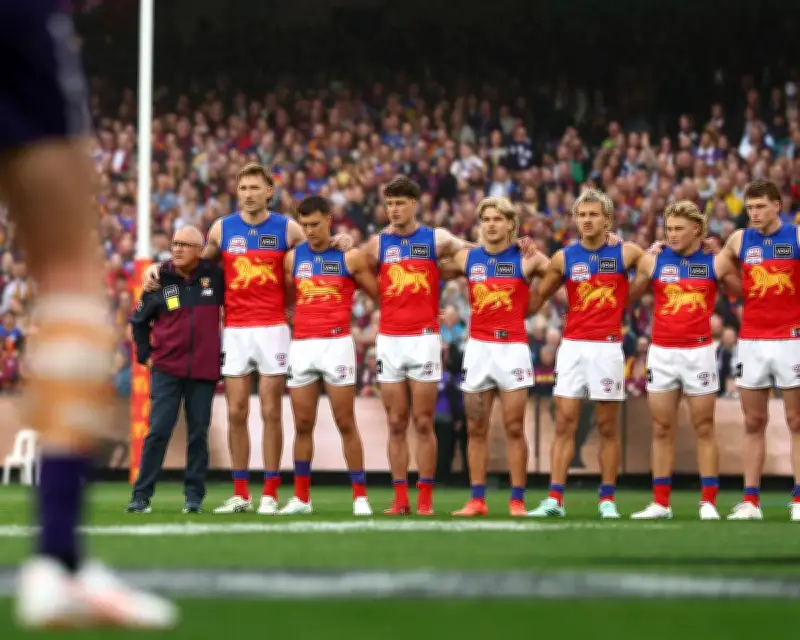
Brisbane's AFL dynasty is built on sheer talent, a loyal coach and their love of a dire situation. Chris Fagan kept faith in his Lions which meant they could thrive with the weight of the football world upon them – and rip out Fremantle hearts.
A historic grand final triumph
There is no precedent for what happened at the MCG on Saturday. There have been devastating finals losses before – the Bulldogs losing the 1997 preliminary final to Adelaide and St Kilda losing the 2009 grand final to Geelong immediately spring to mind. A senior St Kilda staffer described the rooms after that game as resembling “a casualty ward following a mass disaster”. Thankfully, we don’t talk about sport like that any more. The modern athlete and the modern sporting club is better able to put their world into some sort of perspective.
The prevailing mood in the rooms, in the stands and on the trains on Saturday was a mix of desolation and bewilderment. Part of it was Fremantle’s history. Part of it was the decision to activate Wharfie Time. Part of it was just how quickly it all happened. You establish an identity and for more than three decades you scratch, claw and hope. And in five minutes, your heart is ripped out.
Learning from the 2023 loss
By the time they’d trudged off the MCG, Longmuir and the senior leaders were already endeavouring to channel the way Brisbane handled their 2023 loss. Twenty minutes after that game, Chris Fagan was already selling optimism. “There’s lots of teams that have lost close grand finals that have gone on to win premierships in the ensuing years,” he said. “That’s plenty of evidence that grand final losses don’t have to define you or destroy you, but that they can be the making of you.”
Since then, Brisbane have been on the canvas so many times, and in so many different ways. In 2024, player after player kept rupturing their ACL. There was lingering scuttlebutt over an off-season trip to America. After nine rounds, as Sydney roared to the top of the ladder, the Lions were 13th. They were seven goals down in a semi-final in western Sydney and won. They were being beaten by Geelong in a preliminary final, with ruckman Oscar McInerney with his shoulder hanging out of its socket and on the verge of passing out. They won that too.
Building a list of dreams
There were doubts last year as well. They drew with North Melbourne in Tasmania. They lost three games at the Gabba. They were well beaten in a qualifying final. It was the same story this year – more off field scandal, some home and away games where they barely looked present, another qualifying loss, another grand final week saga involving Lachie Neale, another premiership.
So, how are we here? How is this team in a position to rival the four straight flags of the Depression era Collingwood? Part of it is the sheer weight and spread of talent. Their midfield has the perfect blend of extraction, flair, and Josh Dunkley. Their forward line has the right mix of size, height, and roles. Some of their defenders are there to shut down, some to dictate, some to organise, some to create. Some load the gun and others pull the trigger.
Part of it is the way the list has been constructed. The Brisbane team that bowed out to Port Adelaide in 2004 was an old and rickety one. But the current list and age profile is the thing of dreams. It’s a product of good management, an eye for talent and yes – good genes and favourable AFL policy. Will Ashcroft, Jaspa Fletcher and Darcy Wilmot are 22. Logan Morris is 21. Even the players who feel like they’ve been around forever – Harris Andrews, Josh Dunkley, Hugh McLuggage, Jarrod Berry and Zac Bailey – are all still in their 20s.
Fagan's faith and the dire situation
Part of it is coaching. Fagan inherited a mess. In his first year, they were well beaten most weeks. They improved markedly in his second season, but lost a lot of close games. The third year was when they spiked. But there were many seasons where opportunities slipped through their fingers – often through poor game management, often through tardy goalkicking, sometimes just through rotten luck. Through all that, Fagan kept the faith with a core group of players. He never dropped them. Like Leigh Mathews at Collingwood and Brisbane, he’s been fiercely loyal to those who have performed for him in finals. And like Matthews, he’s always been someone who can adapt his coaching to different personalities. He knows which players can respond to a bake, and which ones will fall in a heap. And he knows which players will rigidly adhere to his systems and structures, and which ones need to be left to play on instinct.
Most of all, they’re a team that needs to feel as though the weight of the footballing world is upon them. They need a challenge. They need a wound. They need a baying opposition crowd, a doubting commentariat. As Fagan said, “they need to get themselves in a dire situation.” They remind me of something Brian Phillips wrote about Novak Djokovic. “After a great shot he’ll flash that look of wounded, nostril-flared, defiant, pleading supremacy, like: You hurt me into playing like this.” Activating Wharfie Time should have been immaterial in the grand scheme of that game. It shouldn’t have mattered. But Brisbane made it matter.
After the siren, Fagan had the look of a man saying, “I’m too old for this shit.” Most of us watching, irrespective of our age, probably thought something similar. An hour later, he was back to his avuncular self, milling in the middle of the MCG with his players and their families. Later that night, at the Pullman Hotel, he was perched on the shoulders on his captain – a 65-year grandfather dancing to Run DMC. He may well drop the mic this week. But the song he composed and conducted will play on and on and on.