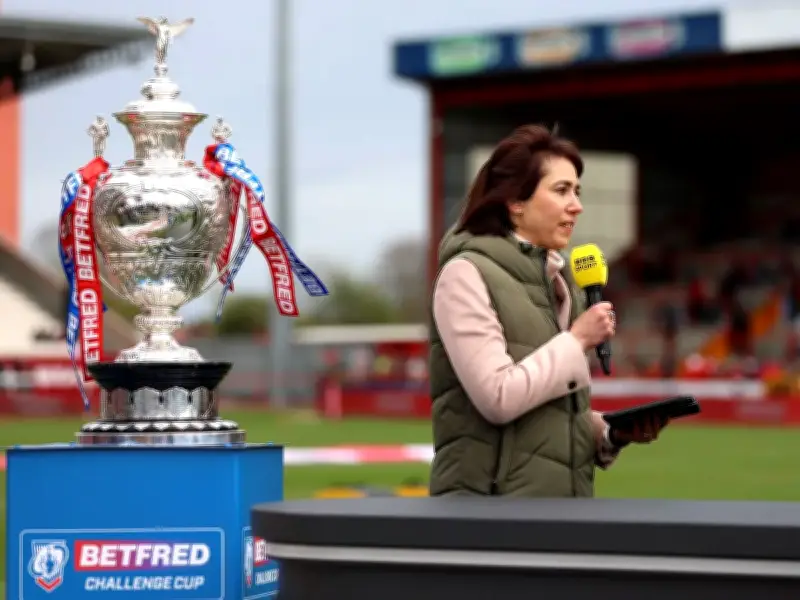
The BBC is reportedly set to lose most of its rights to air rugby league matches ahead of the 2027 season. Even the Challenge Cup's future has been called into question.
Rugby league's relationship with the BBC spans nearly eight decades, with the 1948 Challenge Cup final between Wigan and Bradford Northern being the first live match to air on the broadcaster's channels. Since 1958, the BBC has offered annual live coverage of the Challenge Cup final and has also broadcast live Rugby League World Cup matches and regular-season Super League games.
Super League coverage in question
On Sunday, the Beeb screened an hour-long highlights package of the Super League Grand Final. The semi-final between Wigan Warriors and Wakefield Trinity on September 26 was the most-watched programme of the day when it aired live on BBC Two.
However, a report now suggests that it is set to lose the majority of its rugby league rights, with a new broadcast deal supposedly split between two pay-TV broadcasters. The BBC explains that no final decision has been made.
As things stand, the BBC has aired roughly 12 to 15 live Super League matches per season over the past three years, following a three-year contract signed in 2024. These include games on linear channels like BBC One and BBC Two.
Rights renewal and budget cuts
The production cost of these Super League matches is relatively low because the primary host broadcaster, Sky Sports, pays to cover each match and provides the main camera feeds. Highlight shows are also commonplace on the BBC.
But the rights are up for renewal in 2027 and the Daily Mail claims that Sky Sports and DAZN will snap them up as the BBC steps away due to reported budget cuts. However, this has not been confirmed.
The Challenge Cup final is protected by law to remain on free-to-air television, so the BBC is in a good position to continue showing the men's, women's and wheelchair finals.
Yet that is only if another free network doesn't step in and even then, the earlier rounds and mid-round games could be heading elsewhere, as the BBC could negotiate a final-only contract. Under UK regulations, the final is a Group B protected event, which guarantees it must be available to free-to-air television but does not compel or guarantee that the BBC will hold those rights.
World Cup rights already lost
The BBC has already lost the Rugby League World Cup. In 2022, when the 2021 tournament was played, it held exclusive free-to-air rights for all 61 matches across the men's, women's and wheelchair formats.
International Rugby League granted the BBC free broadcast rights for the tournament to boost UK viewership. But these have been commercialised ahead of the 2026 renewal in Australia and Papua New Guinea. Premier Sports picked up exclusive paid rights instead.
Reports suggested that the BBC was not interested in claiming the rights even though they were offered to the broadcaster for a "tiny sum."
In February, the BBC's director of sport, Alex Kay-Jelski, insisted that it does not have to air live sports to stay relevant. He said at the Financial Times's Business of Football Summit: "You can still be relevant, you can still matter if you don't show the sport."
"No one out there can show it all. So, you just have to make sure you're in the conversation of the things that matter. For example, we have audio rights to Formula 1 but not video rights, but we still have reporting and live pages and digital video that draw in millions and millions and millions of people."