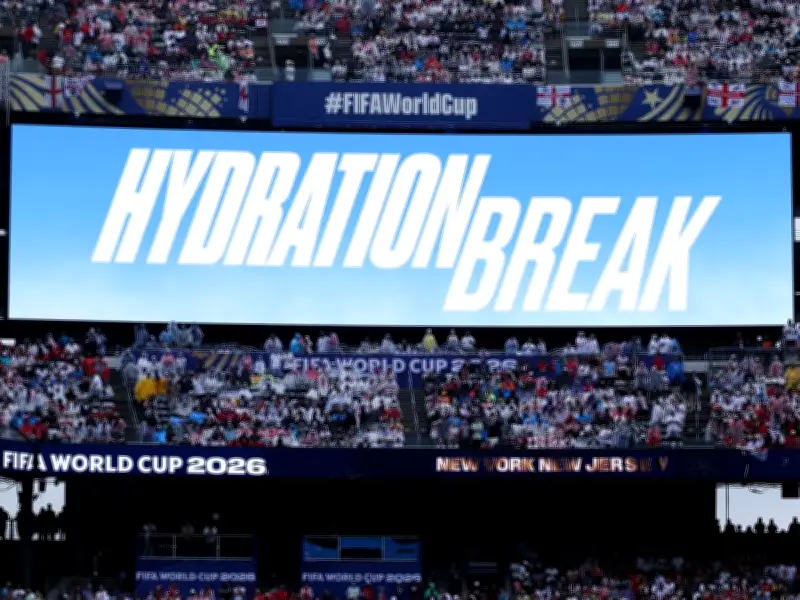
Hydration breaks could remain for the 2030 World Cup, with tender documents for the TV rights offering a hint at FIFA's decision on their controversial inclusion.
The three-minute breaks in each half were brought in by football's governing body for this summer's World Cup across Canada, the United States and Mexico. It saw the traditional 45-minute halves broken up into quarters in all 104 matches.
TV rights documents hint at decision
The decision was taken to guard against the scorching temperatures many of the games were played in. But it also allowed broadcasters to sneak in more advertising, which proved to be a major benefit for US rights holders Fox Sports and Telemundo.
The Guardian reports that FIFA tender documents for the TV rights for the 2030 World Cup in Spain, Portugal and Morocco includes a provision for broadcasters to sell adverts during hydration breaks. FIFA say that no decision has been taken and, at this stage, the documents need to cover all eventualities.
Reaction from viewers and coaches
Hydration breaks were widely panned by viewers, who grew irritated by the interruption to matches, especially when they were played in milder climates. But their introduction was broadly accepted by coaches, who were given a time-out to speak to their players and tweak tactics mid-half.
UEFA has opted not to implement mandatory hydration breaks at Euro 2028, which is being hosted in the UK and Ireland. But Gianni Infantino's comments during the World Cup hint at what could swing the decision, with FIFA potentially able to demand more for broadcasting rights due to additional advertising time.
“Broadcasters maybe generate more, but for us, we make zero additional revenues,” the FIFA president said. "Maybe the coach can reassess certain situations, correct certain mistakes. The players get a little rest and come back in full speed. Well, is that bad necessarily? Maybe it’s good."
"And we see as well the intensity of the games. We’ve never seen 90 minutes in a tournament like this played in such an intensity. Until the last second of the match, players attack and so on. And maybe, maybe not, but maybe it’s also a bit thanks to this little break that the players have and after they can go back on the field and show what they can do."
Revenue and player views
Fox reportedly generated between $2m and $9m in advertising revenue per game due to hydration breaks at the World Cup. According to figures from Guideline, the US broadcaster made $835m during the tournament, almost double the $485m rights fee paid to FIFA.
Liverpool and Netherlands star Virgil van Dijk summed up the debate around hydration breaks during the World Cup. "Hydration breaks are a bit interesting, because I was obviously watching almost all the games up until today, and every time going to commercial is a bit... Not really that I like it," he said.
"I think for the neutral watchers on TV it's also not great. If it's really hot, obviously it would be good to put them in. But I think you have to look at it in every game, separately, in my opinion."