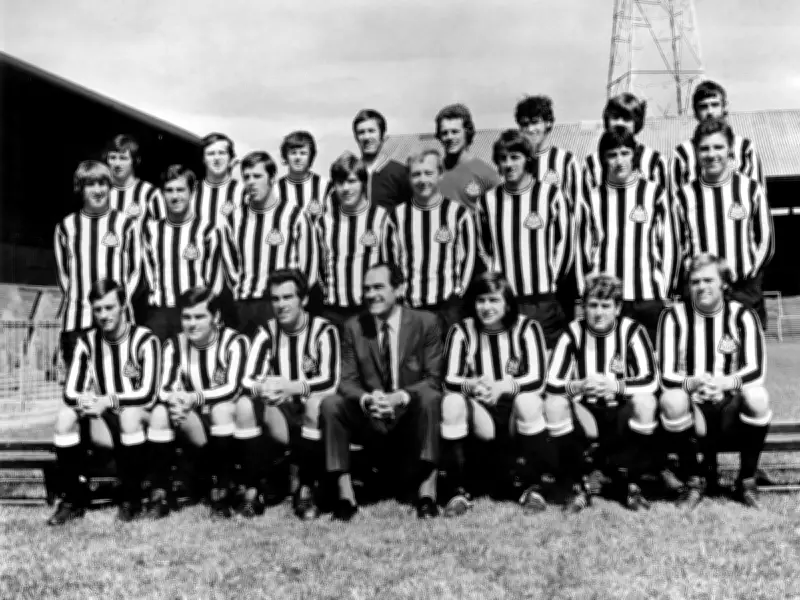
In the summer of 1971, Newcastle United underwent a period of transition both on and off the pitch. As players gathered at St James' Park in late July for the annual pre-season squad photo, manager Joe Harvey prepared to revamp his team, while work was set to begin on the dilapidated stadium.
Two years after winning the Inter-Cities Fairs Cup, several long-serving players were set to depart Tyneside within months, including Wyn Davies, John Craggs, John McNamee, Alan Foggon, Benny Arentoft, and Keith Dyson. Striker John Tudor had arrived from Sheffield United earlier in the year, while Malcolm Macdonald, a 21-year-old Londoner, was signed from Luton Town for a club record £180,000.
The pacy and powerful centre-forward would become an unstoppable goal machine, a terrace idol, and earn a reputation as one of the club's greatest ever players during his five years at Gallowgate. Harvey also recruited centre-half Pat Howard and a potentially brilliant midfield duo of Terry Hibbitt and Tony Green.

Supermac's Thrilling Arrival
Nobody remembers the first two league games of the 1971-72 season, a loss at Crystal Palace and a draw at Spurs. But the third game, at home against a Liverpool side featuring a young Kevin Keegan, remains legendary on Tyneside. It marked the thrilling arrival of Supermac, whose brilliant hat-trick earned the Magpies a 3-2 win in a game which saw him carried off the pitch badly concussed towards the end.
'It's a knockout for mighty Mac' was the back page headline in the next day's Sunday Sun. The match report noted: "Three times his explosive left foot blasted Liverpool and three times steadied a rocking Newcastle boat."
Rather than ignite the season, however, the victory was followed by a run of highly indifferent form which saw United hovering uncomfortably around the relegation places by October, prompting the acquisition of Scottish international playmaker Tony Green from Blackpool for £150,000 to bolster the team. Things began to improve with wins over Southampton, Nottingham Forest, West Bromwich Albion, and West Ham, and the Magpies gradually climbed the table.
St James' Park Upgrade
As January 1972 arrived, after years of disputes between the club and city council and plans which never left the drawing board, St James' Park would undergo desperately needed upgrading. The ground had barely changed since the 1920s and was described in one newspaper article as the 'slummiest' in England. The vast unroofed terracing of the Popular Side was to be demolished, and a new Brutalist-designed cantilever East Stand with seats and standing would replace it. For the rest of the season, and into the next one, one-quarter of the ground became a building site.
The second half of the campaign would largely be an improvement on the first, barring the still-infamous 2-1 defeat to non-league Hereford Town in a humiliating FA Cup third round replay. In an ironic twist of fate, a week later, Newcastle went to Old Trafford and comfortably defeated a Manchester United team featuring Best, Charlton, and Law.
End of Season and England Call-Up
With Macdonald and Tudor a potent threat upfront, and Hibbitt and Green pulling the strings in midfield, form settled and was generally good. There were wins over Southampton, Leicester, Arsenal, Derby, Leeds, and West Brom, although a 5-0 thrashing by Liverpool at Anfield felt like payback for that 3-2 win in the early reverse fixture.
Come the end of the campaign, Newcastle United were sitting in 11th place, perhaps lower in the league table than the sum of the team's parts merited. Most of the squad would fly off for a handful of summer exhibition matches in the Far East, including a game in Hong Kong against Pele's club team, Santos.
Meanwhile, Sir Alf Ramsey came calling after Malcolm Macdonald hit a remarkable 30 goals in his debut season. His form earned him a call-up as Newcastle's first England full international since Ivor Broadis in 1954, and the last until Chris Waddle in 1985.