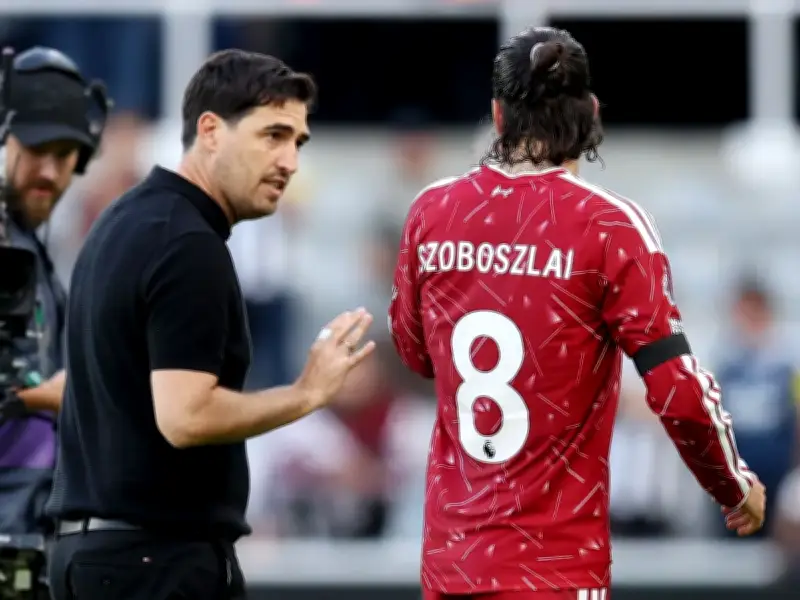
Liverpool are the only one of the Premier League’s leading octet not to enter the midfield market this summer, a contrast highlighted by their rivals’ combined spending of £966.5m on new midfielders alone.
The Reds’ engine-room was left untouched during last summer’s £450m spending spree, and that looks to be the case again this year despite calls from the terraces urging otherwise. Such calls have grown following Curtis Jones’ £30m exit to Internazionale and in response to the Reds’ midfield deficiencies in their 2-2 draw at St. James’ Park.
Fabinho’s Departure and the Unfilled Void
Fabinho inadvertently gave Liverpool a reminder of their midfield struggles earlier this week, barely 24 hours after their Premier League opener away at Newcastle United had drawn further scrutiny on the Reds engine-room. The Brazilian completed a free transfer to Trabzonspor on Monday following three years at Saudi Pro League side Al-Ittihad, having left Liverpool to sign for the Middle Eastern club in a £40m deal back in the summer of 2023.

The Reds parted with £145m that summer to revamp their engine-room, bringing in Dominik Szoboszlai, Alexis Mac Allister, Ryan Gravenberch and Wataru Endo after seeing Jordan Henderson, James Milner, Naby Keita and Alex Oxlade-Chamberlain all move on along with Fabinho. Yet they ultimately failed to sign a first-choice replacement for the Brazilian, and three years on, that still remains the case.
Of course, it was not for lack of trying. Moises Caicedo and Romeo Lavia both snubbed moves to Anfield in the summer of 2023 in favour of switches to Chelsea, while Martin Zubimendi also spurned their advances when opting instead for one final season at Real Sociedad in the summer of 2024.
Iraola’s Stance and Tactical Shift
But strengthening their attack remains Liverpool’s priority in the final days of the summer transfer window, with Andoni Iraola insisting a new enforcer would not necessarily provide the answer for their midfield woes regardless.
“It’s not just personnel,” he said after the draw at Newcastle. “I understand that Ryan Gravenberch is basically the number six and is on the edge of the box, and if he shoots and scores then we are saying what a play from Ryan Gravenberch.
“I don’t want us to take that from his game but we have to adapt as a team to these situations, we have to know these situations can happen.
“The second goal we did better in terms of having the numbers to defend, but we don’t make a foul or go to the first challenge. It’s not just because one person is playing there. It’s something we have to correct between a lot of players.”
Admittedly, part of the reasoning behind Liverpool’s stance will be their change of system since Jurgen Klopp’s departure in the summer of 2024. While the German played with a lone number six and two eights in a midfield trio, both Iraola and his predecessor, Arne Slot, favoured a double-pivot midfield behind a number 10.
But with Florian Wirtz occupying that playmaker berth, full-backs Jeremie Frimpong and Milos Kerkez essentially wing-backs who want to attack, and both Gravenberch and Szoboszlai midfielders who want to get forward, it inevitably leaves the Reds vulnerable on the break and Iraola with a few issues to iron out amongst his current personnel if a new number six is not considered the solution.
Rivals’ Midfield Spending Spree
Yet while Liverpool have not looked to strengthen their midfield this summer, it has been a very different story across their domestic rivals. In the ‘big six’, champions Arsenal spent £75m to bring in Bruno Guimaraes from Newcastle United while Man City have parted with £202m to land Elliott Anderson and Ayyoub Bouaddi. Such a figure could still rise considerably given their interest in Enzo Fernandez with reports suggesting they are set to make an opening bid for the Chelsea man. The Londoners were previously demanding at least £120m to cash in on the Argentina international.

Manchester United have spent £153m to sign Carlos Baleba, Andrey Santos and Youri Tielemans, while Tottenham Hotspur forked out £185m to land Sandro Tonali and Mateus Fernandes. Meanwhile, Chelsea broke the transfer record for a British player to sign Morgan Rogers for £117m, and have also brought in Valentin Barco in a £34m switch from sister club Strasbourg and Jordan Henderson on a free transfer from Brentford. Should Fernandez depart, they might have to strengthen further.
And beyond the ‘big six’ at Aston Villa and Newcastle United - the only other two English sides to compete in the Champions League since the start of the 2017/18 season - midfield reinforcements have been vital also. The Villans have spent £90m to sign Johan Manzambi and Joao Gomes, making the former their club-record signing, while the Magpies have coughed up £110.5m on Nico Gonzalez, Aladji Bamba and Sean Steur.
Consequently, the Premier League’s Champions League regulars have spent a combined total of £966.5m on new midfielders alone so far this summer and could easily break the £1bn barrier by the time the transfer window closes next week.
Market Trends and Liverpool’s Calculated Gamble
The six most expensive transfers involving English sides so far this summer are all for new midfielders, while Savinho is the only non-midfielder to have cost £70m or more. If Liverpool were to be successful in their pursuit of Bradley Barcola, he too would buck the trend. But it is still a midfield market and the fees are extravagant.
Admittedly high-profile engine-room departures across the Reds’ rivals have dictated such a necessity for the majority. In contrast, Liverpool’s attack is their priority following Mohamed Salah’s exit, with Jones their only senior midfield departee and Trey Nyoni considered a suitable internal replacement.
Given such a need in attack and the inflated midfield market, perhaps it is understandable why the Reds are not looking to strengthen their engine-room too. They already boast enough bodies after all, with the debate around Iraola’s options more with regards to quality and balance. Perhaps there is a wisdom in holding back in shopping for such players until a time when they are not on everyone’s wishlist. Then you sidestep intense competition and inflated financial demands.
But it is still curious that a position onlookers are urging Liverpool to address has so far remained untouched at a time when it has emerged as a leading transfer trend across the market for all of the Reds' domestic rivals. If their engine-room woes continue, questions will continue to be asked and they risk being left behind with their rivals' new signings only highlighting further what has been left unaddressed at Anfield. The pressure is on Iraola for his current options to step up and become the solution.